In the fast-evolving landscape of the interactive entertainment industry, few studios command the legacy, creative reverence, and cultural footprint of Double Fine Productions. Helmed by industry icon Tim Schafer—whose pedigree includes legendary LucasArts adventures such as The Secret of Monkey Island (1990) and Grim Fandango (1998)—Double Fine has spent over two decades operating as an incubator for whimsical, deeply original, and mechanically inventive video games.
Now, in a surprising and triumphant revival of one of the industry’s most celebrated internal traditions, Double Fine has brought back "Amnesia Fortnight." Originally designed as an internal jam where developers could spend two weeks rapidly prototyping experimental concepts away from their day-to-day franchise commitments, Amnesia Fortnight later transformed into a public-facing, crowdfunded media phenomenon.
This latest iteration, officially titled "Amnesia Fortnight 2026, Indie Reboot," marks a major milestone. Developed in partnership with the acclaimed documentary studio 2 Player Productions and heavily backed by an enthusiastic community on Kickstarter, the initiative has successfully funded and developed four brand-new prototypes over a two-week creative sprint. Supported by Microsoft and Xbox Game Studios—which acquired Double Fine in 2019—this revival demonstrates that even under the umbrella of a major platform holder, the studio has retained its indie soul, its penchant for creative risk, and its unique ability to foster raw, unfiltered design innovation.
Detailed Chronology: From LucasArts Roots to Xbox Stewardship
To fully understand the significance of Amnesia Fortnight 2026, one must trace the winding historical path of Tim Schafer and his creative enclave. Schafer’s career began at LucasArts during the golden age of the graphic adventure genre, where his distinct comedic voice, sharp writing, and puzzle design helped shape milestones like Day of the Tentacle.
When Schafer founded Double Fine Productions in 2000, the studio immediately sought to carve out a distinct identity with cult classics such as Psychonauts (2005) and Brütal Legend (2009). These games combined deeply imaginative art directions with unconventional mechanics, establishing Double Fine as a bastion of creative audacity.
However, the traditional publishing model was not always kind to ambitious, narrative-driven titles. In 2014, Double Fine shook the industry by utilizing Kickstarter to fund Broken Age, pioneering the wave of crowdfunded independent games. While the campaign was a historic success, it also highlighted the logistical and financial strains of independent game development—a turbulent chapter well-documented by 2 Player Productions in their landmark documentary series.
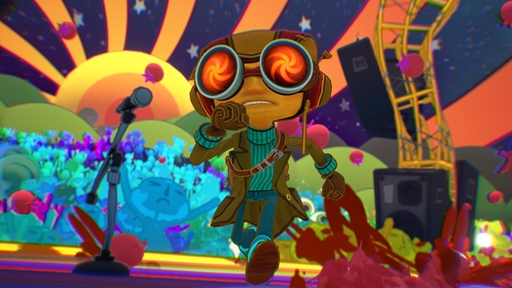
The turning point for the studio arrived in 2019 when Microsoft announced its acquisition of Double Fine, welcoming the studio into the Xbox Game Studios family. For many observers, studio acquisitions by major tech conglomerates spark fears of creative homogenization or commercial pressure. Yet, Microsoft took a remarkably hands-off approach, allowing Double Fine the financial stability required to finish Psychonauts 2 (2021) to critical and commercial acclaim. Under Xbox’s stewardship, the studio has enjoyed the best of both worlds: the security of corporate backing paired with the creative freedom of an independent studio.
Nevertheless, as the years progressed past the launch of Psychonauts 2, questions began to swirl within the community. With the studio expanding and working on top-tier projects, would Double Fine lose touch with the rapid-fire, low-budget prototyping roots that defined its early days? Amnesia Fortnight 2026 serves as a definitive answer to that question—a resounding proof that the studio’s innovative spirit remains fully intact.
Supporting Context & Metrics: The Mechanics of "Amnesia Fortnight"
To appreciate what makes Amnesia Fortnight so revered, one must examine its origins. Conceived internally as a way to combat burnout and prevent creative stagnation, the jam gave development teams just two weeks to build a game prototype entirely from scratch, free from the constraints of publisher oversight.
Though initially conducted in secret starting in 2007, the prototypes generated during these jams occasionally yielded breakout hits. For instance, the 2010 jam spawned Costume Quest, a charming RPG that captured the nostalgic magic of Halloween while establishing a lucrative new intellectual property for the studio.
For Amnesia Fortnight 2026, Indie Reboot, Double Fine partnered once again with 2 Player Productions to document the entire process, utilizing Kickstarter to fund the venture and engage the community directly. The campaign shattered expectations, raising 67.7 million yen (approximately $450,000 USD) from over 8,300 backers.
While $450,000 is a modest sum by modern AAA standards, the cultural impact of the event vastly outweighs the budget. Amnesia Fortnight serves as a masterclass in transparency, showing players how games are made from the ground up, warts and all.
The Etymology of "Amnesia Fortnight"
In British English, a "fortnight" refers to a period of fourteen days (two weeks). The term playfully suggests that developers work so intensely on these short projects that they suffer from total memory loss by the end—a humorous nod to the exhausting yet exhilarating nature of game jams.
The Four Prototypes of Amnesia Fortnight 2026
The core of Amnesia Fortnight 2026 centers around four distinct, highly experimental prototypes developed during a breathless two-week sprint in September 2026. Each project was spearheaded by different members of Double Fine’s veteran talent pool, showcasing a remarkable breadth of genre exploration.
1. Architactics
Project Lead: Asif Siddiky
Overview:Architactics is a tactical strategy game that merges architectural design with grid-based combat. Players must construct defensive structures while managing resource constraints to repel waves of invading enemies. Siddiky’s team focused heavily on verticality and spatial puzzle-solving, forcing players to think like both civil engineers and military tacticians. The prototype explores how physical space can dictate strategic outcomes, offering a deeply cerebral experience that resonated strongly with strategy enthusiasts.
2. Bard Crawl
Project Lead: Jared Mills
Overview: Shifting away from traditional combat-heavy dungeon crawlers, Bard Crawl puts players in the shoes of a charismatic musician whose primary weapon is song. Utilizing rhythm-based mechanics, players must navigate dangerous dungeons by serenading monsters, calming hostile NPCs, and utilizing musical buffs to manipulate encounters. Double Fine’s trademark wit shines through in the game’s comedic writing and whimsical animations, proving that pacifist mechanics can be just as engaging as swordplay.
3. Plot Armor
Project Lead: Lauren Scott
Overview:Plot Armor tackles one of gaming’s oldest tropes head-on: the invincibility granted to main characters by narrative necessity. In this inventive puzzle-platformer, players control a protagonist whose literal armor is made of plot armor—meaning they cannot die as long as the story demands their survival. The gameplay revolves around intentionally placing the protagonist in dangerous situations to trigger narrative conveniences, turning narrative tropes into active mechanics.
4. Uprise
Project Lead: Jolie Menzel
Overview:Uprise explores themes of rebellion and societal transformation through an action-adventure framework. Players control a revolutionary leader fighting against an oppressive regime, utilizing environmental traversal and stealth to rally citizens to their cause. The game combines fast-paced movement mechanics with intricate crowd-management systems, forcing players to weigh the risks and rewards of open conflict versus covert operations.
Official Statements and Future Outlook
The conclusion of the Amnesia Fortnight 2026 Kickstarter campaign marks a major milestone for Double Fine Productions. In interviews accompanying the event, Studio Director Tim Schafer emphasized that the initiative is more than just a marketing stunt—it is a vital part of the studio’s DNA.
"When you give developers complete freedom to make whatever crazy ideas pop into their heads, you inevitably unlock a level of creativity that gets buried under the weight of multi-year AAA development," Schafer noted. "Amnesia Fortnight is our way of staying loose, remembering why we fell in love with making games in the first place, and sharing that joy directly with our fans."
While none of these four prototypes have been officially greenlit for full commercial release yet, the reception from the community has been overwhelmingly positive. Historically, Amnesia Fortnight prototypes have served as a breeding ground for future hits, and fans are already speculating on which of these concepts might eventually follow in the footsteps of Costume Quest or Psychonauts.
Ultimately, Amnesia Fortnight 2026 reaffirms Double Fine’s status as a unique entity in modern gaming: a studio that, despite its corporate growth and critical acclaim, refuses to lose its appetite for experimentation. By opening its doors and inviting fans into the chaotic, beautiful mess of rapid prototyping, Double Fine has proven once again that the heart of indie development still beats strongly within its halls.
Written by the 4Gamer Editorial Department. Published as part of the ongoing "Access Accepted" series, running continuously since 2004 to provide deep analytical coverage of the global video game industry.









Belum ada komentar. Jadilah yang pertama berkomentar!