Nestled within the northwestern expanse of Kyoto Prefecture lies Fukuchiyama City, a captivating destination where the echoes of Japan’s turbulent Sengoku period harmonize with pristine natural beauty. Famously established as a fortified castle town by the legendary warlord Akechi Mitsuhide, Fukuchiyama offers an ideal equilibrium between rural tranquility and accessible urban charm. As autumn descends upon the region, the landscape undergoes a breathtaking transformation, cloaking ancient temples, misty plateaus, winding river gorges, and historic fortifications in vibrant shades of crimson, amber, and gold.
This definitive guide introduces seven of the most photogenic and culturally significant autumn foliage destinations in Fukuchiyama City for the 2026 season. Ranging from globally renowned pilgrimage sites to secluded local sanctuaries, these locations offer travelers a compact yet profoundly enriching blend of history, folklore, and natural wonder. Designed for discerning travelers seeking an authentic escape from the bustling metropolitan centers of Kyoto and Osaka, this article details prime viewing windows, logistical pathways, and practical travel insights to ensure an unforgettable seasonal journey.
Detailed Chronology & Access: Navigating the Gateway to Northern Kinki
Strategic Geographic Location and Transportation Hubs
Fukuchiyama serves as the principal gateway to the northern Kinki region, functioning as a vital nexus connecting major economic centers with secluded natural retreats. Situated approximately 1 hour and 20 minutes from Kyoto Station and 1 hour and 40 minutes from Osaka Station via limited express rail services, the city provides exceptional connectivity for both day-trippers and extended-stay tourists. Furthermore, its strategic positioning offers seamless transitions to surrounding premier destinations, including the coastal wonder of Amanohashidate and the restorative hot spring resort town of Kinosaki Onsen.
The Focal Point: Fukuchiyama Station
The journey for most visitors begins at Fukuchiyama Station, a modern transportation hub where the JR San’in Main Line, the Fukuchiyama Line, the Maizuru Line, and the Kyoto Tango Railway’s Miyafuku Line converge.
Location: 620-0045 Ekimaecho, Fukuchiyama City, Kyoto Prefecture.
Station Amenities: The station premises are fully equipped to accommodate international and domestic travelers, featuring automated ticket vending machines, convenience stores, and comprehensive passenger services.
The Tourist Information Center: Exiting from the north side of Fukuchiyama Station leads directly to the Fukuchiyama Tourist Information Center. Operated in conjunction with the Fukuchiyama Tourism Association, this facility is an indispensable resource. Visitors can procure official castle stamps, purchase regional souvenirs and castle-related goods, secure tour guide reservations, rent bicycles and mobile batteries, and utilize temporary luggage storage services.
Estimated Travel Matrix from Fukuchiyama Station
To Kyoto Station: Approximately 80 minutes via the JR Limited Express Kinosaki.
To Osaka Station: Approximately 100 minutes via the JR Limited Express Kounotori.
To Kansai International Airport (KIX): Approximately 3 hours and 5 minutes via the JR Limited Express Kounotori connecting to the JR Kansai Airport Rapid Service.
To Amanohashidate Station: Approximately 45 minutes via the JR Limited Express Hashidate.
To Kinosaki Onsen Station: Approximately 65 minutes via the JR Limited Express Kinosaki or Kounotori.
The Seven Must-See Autumn Foliage Destinations in Fukuchiyama
The prime viewing period (best time to see) for autumn foliage in Fukuchiyama City typically spans from early to late November, though exact dates may fluctuate slightly depending on annual meteorological conditions and microclimates.
1. Choanji Temple: The "Maple Temple of Tamba"
Location: Okunobe 577, Fukuchiyama City, Kyoto Prefecture, 620-0928
Best Viewing Window: Early to late November
Affectionately revered across the region as the "Maple Temple of Tamba," Choanji Temple stands as Fukuchiyama’s premier destination for autumn leaf viewing. Founded under imperial orders by Prince Maroko—the younger brother of the renowned statesman Prince Shōtoku—this ancient temple boasts centuries of spiritual heritage and horticultural mastery.
The temple grounds feature a meticulously maintained dry landscape garden (karesansui) that captures the austere aesthetics of Zen Buddhism. In peak autumn, falling crimson maple leaves blanket the stone and gravel garden beds, creating a striking visual contrast that epitomizes seasonal transition. Alongside the sea of red maples, a towering historic ginkgo tree infuses the temple precinct with brilliant golden hues. The harmonious interplay between traditional temple architecture and vibrant foliage produces a living tableau of unmatched elegance.
2. Yakuno Kogen Takarayama Park: A Crimson Mountain Carpet
Location: Hirano, Hirano Town, Fukuchiyama City, Kyoto Prefecture, 629-1322
Best Viewing Window: Mid- to late November
For travelers seeking immersive nature walks and panoramic vistas, Yakuno Kogen Takarayama Park offers an unforgettable alpine-style experience. Upon entering the hiking trail directly from the parking lot at the foot of the mountain, visitors are immediately enveloped by an ocean of red. As autumn leaves drop along the forest floor, the ground transforms into a natural crimson carpet that stretches beneath a canopy of fiery branches.
The park is ideal for hiking, forest bathing, and bird watching. Along the ascent toward the Takarayama Park Observation Deck—a manageable 15-minute climb from the parking area—hikers pass 88 stone Buddha statues scattered throughout the terrain of Mount Takarayama. Reaching the observation deck rewards travelers with sweeping panoramic views of the expansive Yakuno Kogen. Notably, from late September through the winter months, early risers can frequently witness the phenomenon of a breathtaking sea of clouds (morning mist) rolling across the valley.
3. Tenneiji Temple: A Secluded Zen Sanctuary
Location: Ōro 1474, Fukuchiyama City, Kyoto Prefecture, 620-0077
Best Viewing Window: Mid- to late November
Nestled deep within abundant natural surroundings, Tenneiji Temple is a historic Rinzai Zen Buddhist temple belonging to the Myoshinji branch. Established in 1365 by the eminent monk Guchu Shukyu, the temple preserves the austere traditions and architectural integrity of medieval Zen institutions.
The temple grounds house multiple structures of profound historical significance, including the Yakushi-do (Medicine Buddha Hall) constructed during the Edo period. Tenneiji also functions as a repository for valuable national cultural assets, preserving historic letters penned by Akechi Mitsuhide and Hidemitsu, alongside designated craft works and paintings. Because it receives fewer visitors than major metropolitan temples, Tenneiji serves as an idyllic hidden gem. The serene contrast between the historic Yakushi-do and the surrounding autumn foliage allows visitors to absorb the tranquil atmosphere in unhurried contemplation.
4. Tenichii Oobara Shrine: A Mystical Red and Yellow Approach
Location: 191-1 Oobara, Miwa-Oobara, Fukuchiyama City, Kyoto Prefecture, 620-11
Best Viewing Window: Mid- to late November
Functioning as a subsidiary shrine of the historic Obara Shrine—which was founded in 852 and rebuilt in its current form in 1796—Tenichii Oobara Shrine offers one of the most picturesque approaches in the region. Oobara Shrine itself is widely worshipped as a guardian deity of safe childbirth and bountiful harvests, drawing large crowds during its annual festival on May 3rd. Historic cultural elements, such as a traditional birthing house reflecting Meiji-era customs, underscore the site’s deep folkloric roots.
Venturing slightly beyond the main shrine reveals the subsidiary grounds, where the pathway is intricately interwoven with red, yellow, and green foliage. Boasting a deeply mystical atmosphere, the location is so visually striking that local couples frequently choose it as a backdrop for traditional wedding photography.
5. Futasegawa Stream: Dramatic Gorge Views and Suspension Bridges
Location: Oe Town Busshoji, Fukuchiyama City, Kyoto Prefecture, 620-0321
Best Viewing Window: Early to late November
Carved by nature over millennia, the Futasegawa Stream in the Ōe district features some of the most dramatic geological formations and pristine clear waters in Kyoto Prefecture. The gorge is steeped in regional folklore, being dotted with historic sites tied to the legendary Shuten-doji (ogre) myth, including petrified ogre footprints and the storied rock where the legendary warrior Minamoto no Yorimitsu rested.
A network of well-maintained walking trails follows the contours of the stream, allowing visitors to experience the vibrant mountain foliage up close. A highlight of the area is the wooden suspension bridge known as "Shin-Doji Bridge," which spans the Futasegawa River. From this vantage point, visitors enjoy a commanding, unobstructed look down upon the kaleidoscopic mountain forests and the rushing river far below.
Location: 377-1 Izaki, Fukuchiyama City, Kyoto Prefecture, 620-0017
Best Viewing Window: Mid- to late November
Centered around the tranquil, 1.3-kilometer circumference of Sandanike Pond, this expansive municipal park is a beloved year-round recreation hub famous for its seasonal displays of cherry blossoms, azaleas, and autumn leaves.
The park grounds integrate diverse facilities, including a zoological garden, botanical gardens, a children’s science museum, sports fields, tennis courts, and an extensive network of hiking trails. During November, the walking paths looping around the pond and the botanical gardens come alive with the vibrant contrast of rich green pines and blazing red maple leaves. Visitors can easily combine an afternoon of leisurely hiking with educational and family-friendly cultural attractions.
7. Fukuchiyama Castle: The Crown Jewel of Akechi Mitsuhide’s Legacy
Location: 5 Uchiki, Fukuchiyama City, Kyoto Prefecture, 620-0035
Best Viewing Window: Mid- to late November
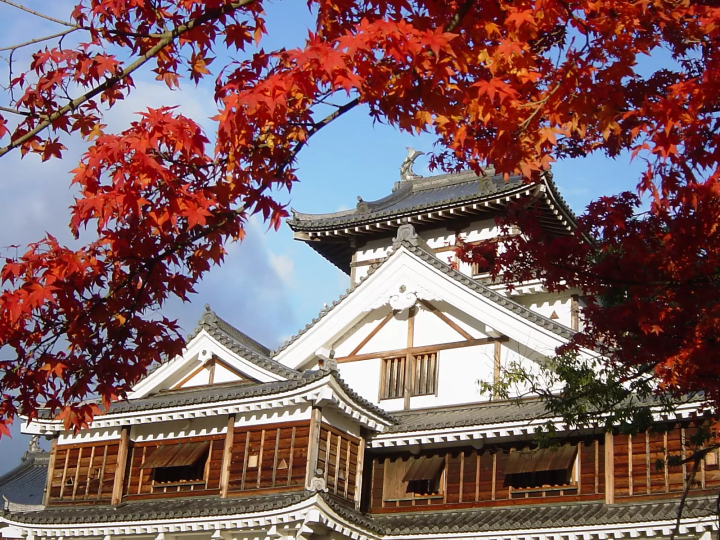
No exploration of Fukuchiyama is complete without visiting its defining historical landmark: Fukuchiyama Castle. Originally constructed by Akechi Mitsuhide after his conquest of Tamba Province, the castle preserves its original stone walls (nozurazumi masonry) built from repurposed gravestones and temple lanterns—a testament to wartime expediency during the Sengoku period. The castle tower stands proudly as the only reconstructed keep in northern Kinki, housing an extensive museum displaying artifacts, documents, and video exhibitions detailing Mitsuhide’s stewardship and the lineage of subsequent lords.
As autumn deepens, the slopes surrounding the fortress ignite with color. A natural "tunnel of autumn leaves" forms along the pathway leading up to the castle tower, created by interlacing maple branches arching over the historic stone steps. Complementing this, panoramic views from the waterfront plaza within Fukuchiyama Castle Park offer striking photographic compositions of feudal architecture framed against a fiery autumnal canopy.
Supporting Context & Metrics
Geographic Scope: Fukuchiyama City spans an area of approximately 552.57 square kilometers in northwestern Kyoto Prefecture, characterized by mountainous terrain interspersed with river basins formed by the Yura River.
Climatic Influences: The region experiences a Japan Sea-side climate, which brings distinct seasonal shifts. Autumn transitions feature crisp diurnal temperature variations that enhance the pigment brilliance of maple (momiji) and ginkgo (icho) foliage.
Tourism Demographics: While Kyoto City proper absorbs the vast majority of international tourism, regional initiatives by the Fukuchiyama Tourism Association continue to promote sustainable, decentralized travel, resulting in a steady increase in independent travelers seeking authentic rural-urban hybrid experiences.
Official Statements and Local Insights
Local authorities and tourism representatives emphasize the unique cultural integration embedded within Fukuchiyama’s natural attractions.
"Fukuchiyama offers something exceedingly rare in modern travel: an environment where centuries of military and spiritual history coexist seamlessly with untouched natural beauty," notes a representative from the Fukuchiyama Tourism Association. "Whether walking the sacred paths of Choanji Temple, tracing the mythical footpaths of the Futasegawa Stream, or standing atop the stone walls of Akechi Mitsuhide’s castle, our autumn season invites visitors to step away from the fast pace of urban life and engage all five senses in a landscape shaped by time."
Furthermore, municipal planning officials stress the importance of infrastructure accessibility, noting that continuous upgrades to the tourist information network at Fukuchiyama Station ensure that international visitors can navigate regional transport, luggage storage, and bicycle rentals with absolute confidence.
Future Outlook: Sustainable Tourism and Seasonal Development in Fukuchiyama
As the tourism landscape evolves toward sustainability and regional decentralization, Fukuchiyama City is strategically positioned to capture the interest of mindful travelers. Future initiatives by the local government and tourism associations aim to expand multilingual wayfinding systems, promote eco-friendly cycling routes connecting the major foliage sites, and enhance digital reservation platforms for hands-on cultural workshops held near key historical temples.
Efforts are also underway to bolster off-season appeal by connecting autumn foliage tourism with winter phenomena—such as the famous sea of clouds visible from Takarayama Park—and spring cherry blossom excursions. By maintaining a careful balance between historical preservation and visitor engagement, Fukuchiyama ensures that its natural treasures and feudal heritage will continue to inspire and captivate travelers for generations to come.


![[2026 Edition] 7 Must-See Autumn Foliage Spots in Fukuchiyama City, Kyoto Prefecture | Breathtaking Natural Beauty](https://resources.matcha-jp.com/resize/720x2000/2026/08/19-269136.webp)
![[2026 Edition] 7 Must-See Autumn Foliage Spots in Fukuchiyama City, Kyoto Prefecture | Breathtaking Natural Beauty](https://resources.matcha-jp.com/resize/200x2000/2025/12/19-253414.webp)
![[2026 Edition] 7 Must-See Autumn Foliage Spots in Fukuchiyama City, Kyoto Prefecture | Breathtaking Natural Beauty](https://resources.matcha-jp.com/resize/720x2000/2026/08/26-269703.webp)
![[2026 Edition] 7 Must-See Autumn Foliage Spots in Fukuchiyama City, Kyoto Prefecture | Breathtaking Natural Beauty](https://place.matcha-jp.com/resize/200x2000/2024/08/23-12-52-56-15800e9f58a38392616cda11e16d1680b0f2.webp)
![[2026 Edition] 7 Must-See Autumn Foliage Spots in Fukuchiyama City, Kyoto Prefecture | Breathtaking Natural Beauty](https://resources.matcha-jp.com/resize/720x2000/2026/08/19-269155.webp)
![[2026 Edition] 7 Must-See Autumn Foliage Spots in Fukuchiyama City, Kyoto Prefecture | Breathtaking Natural Beauty](https://resources.matcha-jp.com/resize/720x2000/2026/08/25-269554.webp)
![[2026 Edition] 7 Must-See Autumn Foliage Spots in Fukuchiyama City, Kyoto Prefecture | Breathtaking Natural Beauty](https://place.matcha-jp.com/resize/200x2000/2026/08/12-13-53-38-3147a5d2975d83723320332165c4f12a63d1.webp)
![[2026 Edition] 7 Must-See Autumn Foliage Spots in Fukuchiyama City, Kyoto Prefecture | Breathtaking Natural Beauty](https://resources.matcha-jp.com/resize/720x2000/2026/08/19-269157.webp)
![[2026 Edition] 7 Must-See Autumn Foliage Spots in Fukuchiyama City, Kyoto Prefecture | Breathtaking Natural Beauty](https://place.matcha-jp.com/resize/200x2000/2026/08/13-09-17-07-314720bde4a25459c549fe7cced8d4d2606d.webp)
![[2026 Edition] 7 Must-See Autumn Foliage Spots in Fukuchiyama City, Kyoto Prefecture | Breathtaking Natural Beauty](https://resources.matcha-jp.com/resize/720x2000/2026/08/19-269158.webp)
![[2026 Edition] 7 Must-See Autumn Foliage Spots in Fukuchiyama City, Kyoto Prefecture | Breathtaking Natural Beauty](https://place.matcha-jp.com/resize/200x2000/2026/08/12-14-30-07-3147e14b5cfb56c37db1d47ee3c950f2c1a5.webp)
![[2026 Edition] 7 Must-See Autumn Foliage Spots in Fukuchiyama City, Kyoto Prefecture | Breathtaking Natural Beauty](https://resources.matcha-jp.com/resize/720x2000/2026/08/19-269159.webp)
![[2026 Edition] 7 Must-See Autumn Foliage Spots in Fukuchiyama City, Kyoto Prefecture | Breathtaking Natural Beauty](https://place.matcha-jp.com/resize/200x2000/2026/02/04-09-56-05-3147d6d792c494c392d9ce78d63c81f16156.webp)
![[2026 Edition] 7 Must-See Autumn Foliage Spots in Fukuchiyama City, Kyoto Prefecture | Breathtaking Natural Beauty](https://resources.matcha-jp.com/resize/720x2000/2026/08/19-269160.webp)
![[2026 Edition] 7 Must-See Autumn Foliage Spots in Fukuchiyama City, Kyoto Prefecture | Breathtaking Natural Beauty](https://resources.matcha-jp.com/resize/720x2000/2026/08/19-269161.webp)
![[2026 Edition] 7 Must-See Autumn Foliage Spots in Fukuchiyama City, Kyoto Prefecture | Breathtaking Natural Beauty](https://place.matcha-jp.com/resize/200x2000/2026/06/30-14-42-44-3147e19055509f9231f7c8dbde1a5956043b.webp)
![[2026 Edition] 7 Must-See Autumn Foliage Spots in Fukuchiyama City, Kyoto Prefecture | Breathtaking Natural Beauty](https://resources.matcha-jp.com/resize/720x2000/2026/08/19-269162.webp)
![[2026 Edition] 7 Must-See Autumn Foliage Spots in Fukuchiyama City, Kyoto Prefecture | Breathtaking Natural Beauty](https://place.matcha-jp.com/resize/200x2000/2026/02/04-15-41-38-3147cd04256044b8b3392f1696aa71e552d9.webp)
![[2026 Edition] 7 Must-See Autumn Foliage Spots in Fukuchiyama City, Kyoto Prefecture | Breathtaking Natural Beauty](https://resources.matcha-jp.com/resize/720x2000/2026/08/19-269137.webp)
![[2026 Edition] 7 Must-See Autumn Foliage Spots in Fukuchiyama City, Kyoto Prefecture | Breathtaking Natural Beauty](https://place.matcha-jp.com/resize/200x2000/2024/06/25-11-53-38-24628e82b0b8e5397a095fb2810be181b03c.webp)
![[2026 Edition] 7 Must-See Autumn Foliage Spots in Fukuchiyama City, Kyoto Prefecture | Breathtaking Natural Beauty](https://place.matcha-jp.com/resize/200x2000/2026/07/14-10-41-25-314784a1eab486d19d4c05b43ed28ef50122.webp)
![[2026 Edition] 7 Must-See Autumn Foliage Spots in Fukuchiyama City, Kyoto Prefecture | Breathtaking Natural Beauty](https://resources.matcha-jp.com/resize/200x2000/2026/06/02-264978.webp)
![[2026 Edition] 7 Must-See Autumn Foliage Spots in Fukuchiyama City, Kyoto Prefecture | Breathtaking Natural Beauty](https://resources.matcha-jp.com/resize/200x2000/2026/02/12-258435.webp)





Belum ada komentar. Jadilah yang pertama berkomentar!