

Executive Overview
Apple’s historical relationship with high-end desktop and laptop gaming has been marked by ambition, heavy investment, and persistent hurdles. Despite rolling out robust hardware architectures, powerful Apple Silicon chips, and dedicated software toolkits aimed at convincing AAA developers to port their biggest titles to macOS, the Mac has largely remained an afterthought for mainstream gamers. Traditional gaming strongholds like Windows PCs and dedicated consoles continue to dominate the market, anchored by massive libraries, entrenched ecosystems, and decades of graphics pipeline optimization.
However, the launch of Metal 4 at Apple’s Worldwide Developers Conference (WWDC25) signals a pragmatic, highly strategic shift in Apple’s approach. Rather than merely pleading with studios to port games, Apple is delivering practical, high-performance tools designed to solve the most significant hardware bottlenecks developers face when scaling AAA games to energy-efficient architectures.
At the core of Metal 4 are two monumental additions to the MetalFX upscaling suite: Frame Interpolation and Advanced Denoising. By harnessing temporal data, motion vectors, and intelligent machine learning routines, these features promise to drastically reduce the rendering overhead required for high refresh rates and resource-heavy graphics techniques like ray tracing.
Compatibility is equally broad, with Metal 4 supporting Apple Silicon chips ranging from the M1 generation and later, alongside the A14 Bionic and later for iOS and iPadOS devices. For developers, these tools represent a streamlined pathway to delivering console-quality experiences without rewriting graphics engines from scratch. For players, Metal 4 could finally bridge the performance gap, making the Mac a truly viable, high-fidelity gaming platform.
Detailed Chronology: The Evolution of Mac Gaming and the Path to Metal 4
To truly understand the weight of Apple’s WWDC25 announcements, it is necessary to examine the trajectory of Apple’s graphics ecosystem and its ongoing campaign to capture the gaming market.
The Pre-Silicon Era: OpenGL, Metal 1, and the Fragmented GPU Landscape
For decades, macOS relied heavily on OpenGL and, later, OpenCL for graphics rendering. However, these aging cross-platform APIs failed to give developers low-level access to Apple’s proprietary hardware. Realizing that software overhead was crippling performance, Apple introduced Metal in 2014 with iOS 8, later bringing it to macOS. Metal bypassed the traditional graphics driver layer, offering direct communication between application software and the GPU.
Despite its efficiency, Metal’s early iterations faced a major structural barrier: hardware fragmentation. Apple’s transition from Intel processors with integrated or discrete AMD/Nvidia graphics to its own unified memory architecture was the turning point that would eventually change everything.
The Apple Silicon Revolution and Metal 3
In late 2020, Apple introduced the M1 chip, forever altering the paradigm of personal computing. By integrating the CPU, GPU, and unified memory architecture onto a single die, Apple Silicon delivered unprecedented energy efficiency alongside formidable raw compute power.
Capitalizing on this momentum, Apple released Metal 3 at WWDC22. Metal 3 introduced MetalFX Upscaling, a spatial and temporal upscaling technique designed to compete with industry standards like NVIDIA’s DLSS (Deep Learning Super Sampling) and AMD’s FSR (FidelityFX Super Resolution). MetalFX allowed games to render at lower internal resolutions before intelligently upscaling the final image to native display resolution. This single feature proved instrumental in helping games like Resident Evil Village, Death Stranding, and Baldur’s Gate 3 run smoothly on MacBooks and iPads.
WWDC25 and the Dawn of Metal 4
Building directly upon the foundation laid by Metal 3, Apple used WWDC25 to unveil Metal 4. Rather than completely redesigning the graphics API, Apple focused heavily on optimizing frame delivery and lighting realism—two historically weak points for mobile and unified-memory architectures when dealing with AAA console ports. The introduction of hardware-accelerated frame interpolation and integrated denoising marks the most mature phase of Apple’s gaming initiative to date.
Supporting Context & Metrics: Decoding MetalFX, Interpolation, and Denoising
To appreciate how Metal 4 improves game performance, one must look closely at the underlying mechanics of modern real-time graphics rendering.
The Mechanics of MetalFX Upscaling
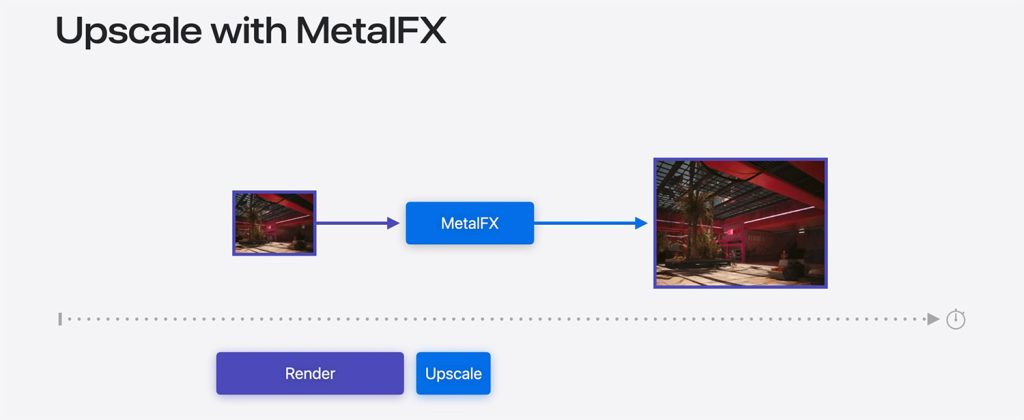
Before analyzing interpolation and denoising, understanding the baseline mechanics of MetalFX upscaling is vital. As Apple formally outlined during WWDC25 sessions:
"Rendering high resolution images can consume the GPU for a significant period of time. Instead, your app can render low resolution images and use MetalFX to upscale them. The combined time to render your final image is reduced and that means your app can save time for each frame it renders. You can use the time saved to render the next frame sooner."
By taking a frame rendered at, for example, 1080p and reconstructing it to look sharp at 4K using temporal data, developers can slash GPU workload by 50% or more. This freed-up thermal and compute headroom has become the absolute baseline for performance-conscious game development on modern macOS hardware.
Frame Interpolation: Creating Smoothness Without the Render Cost
PC gamers are likely familiar with frame generation technologies found in modern graphics cards, where AI algorithms generate entirely synthetic frames to boost fluidity. Apple has adapted this philosophy for the Metal ecosystem with MetalFX Frame Interpolation.
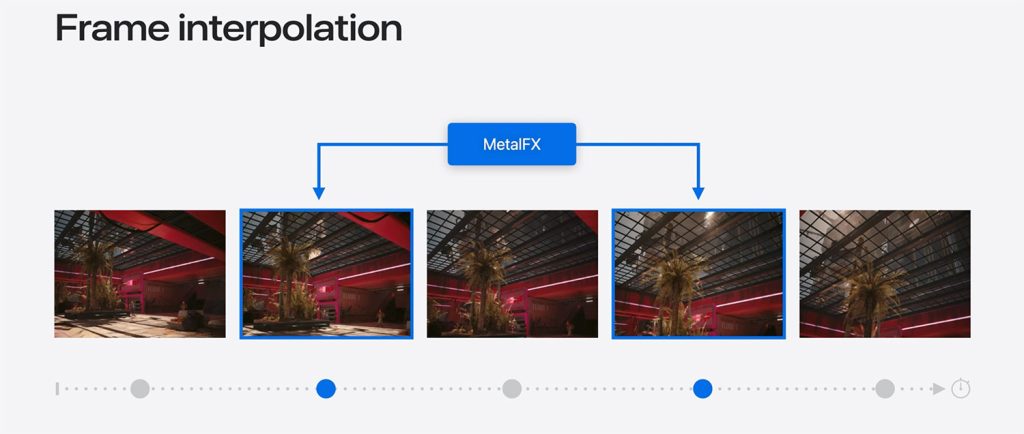
Instead of forcing the GPU to sweat over rendering every single pixel of an intermediate frame from scratch, MetalFX interpolation analyzes motion vectors and depth data from adjacent frames. It calculates how objects, lighting, and textures shift across the screen, inserting a high-quality intermediate frame in a fraction of the time.
[Frame N] ──( Motion Vectors & Depth Data )──> [MetalFX Interpolation] ──> [Synthetic Frame N.5]
    │                                                                             │
    └───────────────────────────> [Final High-Refresh Output] <───────────────────┘
For players, this yields significantly smoother animations and an elevated perceived frame rate—transforming a choppy 30 frames-per-second baseline into a fluid, responsive 60fps or higher experience, or pushing 60fps displays into the realm of high-refresh 120Hz gaming. For developers, it provides a vital shortcut to hitting target performance metrics on MacBook Airs and entry-level Mac minis without needing to dial game settings down to their lowest presets.
Advanced Denoising: Making Ray Tracing Viable on Mac
Ray tracing has become the graphical gold standard for modern AAA gaming, simulating the physical behavior of light to deliver hyper-realistic reflections, shadows, and global illumination. However, ray tracing is notoriously computationally expensive. Casting enough rays to generate a clean, artifact-free image requires immense GPU power.
To circumvent this bottleneck, games often employ ray-tracing at low sample counts—resulting in a grainy, speckled, "noisy" visual output. Historically, developers had to write custom denoising algorithms or rely on complex CPU-side processing to clean up these frames.
With Metal 4, Apple has integrated advanced denoising directly into the MetalFX pipeline. Games can now render scenes with far fewer rays, and the MetalFX pipeline automatically cleans up the speckled artifacts during the upscaling process. This integrated approach delivers a pristine, noise-free image with a fraction of the performance penalty traditionally associated with real-time ray tracing.

Official Statements and Technical Guidance
Apple’s engineering teams have heavily emphasized that Metal 4 is designed to remove friction from the porting process. During the technical sessions at WWDC25, Apple engineers stressed that these tools are built to integrate seamlessly into existing cross-platform rendering pipelines.
In the foundational session Discover Metal 4 (Session 205), Apple developers highlighted the unified nature of the new framework:
"Our goal with Metal 4 is to give developers deeper, more direct control over temporal workloads while minimizing the boilerplate code required to achieve high fidelity. By embedding advanced reconstruction techniques directly into the framework, we are empowering studios to target Apple Silicon with greater confidence than ever before."
Furthermore, in the companion session Go further with Metal 4 games (Session 211), engineers walked through practical implementation strategies, demonstrating how developers utilizing industry-standard engines like Unreal Engine and Unity can hook into MetalFX frame interpolation and denoising with minimal structural disruption.
Apple has confirmed that Metal 4 is backward-compatible across a massive install base, running natively on:

- Mac computers powered by the M1 chip and later.
- iPhones and iPads powered by the A14 Bionic chip and later.
This vast hardware footprint ensures that optimizations made for desktop-class Mac games will instantly scale down to mobile platforms, unifying Apple’s ecosystem under a single, highly optimized graphics umbrella.
Future Outlook: Can Metal 4 Finally Win Over AAA Studios and Gamers?
The introduction of Metal 4 represents a profound evolution in Apple’s gaming strategy. Rather than relying purely on marketing campaigns or financial incentives to attract developers, Apple is providing robust, cutting-edge software engineering tools that directly address the hardware limitations of unified memory and thermal constraints found in thin-and-light laptop designs.
Overcoming the Developer Hesitancy
For years, the primary complaint from game developers regarding macOS was the immense resource overhead required to optimize games for a non-Windows platform with vastly different graphics memory management. By standardizing advanced upscaling, frame interpolation, and native ray-tracing denoising into Metal 4, Apple is lowering the barrier to entry. Studios can port a Windows/Console game, leverage MetalFX to handle the heavy lifting of performance scaling, and deliver a polished experience to millions of Mac users with minimal bespoke optimization.
The Consumer Experience: What Lies Ahead
For the end user, Metal 4 promises to narrow the gap between dedicated gaming rigs and everyday productivity machines. A thin MacBook Pro or an iMac powered by an M-series Max or Ultra chip will be increasingly capable of running demanding titles at high resolutions, fluid frame rates, and with complex lighting effects enabled—all without triggering aggressive thermal throttling or draining the battery in minutes.
As WWDC25 developers begin integrating Metal 4 SDKs into upcoming projects, the true test will be seen in the software library. If major AAA publishers adopt Metal 4’s frame interpolation and denoising pipelines for upcoming late-2025 and 2026 releases, Apple’s long-standing dream of establishing the Mac as a premier gaming platform may finally transition from aspiration into reality.








Belum ada komentar. Jadilah yang pertama berkomentar!