

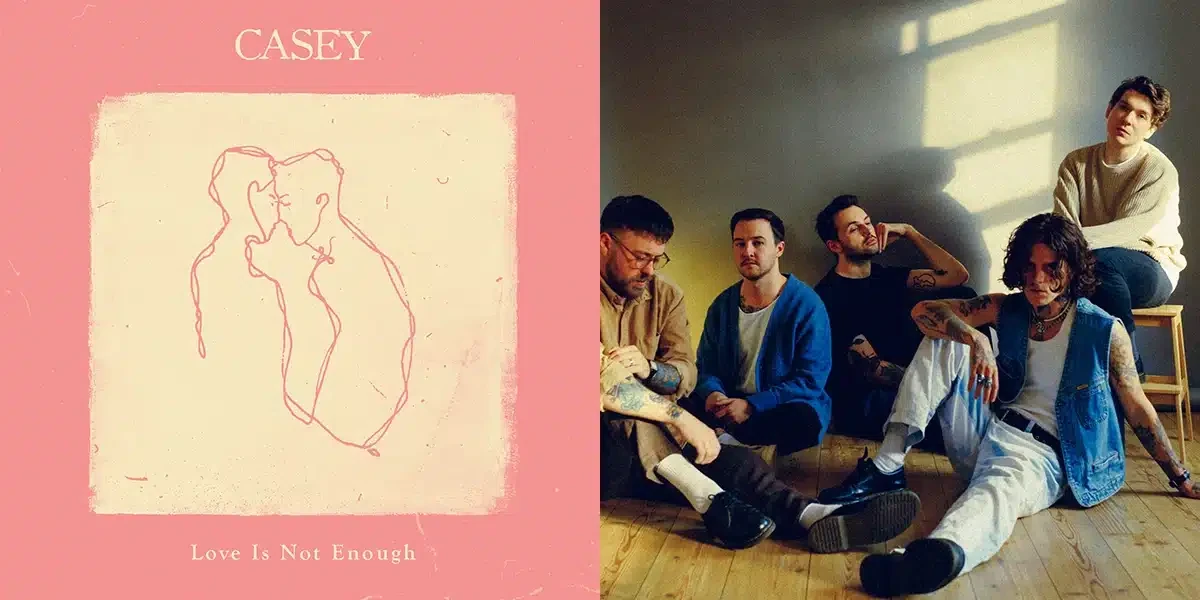
When Welsh alternative outfit Casey unleashed their debut album, Love Is Not Enough, on September 23, 2016, they did not merely release a collection of songs; they constructed a masterclass in emotional architecture. Fusing the raw, bludgeoning velocity of hardcore with the expansive, cascading textures of post-rock, dynamic-driven arrangements, and vulnerability-laden clean vocals, the album served a single, overriding centrepiece: unfettered sorrow. It was the musical embodiment of grief stacked upon grief, capturing a generational mood that resonated far beyond the confines of the British underground.
Ten years on, the ripple effects of Love Is Not Enough remain unmistakably audible. Its blueprint—characterized by poetic, enjambment-heavy lyricism, atmospheric guitar work, and structural builds that mirror the volatility of human heartbreak—helped reshape the landscape of modern heavy music. As the band’s catalog continues to inspire subsequent generations of acts globally, a retrospective look at the genesis, turbulent recording process, literary origins, and lasting legacy of Casey’s seminal record reveals a profound narrative of creative resilience.
Detailed Chronology: From Hospital Beds to Studio Masters
The Genesis of Well Wisher
The story of Casey begins in the wreckage of burnout. In 2013, Tom Weaver, guitarist for the Welsh metalcore outfit Continents, was hospitalised just hours before a scheduled performance in Germany. The physical and mental toll of relentless touring had taken its final, irreversible toll. Returning home exhausted and bandless, Weaver received a life-line from his childhood best friend, Liam Torrence, whose own band, Hot Damn, had recently dissolved.
Torrence proposed a straightforward creative outlet: a studio-only project where Weaver would handle vocal duties and Torrence would play guitar. Operating under the moniker Well Wisher, the duo set out to explore the melancholic confines of melodic hardcore.
At the time, the United Kingdom was navigating a golden age of melodic hardcore spearheaded by bands like Landscapes, More Than Life, and Dead Swans. Unlike their international counterparts, British underground scenes maintained a deeply integrated ecosystem; metalcore giants such as Bring Me the Horizon and Architects—alongside touring American acts—frequently welcomed melodic hardcore support bands, embedding the genre deep into the national consciousness.
Expanding the Vision and the Birth of Casey
While early Well Wisher demos captured the aggressive pulse of contemporary "srscore" (a hybrid of emotional metalcore pioneered by acts like Misery Signals and Counterparts), Weaver found himself yearning for a more atmospheric departure. Inspired by the loose American collective known as “The Wave”—including Pianos Become the Teeth, Touché Amoré, La Dispute, and Defeater—Weaver sought to merge the melodic fury of screamo with the ambient, dynamic architecture of post-rock stalwarts like This Will Destroy You.
To actualize this vision, Weaver enlisted guitarist Toby Evans, known for his post-rock tendencies in Our Tomorrow. The project quickly mutated from a bedroom studio venture into a five-piece powerhouse of South Wales songwriting talent. Drummer Max Nicolai (formerly of Here Lies the Enemy) and bassist Scott Edwards (of Dead Wretched and Boys with X-Ray Eyes) rounded out the lineup. Rebranding to avoid genre constraints, the band chose the name "Casey"—a deliberate homage to Rise of Science’s album Casey and late Hawthorne Heights guitarist Casey Calvert.
The Chaotic Recording of Love Is Not Enough
By the summer of 2015, following a string of early singles and an introductory EP, the quintet entered Monnow Valley and Terra Firma Studios to record their debut full-length. The process was fragmented and high-stress. Members were rarely in the room together, piecing tracks together between scheduling conflicts.
Toby Evans, who had mixed all of the band’s prior releases, initially shouldered mixing duties for the album. However, burdened by night shifts sleeping on studio floors and the crushing weight of perfectionism on his first full-length mixing credit, production bottlenecked.
Intervention arrived via Mike McGough, frontman of Being as an Ocean, the Elijah, and Casey’s manager. McGough secured studio time with Matt McClellan at Glow in the Dark Studios in Atlanta, Georgia, to salvage and complete the record’s mix. In a gesture of gratitude, Casey invited McGough to contribute an unlisted guest vocal feature to the latter half of the track "Ceremony."
Although principal recording wrapped between August and October 2015, Love Is Not Enough was held until September 2016. In the interim, bassist Scott Edwards departed the band, playing his final tour in March 2016 alongside Alazka before handing the low-end duties over to long-time friend and substitute Adam Smith.
Supporting Context & Metrics: Literary Influences and Sonic Architecture
The Literary Weight of Weaver’s Pen
What truly elevated Casey above their contemporaries was their hyper-literate, poetry-forward lyricism. Drawing inspiration from literary heavyweights—a passion catalyzed by a humiliating secondary school English assignment where a young Weaver received a zero and a thesaurus for overusing the word "nice"—the vocalist embraced complex language and emotional specificity.
“That started me down the rabbit hole of expanding my vocabulary and incorporating more complex language,” Weaver reflects, citing Dessa, Sylvia Plath, Aaron Weiss, and Susan Sontag as foundational inspirations.
This literary background manifested in Love Is Not Enough, a deeply confessional concept album exploring the painful reality that love alone cannot cure mental illness. The record centers on a harrowing breakup Weaver endured immediately before entering the studio. Eschewing traditional end-stopped song structures, Weaver utilized enjambment—carrying sentences across line breaks—to mimic the breathless cadence of essays.
Recurring motifs anchored the record’s thematic weight. The dichotomy of a "house" versus a "home" echoes across tracks like "Haze," "Little Bird," and "Mourning," mutating from physical space to emotional vacuum. Extended metaphors, such as comparing a failing lover to a bird kept in a clipped cage, cemented the album’s status as a masterwork of lyrical devastation.
Vocal Dynamism and Gaze-Inflected Guitars
Musically, Casey defied the strict genre formulas of their peers by treating clean vocals and harsh screams not as alternating gimmicks, but as emotional levers. Drawing from the pop-screamo roots of Funeral for a Friend and Hawthorne Heights, Weaver utilized soaring clean passages for intimate, confessional verses, reserving upper-mid register fry screams for cathartic, post-rock-style instrumental crescendos.
Beneath the vocals lay Evans’ guitar work, which pulled inspiration not just from hardcore, but from shoegaze icons My Bloody Valentine, A Place to Bury Strangers, and The Pains of Being Pure at Heart. The resulting wall of atmospheric guitar textures gave the album a lush, cinematic scope that bridged the gap between raw aggression and ethereal beauty.
Official Statements & Industry Perspectives
Reflecting on the album’s creation and legacy, the band members have frequently noted the organic nature of their evolution.
-
On the purity of the songwriting process:
"Lyrics always come last… I’ll wait for the music to be done to make sure that whatever pieces I commit to it are permanent," Weaver explains regarding his writing method. "I’ll typically settle on a statement I really like, and then I’ll think, ‘How do I arrive at this? Where should I go from here?’ and then write outwards in both directions."
-
On external influences and genre-agnosticism:
"It was just a melting pot of our listening habits," Weaver notes. "I loved both Landscapes records, and Love Let Me Go [by More Than Life] was a big record for me too… I love bands like My Bloody Valentine, but also newer gaze-style bands like A Place to Bury Strangers."
-
On unreleased material and lost tracks:
Discussing the early sessions, Weaver admits that few early ideas were wasted, though casualties did occur. "I’m not sure Casey ever wrote a demo that didn’t end up being a full song… I’m not entirely sure why we ended up dropping ‘Ghost’ [the B-side to ‘Haze’], to be honest. In hindsight, it’s no different sonically to some of the other work on [Love Is Not Enough]."
Future Outlook: Legacy, Disbandment, and Reformation
Following the release of their sophomore record, Where I Go When I Am Sleeping (2018), Casey chose to disband in 2019, marking the close of a definitive era in atmospheric heavy music. During their absence, the seed they planted blossomed internationally. Promoted largely via community YouTube channels like Dreambound, bands such as Vacant Home, Wilderness, Selfworth, Bloom, and Witness adopted Casey’s signature blend of soaring ambience and hardcore breakdowns.
Even as subgenres shifted, Casey’s DNA endured. Modern acts ranging from accessible alternative groups like Static Dress and Delair the Liar to heavyweights like Currents and Backroads UK absorbed their emotional vocabulary.
When Casey announced their reformation in December 2022, the heavy music community met the news with rapturous anticipation. Their subsequent third album showcased a deliberate sonic evolution: a softer, more contemplative palette where screams are sparse, and hope finally edges out despair. Yet, whether exploring the volatile grief of 2016 or the measured reflection of their modern era, Casey remains an enduring testament to the power of radical vulnerability in heavy music.









Belum ada komentar. Jadilah yang pertama berkomentar!