

Executive Overview
Kent Jones’s 2025 comic drama Late Fame functions as both a cinematic triumph and a deeply textured love letter to the shifting landscapes of Lower Manhattan. Anchored by a masterclass in physical and psychological acting from Willem Dafoe, the film adapts Arthur Schnitzler’s posthumously published 1895 Vienna-set novella, transposing its razor-sharp observations of social strata and artistic pretense into the rich, gritty pavement of contemporary New York City.
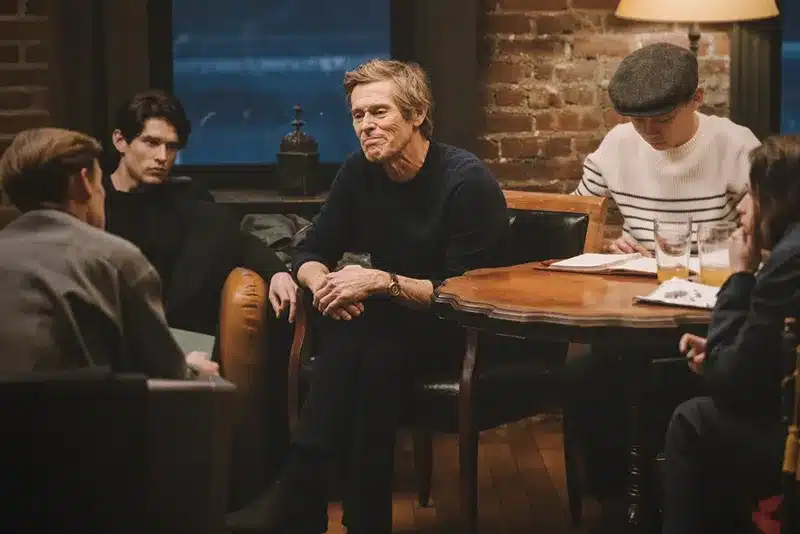
Dafoe stars as Ed Saxberger, a 64-year-old postal worker whose youth included a brief flirtation with the city’s elite artistic circles, the publication of a single, long-forgotten book of poetry, and a subsequent retreat into quiet obscurity. The narrative ignites when a twenty-something academic poet named Wilson Meyers, played with eager intensity by Edmund Donovan, redcovers Saxberger’s out-of-print work. Thrust rather unceremoniously into the orbit of a younger generation of aspiring writers and performers, Saxberger discovers that anonymity does not always last, and that the ego—once dormant—can be remarkably easily reawakened.
Featuring stellar supporting performances from Greta Lee as the fiercely talented and magnetic performer Gloria, and backed by an executive production team that includes Martin Scorsese, Late Fame bridges the gap between old-world European sensibilities and modern urban grit. With a moody soundtrack featuring Lou Reed, loving homages to neighborhood cultural landmarks like Film Forum, and a script penned by Samy Burch that treats exposition with rare grace, the film establishes itself as an instant classic of urban cinema. This report offers a comprehensive examination of the film’s narrative mechanics, its thematic lineage within American independent cinema, its technical achievements, and its prospective cultural footprint.
Detailed Chronology and Narrative Architecture
The Quiet Life of Ed Saxberger
The film opens with an intentional, unhurried focus on the rhythms of Ed Saxberger’s daily existence. At 64 years old, Saxberger has built a life of calculated minimalism. Decades prior, he abandoned high school, migrated to New York City, rubbed shoulders with avant-garde intellectuals, and produced a solitary volume of verse. Rather than chasing literary immortality, however, he settled into the predictable, grounding routine of a postal worker in lower Manhattan.
Director Kent Jones and screenwriter Samy Burch refuse to rely on heavy-handed exposition to explain Saxberger’s past. Instead, the audience reads his history directly from Willem Dafoe’s face—the lines etched by age, the economy of his line readings, and the matter-of-fact body language he exhibits during solitary walks through his neighborhood. Every movement communicates a man who has made peace with his choices, maintaining sobriety for six years—a detail casually revealed when he declines a single drink on a friend’s birthday—without wearing his past struggles as a badge of honor.
The Influx of Youthful Ambition
The status quo shatters when Wilson Meyers materializes outside Saxberger’s apartment. A hyper-articulate, academically trained aspiring poet in his twenties, Meyers has somehow unearthed a pristine copy of Saxberger’s forgotten book. Struck by its unheralded brilliance, Meyers appoints himself the keeper of Saxberger’s flame, introducing the bewildered postal worker to a coterie of similarly aged male aspiring writers.
This introduction sets up a generational and cultural collision. The younger men operate in a warmer, cushioned salon culture, passionately debating art, revolution, and their own place in the cultural firmament. In contrast, Saxberger retreats to stark, blue-lit working-class bars where his peers talk of mundane realities. Yet, as Dafoe’s expert performance demonstrates, Saxberger’s initial wariness slowly melts away, replaced by an involuntary, buoyant spring in his step. The forgotten poet, offered a taste of "late fame," takes the bait.
Gloria and the Crucible of Performance
While the circle of young writers forms the intellectual sounding board for Saxberger’s re-emergence, the film’s emotional anchor arrives with Gloria, portrayed with a flinty, wounded brilliance by Greta Lee. Gloria is not a writer; she is a performer—a singer and actress whose larger-than-life presence electrifies every scene she occupies.
Complicated to the point of being hazardous to herself and those around her, Gloria embodies the high stakes of artistic dedication. Her character serves as a warning and a revelation to Saxberger and the audience alike. In a sequence that is already drawing critical acclaim, Lee delivers a long, bravura performance of a Kurt Weill song, crystallizing the emotional volatility, sacrifice, and sublime absurdity inherent in a life dedicated to artistic expression.
Supporting Context & Metrics: Cultural Lineage and Production Aesthetics
The New York Tapestry and Literary Roots
Arthur Schnitzler’s 1895 novella naturally lends itself to themes of psychological exposure, social mores, and repressed desire—qualities that also informed Stanley Kubrick’s adaptation of Schnitzler’s Dream Story in Eyes Wide Shut (1999). However, whereas Kubrick’s vision was famously clinical and rigid, Late Fame radiates warmth, vitality, and deep affection for its municipal setting.
The production design reads like a love letter to Downtown Bohemia. In establishing shots and lingering pans, the camera lovingly documents:
- Literary and Cinematic Touchstones: Saxberger’s bookshelves, which feature Pauline Kael film reviews, Samuel Beckett novels, and classic poetry cassettes alongside nods to Edith Wharton.
- Physical Locales: Washington Square Park’s grand, old-growth trees; low-rise neighborhood buildings; and a fleeting, fond cameo by the iconic Film Forum.
- Sonic Atmosphere: A carefully curated soundtrack anchored by Lou Reed’s "Charlie’s Girl" from the 1975 album Coney Island Baby, cementing a mood that balances late-century grit with timeless introspection.
Cinematic Intersections and Aesthetic DNA
Film historians and critics have noted Late Fame’s effortless integration into a specific lineage of New York-centric cinema. The film weaves together multiple traditions:
- The Gilded Age Social Observation: Channeling the structural manners and class stratifications found in Edith Wharton’s novels, directly echoing Martin Scorsese’s 1993 adaptation of The Age of Innocence (Scorsese serves as an executive producer here).
- The Upper East Side Bourgeoisie: Sharing the dry wit and intellectual neuroses of Whit Stillman’s Metropolitan (1990).
- Urban Authenticity and Isolation: Blending the working-class charm of Joan Micklin Silver’s Crossing Delancey (1988) with the hyper-focused interpersonal claustrophobia of Tom Noonan’s What Happened Was… (1994).
Official Statements and Critical Reception
Industry response following festival screenings and theatrical runs has been overwhelmingly positive, positioning the film as an unexpected heavyweight for the upcoming awards season.
Industry insiders and early reviewers have praised the film’s structural restraint. Producerial statements emphasize the collaborative nature of translating Schnitzler’s 19th-century Viennese social satire into a modern American idiom without losing its psychological bite. Screenwriter Samy Burch has noted in promotional panels that the primary challenge was "allowing the silences between the dialogue to carry the weight of decades."
Critical consensus points to Willem Dafoe’s nuanced internalization of aging and relevance as a career-best turn. Cultural analysts have similarly lauded Greta Lee for grounding the intellectual debates of the male poets in visceral, emotional reality.
Future Outlook: Legacy and Cultural Footprint
As Late Fame completes its theatrical rollout and prepares for broader distribution, its long-term cultural trajectory appears exceptionally promising. Operating with a runtime of one hour and 36 minutes, the film packs an immense density of philosophical inquiry into human relationships, creative stagnation, and generational handover.
Anticipated Accolades
Given the stellar pedigree of the cast and crew—spanning Kent Jones’s sensitive direction, Burch’s sharp script, and standout performances by Dafoe and Lee—industry prognosticators are projecting multiple major Academy Award nominations. Beyond acting nods, technical categories such as editing (overseen by Mike Selemon) and production design are expected to garner serious consideration from voting bodies.
A Touchstone for Future Generations
While the film is steeped in the specific cultural vernacular of New York City and demands a degree of urban literacy from its audience, its core themes are universally resonant. Just as past generations adopted iconic urban dramas like Rent or Hedwig and the Angry Inch, younger audiences are expected to embrace Late Fame for its unflinching look at the cost of creation and the beauty of quiet resilience.
Ultimately, Late Fame does not merely depict an aging poet tasting the fleeting sweetness of belated recognition; it offers a timeless meditation on how we curate our lives, how we reconcile our past ambitions with our present realities, and how the city around us continues to beat with an enduring, irresistible pulse.







Belum ada komentar. Jadilah yang pertama berkomentar!