In the cinematic landscape of biographical dramas, few historical milestones carry the urgent, systemic weight of the 1977 504 Sit-in. Directed by Academy Award winner Sian Heder (CODA), Being Heumann chronicles this pivotal chapter in American civil rights history. Set against the backdrop of San Francisco, the film dramatizes the historic 28-day occupation of the city’s Federal Building. Spearheaded by legendary disability rights activist Judy Heumann—portrayed with fiery, magnetic dynamism by Ruth Madeley—the protest forced the federal government to finally sign Section 504 of the Rehabilitation Act of 1973 into law.
Co-written by Heder and disabled author and screenwriter Rebekah Taussig, the feature boasts what is arguably the most expansive and authentic representation of disabled actors ever assembled in a single mainstream motion picture. Alongside Madeley, the ensemble features stellar performances from Mark Ruffalo as the frugal, sardonic Department of Health, Education, and Welfare (HEW) Secretary Joseph Califano, Dylan O’Brien as an evolving beat reporter, and an inclusive supporting cast that includes Madeline Delp, Rio Finnegan, Rob Delaney, Ray Fisher, Michael Patrick Thornton, Daniel Durant, and Russell Harvard.
Yet, despite its monumental strides in authentic representation and its rare, unflinching look at the daily logistics of disability and caretaking, Being Heumann occupies a complex critical space. While it succeeds brilliantly in humanizing its subjects and illuminating the complexities of intersectional disability politics, the film occasionally stumbles under the weight of conventional biopic tropes. Balancing an imperative to educate general audiences with an authentic depiction of a hard-fought political battle, Heder’s direction oscillates between deeply moving, granular realism and an overly upbeat, crowd-pleasing aesthetic that occasionally softens the very real physical and emotional stakes of the struggle.
Detailed Chronology: The 1977 San Francisco Federal Building Sit-In
To fully appreciate the narrative stakes of Being Heumann, one must contextualize the historical powder keg of April 1977. For years, disability advocates across the United States had lobbied for the implementation of Section 504 of the Rehabilitation Act of 1973—a landmark piece of civil rights legislation designed to bar discrimination against individuals with disabilities in programs receiving federal financial support. Despite its passage four years prior, successive administrations stalled on enacting the implementing regulations.
When Joseph Califano, heading the HEW under the Carter administration, further delayed signing the final regulations and threatened to weaken their scope, Judy Heumann and an alliance of determined activists took direct action. On April 5, 1977, hundreds of disabled individuals, alongside their allies, caretakers, and supporters, entered the San Francisco Federal Building. What was initially planned as a brief demonstration evolved into a historic, 28-day occupation.
Being Heumann captures this arduous chronology by examining the internal mechanics of the sit-in:
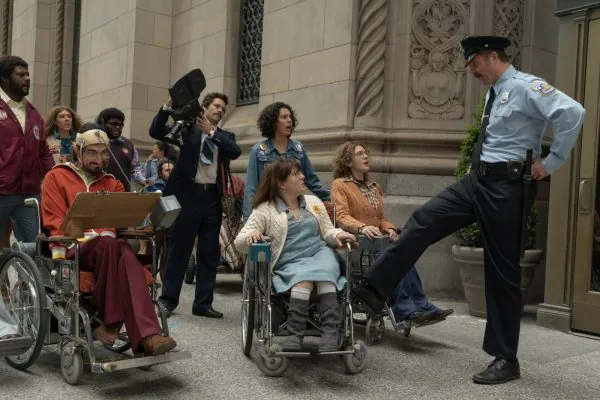
The Logistics of Occupancy: The film meticulously details how protestors managed the day-to-day realities of living inside a federal building utterly devoid of accessible facilities. Scenes depict the exhausting physical coordination required for transfers, hygiene management, and the crucial requirement of repositioning paralyzed individuals every few hours to prevent pressure sores.
Intra-Movement Tensions: Heder and Taussig’s script refreshingly refuses to paint the disabled community as a monolith. The film dedicates substantial runtime to impassioned debates among protestors—representing physical disabilities, blindness, deafness, and chronic conditions—regarding what Section 504 should prioritize, illustrating that accommodations which benefit one group can occasionally present unforeseen hurdles for another.
Escalation and Confrontation: As the weeks dragged on, the federal government attempted to starve out the occupiers by cutting off their telephone lines and restricting food and water supplies. The narrative reaches a fever pitch when the protest expands outward, notably shifting toward a confrontation near Secretary Califano’s private residence—a sequence dramatized with high-stakes tension, though modulated to fit the film’s overarching optimistic tone.
Supporting Context & Metrics: Authentic Representation and the Mechanics of Care
The true watershed moment of Being Heumann does not lie strictly within its historical recreation, but rather in its radical commitment to authentic casting and behind-the-scenes perspective. Mainstream cinema has historically marginalized disabled narratives, frequently casting able-bodied actors in disabled roles or reducing complex individuals to flat archetypes designed merely to inspire pity or awe.
Being Heumann issues a direct rebuke to this cinematic tradition. Encapsulated by a powerful line delivered within the film—"Don’t be inspired; be inspired to do something"—the production actively works to dismantle inspirational tropes in favor of political action and systemic accountability.
Groundbreaking Casting and Ensemble Depth
By casting actors whose lived experiences align with their characters—such as Ruth Madeley as Judy Heumann and Rio Finnegan as Milton—the film achieves a level of physical and emotional truth unattainable through prosthetic or simulation methods. The unique body shapes, mobility aids, and communication methods of the diverse ensemble are integrated naturally into the fabric of the storytelling.
Furthermore, the film succeeds remarkably as a visual ethnography of caretaking. Mainstream media routinely glosses over the intricate mechanics of living with a severe physical disability. Being Heumann dedicates valuable screen time to showing:
The precise, collaborative coordination between wheelchair users and their aides during street transit, sidewalk navigation, and architectural barriers.
The physical vulnerability involved in bathing, dressing, and nocturnal repositioning.
The psychological weight of relying on others for basic bodily autonomy.
Subverting Tropes and Exploring Intimacy
Heder and Taussig inject necessary nuance into the narrative by exploring dimensions of disabled life rarely touched upon in commercial cinema. In one standout sequence, the film explores intimacy and romance through Judy’s perspective. During a moment with a romantically inclined activist, Judy adopts a dominant posture—asserting control and declaring, "Now you’re going to do what I say"—highlighting how role-play and sexual agency can serve as a vital psychological release for individuals who spend their daily lives subjected to the physical control and assistance of others.
Similarly, Dylan O’Brien’s character—a skeptical beat reporter assigned to cover the fringe protest—serves as an effective proxy for the uninitiated audience member. His arc from dismissive ignorance to genuine solidarity mirrors the societal awakening the real-life movement demanded of the American public.
Official Statements & Critical Reception
Critical discourse surrounding Being Heumann has centered largely on the friction between its radical subject matter and its conventional, crowd-pleasing cinematic execution.
Film critics and disability advocates alike have praised Heder’s empathetic vision and the transcendent performances of the ensemble. Industry analysts note that Being Heumann arrives at a crucial cultural juncture, continuing the momentum established by trailblazing works like CODA while pushing boundaries further into intersectional territory.
In statements regarding the production, Heder has emphasized the necessity of collaboration with the disabled creative community:
"Telling a story of this magnitude requires more than just good intentions; it demands that the voices steering the narrative belong to those who have walked—or rolled—the path. Rebekah Taussig and our incredible cast ensured that every frame reflected truth rather than approximation."
Conversely, cultural reviewers have pointed out the tonal dissonance that occasionally undercuts the film’s revolutionary message. While the inclusion of punk-rock needle drops, snappy humor, and buoyant optimism makes the historical drama accessible to wide theatrical audiences, it occasionally sanitizes the genuine terror and physical danger faced by the occupiers. For instance, the sequence depicting protestors loaded into the back of a U-Haul truck during the escalation toward Califano’s home is framed with the kinetic energy of an action-adventure set piece, glossing over the very real danger that unsecured wheelchairs pose to their users during transit.
Future Outlook
As Being Heumann prepares to make its mark on the cinematic landscape, its legacy will likely be measured on two distinct fronts: its artistic merits as a biographical drama and its systemic impact on Hollywood representation standards.
Raising the Bar for Casting: By proving that disabled actors can anchor a major, multi-million-dollar dramatic feature with nuance, charm, and magnetic screen presence, Being Heumann sets a new benchmark for the industry. Studios can no longer use the excuse of "market viability" to bypass authentic casting choices.
Shifting Cultural Consciousness: Beyond the silver screen, the film serves as a timely reminder of the fragility of civil rights protections. In an era where accessibility standards and institutional support face ongoing legislative and economic challenges, Heumann’s militant insistence on equal access acts as a blueprint for contemporary activism.
The Evolution of Heder’s Filmography: For director Sian Heder, Being Heumann solidifies her reputation as a filmmaker deeply committed to marginalized linguistic and physical communities. While critics may debate whether the film leans too heavily into "cornball" biopic formulas, its underlying humanity and cultural importance are indisputable.
Ultimately, Being Heumann succeeds in reminding viewers that true progress is forged not through passive admiration, but through relentless, disruptive demand for equity. Whether audiences walk away humming its upbeat soundtrack or grappling with the sobering realities of infrastructural neglect, the film achieves its ultimate goal: ensuring that the name Judy Heumann—and the collective power of the disability rights movement—remains permanently etched in the historical consciousness.














Belum ada komentar. Jadilah yang pertama berkomentar!