

Published: October 8, 2026
Category: Government & Policy / Technology
Photo Credit: Win McNamee / Staff / Getty Images
Executive Overview
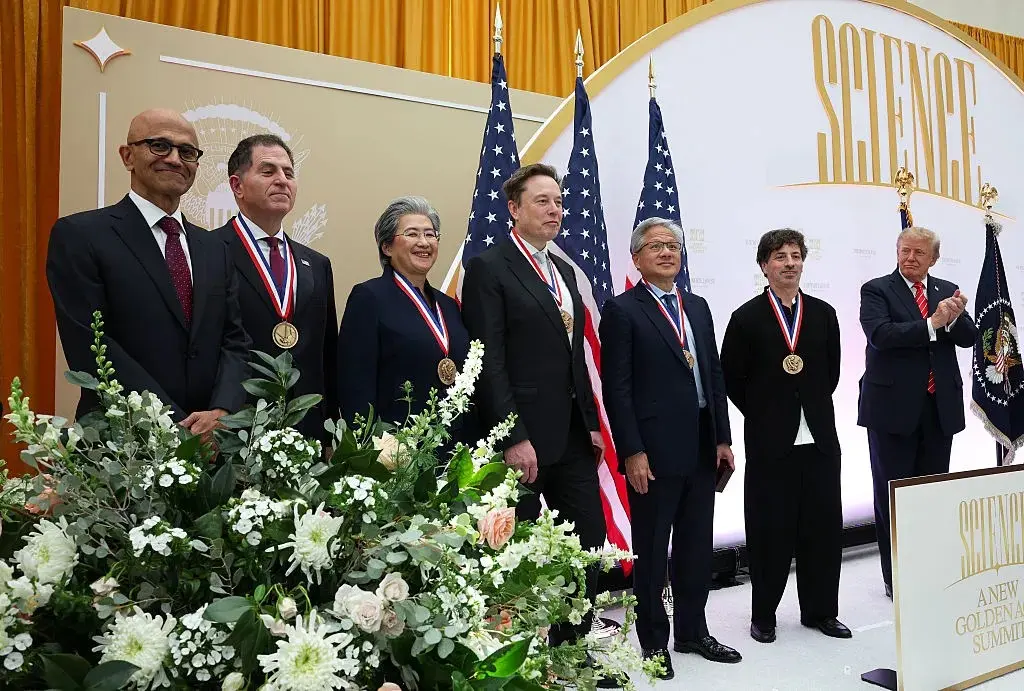
In an extraordinary convergence of Silicon Valley innovation and federal recognition, the highest tiers of American technology leadership converged on Washington, D.C., this week. Speaking at the high-profile Golden Age of American Innovation Summit on Thursday, President Trump bestowed the nation’s most prestigious scientific and technological honors upon some of the most influential executives, founders, and visionaries of the 21st century.
Among the distinguished recipients of the National Medal of Science—the United States government’s highest honor for scientific achievement—were Tesla and SpaceX chief Elon Musk, NVIDIA CEO Jensen Huang, Alphabet co-founder Sergey Brin, and Advanced Micro Devices (AMD) CEO Lisa Su. Simultaneously, the National Medal of Technology and Innovation was presented to Dell Technologies founder Michael Dell and Microsoft CEO Satya Nadella.
While the White House framed the ceremony as a celebration of American exceptionalism, technological dominance, and the boundless potential of the digital age, the event has instantly ignited a national debate. Investigative reports and policy watchdogs have quickly drawn attention to a striking parallel: the collective group of honorees—and the corporate giants they represent—has collectively directed nearly $6 billion in donations, philanthropic pledges, and political contributions toward initiatives, Super PACs, and administration-backed projects tied to President Trump and his allies.
Compounding the political complexity of the summit, Satya Nadella’s receipt of the National Medal of Technology and Innovation occurred against a turbulent backdrop. Just moments before the ceremony, the administration announced an indefinite suspension of Microsoft from the federal H-1B visa program, casting a complex shadow over an event intended to celebrate corporate partnership and national progress.
Detailed Chronology of the Summit and Awards
The Golden Age of American Innovation Summit
The summit, held in the nation’s capital on Thursday, October 8, 2026, was billed by administration officials as a definitive blueprint for the future of American technological hegemony. Bringing together pioneers from artificial intelligence, semiconductor manufacturing, aerospace exploration, and enterprise computing, the event sought to cement a collaborative axis between the federal government and private sector titans.
President Trump took to the stage to deliver a keynote address that emphasized the indispensable role of private enterprise in maintaining global geopolitical and economic supremacy. Praising the assembled leaders, Trump remarked that the honorees had helped "pioneer an incredible future for America." He added with characteristic rhetorical flourish that, because of their groundbreaking contributions, "we will always be on top. No one else can compete with us."
The Award Ceremony
The formal presentation of the medals served as the centerpiece of the summit. The awards—long considered the pinnacle of American academic, industrial, and scientific achievement—historically recognize individuals who have made extraordinary contributions to the knowledge and advancement of science, engineering, and technology.
-
National Medal of Science Recipients:
- Elon Musk: Recognized for his trailblazing work in commercial aerospace engineering, electric vehicle mass production, and sustainable energy infrastructure through SpaceX and Tesla.
- Jensen Huang: Honored for his foundational role in architecting the hardware and software ecosystems—most notably GPUs and CUDA architecture—that power the current global artificial intelligence revolution.
- Sergey Brin: Acknowledged for co-founding Alphabet (Google) and revolutionizing global information retrieval, data indexing, and the democratization of knowledge.
- Lisa Su: Commended for her historic turnaround of AMD, driving monumental advancements in high-performance computing, semiconductor design, and silicon manufacturing.
-
National Medal of Technology and Innovation Recipients:
- Michael Dell: Recognized for pioneering the direct-to-consumer manufacturing model, supply chain efficiency, and scaling Dell Technologies into a global enterprise computing giant.
- Satya Nadella: Honored for steering Microsoft through a massive cloud-computing transition and positioning the software giant at the forefront of the generative artificial intelligence era.
The Immediate Aftermath and the H-1B Controversy
While the summit’s daytime events celebrated public-private synergy, the evening news cycle was immediately dominated by a dramatic policy clash involving Microsoft. In a sudden regulatory shift that caught industry analysts off guard, the federal administration announced the indefinite suspension of Microsoft from the H-1B visa program.
The H-1B program has long been the primary mechanism through which U.S. technology companies recruit highly skilled foreign workers, particularly in software engineering, cloud architecture, and artificial intelligence research. The timing of the suspension—occurring practically simultaneous with Satya Nadella accepting the nation’s highest technology award—introduced an immediate element of friction. Industry insiders and legal experts are currently scrambling to assess the operational impacts of the suspension on Microsoft’s expansive workforce pipeline, even as company representatives navigate the delicate diplomatic and political terrain of Washington.
Supporting Context & Financial Metrics
The intersection of big tech and political financing has long been a subject of intense scrutiny in Washington, but the scale of financial alignment revealed in the wake of Thursday’s summit has elevated the discussion to unprecedented levels. According to comprehensive reports compiled by outlets such as The New Republic and Time, the collective philanthropic, inaugural, and political contributions tied to the honorees and their respective corporate entities approach nearly $6 billion.
Breakdown of Contributions and Philanthropic Pledges
-
The Dell Foundation and Child Savings Programs:
The single largest financial figure underpinning this nexus involves Michael and Susan Dell. Through their philanthropic vehicles and personal commitments, the couple pledged a staggering $6.25 billion to support the "Trump Accounts," an administration-backed savings and wealth-generation program designed for children born in the United States. While framed as a long-term economic empowerment initiative, the massive scale of the pledge has drawn both praise for its ambition and skepticism regarding its timing and political proximity. -
Corporate Inauguration and Facility Funding:
Major technology conglomerates such as Alphabet and Microsoft have historically maintained robust political action committees (PACs) and lobbying apparatuses. In the context of the current administration, corporate entities and leadership figures associated with the summit contributed significantly to high-profile initiatives, including the president’s inaugural fund and the construction and renovation of the White House state ballroom. These contributions, while legal under current campaign finance laws, have provided critics with ammunition to question the appearance of preferential regulatory treatment.
-
Semiconductor and Super PAC Alignment:
In the semiconductor sector, financial trails extend directly into electoral politics. Leadership and affiliated entities tied to AMD made notable financial contributions to pro-Trump Super PACs during critical electoral cycles. These contributions have placed semiconductor policy, CHIPS Act appropriations, and federal trade negotiations under a renewed microscope, as policy wonks analyze whether campaign contributions correlate with favorable industrial policy outcomes.
The Intersection of Public Policy and Private Capital
Critics argue that bestowing the nation’s highest civilian honors upon executives whose companies have heavily financed administration-associated projects creates a troubling conflict of interest. They contend that scientific and technological merit—traditionally evaluated through blind, peer-reviewed, or bureaucratic meritocratic panels—risks being conflated with political patronage.
Conversely, defenders of the administration and the tech executives maintain that these leaders represent the undisputed vanguard of American economic power. In an era of intense geopolitical competition with foreign adversaries like China, proponents argue that a unified front between the White House and Silicon Valley is not merely beneficial, but an absolute strategic necessity for national security and technological preeminence.
Official Statements and Industry Reactions
The polarizing nature of the summit prompted a flurry of official statements from government officials, corporate representatives, and independent watchdog organizations.
The White House Perspective
Defending the ceremony, White House press officials emphasized that the medals were awarded strictly on the basis of generational contributions to American society. An administration spokesperson stated:
"The recipients of the National Medal of Science and the National Medal of Technology and Innovation are true American titans. Their life’s work has redefined what is possible in computing, space exploration, and artificial intelligence. President Trump is proud to honor those who ensure that the United States remains the undisputed beacon of global innovation."
Silicon Valley Silence and Corporate PR
For their part, the corporate public relations departments of Alphabet, Microsoft, NVIDIA, AMD, and Tesla largely framed the awards as a recognition of their respective engineering teams and global workforces.
- Jensen Huang noted in a brief post-ceremony statement that NVIDIA’s accomplishments are a testament to the thousands of engineers working tirelessly to advance accelerated computing.
- Elon Musk characteristically took to social media to emphasize the critical role of interplanetary exploration and sustainable energy in securing humanity’s future, sidestepping the broader political commentary surrounding the event.
- Satya Nadella and Microsoft representatives faced the immediate task of reconciling the prestigious honor with the sudden H-1B visa suspension. Microsoft released a concise corporate statement indicating that the company is actively engaging with federal agencies to understand the parameters of the H-1B suspension and to ensure business continuity for its global engineering talent pool.
Watchdog and Congressional Response
Good-government groups and congressional oversight committees have signaled their intent to probe the financial disclosures surrounding the summit. Representatives from transparency advocacy organizations argued that tying multi-billion-dollar philanthropic pledges and political donations directly to presidential honors undermines the integrity of public awards.
"When the boundaries between campaign finance, philanthropic policy pledges, and the bestowal of national honors begin to blur, public trust in our foundational meritocratic institutions takes a direct hit," noted a policy analyst at a prominent Washington-based transparency think tank.
Future Outlook: What Lies Ahead for Tech and the State
The events of Thursday, October 8, 2026, mark a watershed moment in the evolving relationship between the American federal government and the technology sector. As the dust settles on the Golden Age of American Innovation Summit, several critical trajectories are set to shape the economic and political landscape in the months and years to come.
1. The H-1B Fallout and Talent Mobility
Microsoft’s indefinite suspension from the H-1B visa program serves as an ominous warning shot to the broader technology industry. If the administration extends similar suspensions to other major tech firms—many of whose leaders stood alongside Nadella at the summit—Silicon Valley could face a severe talent acquisition crisis. Companies heavily reliant on global engineering talent will likely accelerate investments in international R&D hubs, shifting high-value technical jobs away from U.S. soil to circumvent domestic immigration restrictions.
2. Antitrust, Regulation, and Industrial Policy
The juxtaposition of multi-billion-dollar financial contributions and highest-tier state honors raises profound questions regarding future regulatory enforcement. Antitrust regulators at the Federal Trade Commission (FTC) and the Department of Justice (DOJ) have spent recent years scrutinizing the market dominance of Alphabet, Microsoft, NVIDIA, and other tech giants. Observers will be watching closely to see whether this public alignment with the executive branch translates into a softer regulatory stance, or if independent regulatory bodies will double down on antitrust investigations to prove their autonomy.
3. The Future of Public-Private Nationalism
Ultimately, the summit highlights a broader global shift toward state-directed technological nationalism. In the face of intense global rivalry over artificial intelligence supremacy, quantum computing, and semiconductor supply chains, traditional boundaries between the capitalist market and state industrial policy are dissolving.
Whether this newly forged axis between the White House and the leaders of Silicon Valley will successfully secure America’s technological future—or whether it will become bogged down in controversies over political patronage and immigration policy—remains one of the defining questions of the decade. As technology executives return to their campuses in Redmond, Mountain View, Austin, and Menlo Park, they do so bearing the nation’s highest medals, yet facing a rapidly shifting and increasingly unpredictable regulatory horizon.









Belum ada komentar. Jadilah yang pertama berkomentar!