

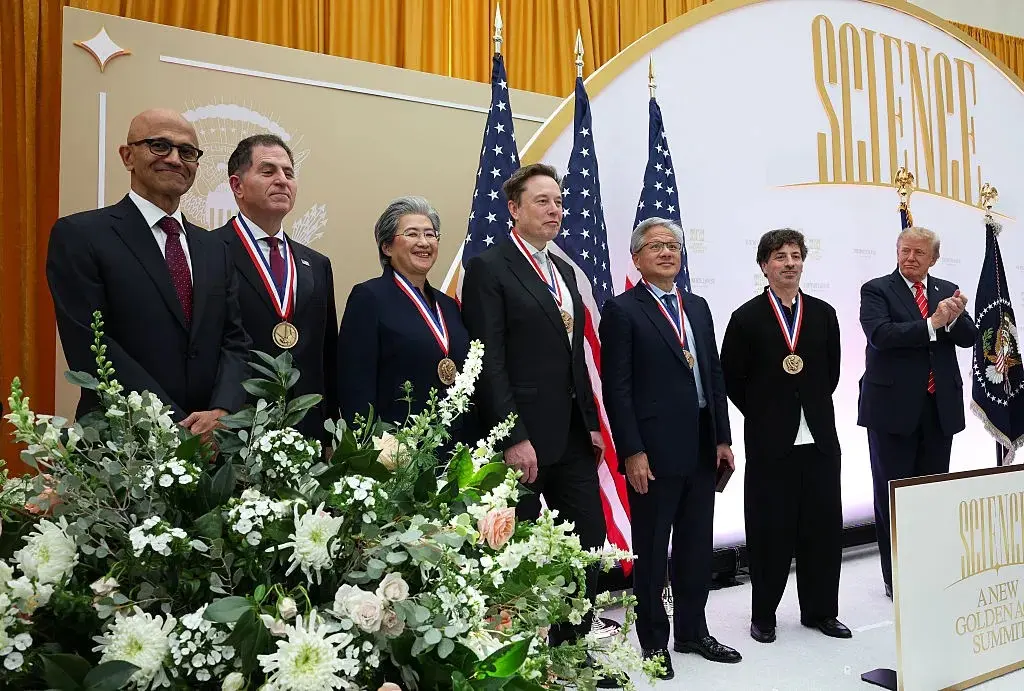
WASHINGTON — In a high-profile ceremony on Thursday at the White House’s Golden Age of American Innovation Summit, President Donald Trump bestowed the United States’ highest scientific and technological honors upon a roster of the world’s most influential tech titans.
Among the recipients of the prestigious National Medal of Science were SpaceX and Tesla CEO Elon Musk, Nvidia CEO Jensen Huang, Alphabet co-founder Sergey Brin, and AMD CEO Lisa Su. Simultaneously, Dell Technologies founder and CEO Michael Dell and Microsoft CEO Satya Nadella were honored with the National Medal of Technology and Innovation.
While the administration framed the event as a celebration of American ingenuity and technological dominance, the ceremony immediately drew intense scrutiny. Public interest watchdogs and investigative reports have highlighted a striking financial convergence: the six distinguished executives and their respective corporate entities have collectively contributed nearly $6 billion toward initiatives, political action committees, and philanthropic programs tied to President Trump and his administration.
This juxtaposition of elite scientific recognition and immense political and financial contributions has ignited a vigorous public debate regarding the intersection of corporate philanthropy, political influence, and government oversight—a narrative further complicated by sweeping regulatory actions unfolding concurrently in Washington.
Executive Overview
The conferring of the National Medal of Science and the National Medal of Technology and Innovation represents the pinnacle of civilian achievement in research, development, and engineering. Traditionally reserved for foundational academic researchers, pioneering mathematicians, and visionary inventors whose breakthroughs have fundamentally altered human capability, the 2026 roster marks a distinct pivot toward corporate leadership and industry giants.
Thursday’s summit, titled the Golden Age of American Innovation Summit, served as the stage for this convergence of statecraft and big tech. President Trump praised the honorees for their central roles in driving the American economy and securing the nation’s technological sovereignty on the global stage.
However, the ceremonial pageantry quickly shared headlines with a more complex reality. Investigative reporting from outlets such as The New Republic and Time revealed that the honorees and their corporate bodies have maintained deep financial ties to the administration. These contributions span a broad spectrum of political giving, including donations to the presidential inauguration fund, underwriting for the construction of the new White House ballroom, contributions to pro-Trump Super PACs, and multi-billion-dollar pledges to the administration’s signature children’s savings initiative, the Trump Accounts.
Compounding the political intrigue, the ceremony took place against a backdrop of shifting regulatory policies. Notably, Microsoft CEO Satya Nadella received his national medal mere hours after the administration announced an indefinite suspension of Microsoft from the H-1B visa program—a vital mechanism allowing U.S. technology companies to recruit specialized foreign talent.
This multi-faceted development highlights an increasingly complex relationship between Silicon Valley leadership and the federal government, where massive investments in national innovation intersect directly with political fundraising and regulatory pressures.
Detailed Chronology of the Summit and Awards
Morning Sessions and Pre-Summit Discussions
The events of Thursday, October 8, 2026, began early with closed-door roundtable discussions between administration officials, federal science advisors, and invited tech executives. The discussions ostensibly centered on maintaining American leadership in artificial intelligence, semiconductor manufacturing, aerospace development, and quantum computing.
According to sources close to the administration, the dialogue focused heavily on public-private partnerships, deregulation, and strategies to secure domestic supply chains against international competitors. Yet, industry insiders noted that the subtext of the morning panels frequently touched upon the shifting regulatory framework governing immigration, antitrust enforcement, and federal contracts.
The Afternoon Ceremony
By mid-afternoon, the summit transitioned to the East Room of the White House, where an invited audience of government officials, industry lobbyists, and press gathered for the formal presentation of the medals.
President Trump entered the room to applause, accompanied by senior administration advisors. In his opening remarks, the president emphasized the symbiotic relationship between American enterprise and state backing. He lauded the assembled executives not merely as corporate leaders, but as architects of the nation’s modern economic and technological infrastructure.
One by one, the recipients were called forward:
- Elon Musk, recognized for his foundational work in electric vehicles, private commercial spaceflight, and satellite communications.
- Jensen Huang, honored for steering Nvidia to the forefront of the artificial intelligence revolution through cutting-edge graphics processing and accelerated computing.
- Sergey Brin, acknowledged for his enduring legacy in organizing the world’s information and pioneering foundational machine learning architectures at Alphabet.
- Lisa Su, celebrated for her transformative leadership at AMD, revitalizing the semiconductor giant and driving high-performance computing forward.
- Michael Dell, receiving the National Medal of Technology and Innovation for decades of hardware manufacturing innovation and enterprise infrastructure scaling.
- Satya Nadella, honored for guiding Microsoft through a massive cloud-computing transformation and positioning the tech giant at the vanguard of generative AI development.
The Immediate Aftermath
The celebratory atmosphere of the East Room sharply contrasted with the rapid dissemination of news outside the White House gates. Within minutes of Nadella accepting his medal, breaking news alerts revealed that the Department of Homeland Security and the Department of Labor had jointly issued an indefinite suspension halting Microsoft’s participation in the H-1B visa program.
The juxtaposition of a prestigious national honor and a punitive administrative action against the same corporate leader underscored the volatile, unpredictable nature of current tech-state relations.
Supporting Context and Financial Metrics
The intersection of technology policy and political finance has long been a subject of study for political scientists, but the scale of financial alignment surrounding the 2026 honorees represents a distinct chapter in modern U.S. politics.

Breakdown of Contributions and Pledges
According to comprehensive tracking by investigative journalists, the total financial contributions and pledges linked to the award recipients and their corporate entities approach the $6 billion mark. These funds are distributed across several distinct vehicles:
- Philanthropic and National Infrastructure Pledges:
- Michael and Susan Dell: Pledged a staggering $6.25 billion to fund the "Trump Accounts," the federal administration’s newly established savings and investment program targeted at American children. This massive pledge constitutes the lion’s share of the cumulative financial footprint associated with the honorees.
- Inaugural and White House Funding:
- Alphabet (Google) and Microsoft: Both corporate entities, along with individual executives, made substantial financial contributions to the presidential inauguration fund. Furthermore, corporate contributions were directed toward the financing and construction of the newly commissioned White House ballroom.
- Political Action Committees (PACs):
- AMD and Associated Leadership: Representatives and associated entities linked to AMD directed significant financial support toward pro-Trump Super PACs, aiming to secure political alignment during critical legislative cycles involving semiconductor subsidies and trade tariffs.
The Debate Over Merits Versus Donations
The timing and scale of these financial contributions have fueled intense skepticism across the political spectrum. Critics argue that bestowing the nation’s highest scientific and technological honors upon major political donors risks cheapening the awards’ historical prestige.
Historically, the National Medal of Science—established by an Act of Congress in 1959—was awarded to luminaries such as Vannevar Bush, Linus Pauling, and Barbara McClintock: individuals whose lives were dedicated to pure scientific inquiry and academic discovery. Transitioning these honors toward corporate executives, many of whom are simultaneously engaged in high-stakes lobbying and massive political fundraising, blurs the line between public service and corporate patronage.
Conversely, supporters of the administration argue that modern technological innovation is inextricably linked to private enterprise, capital allocation, and large-scale risk-taking. Proponents assert that leaders like Musk, Huang, Su, Dell, Brin, and Nadella have generated trillions of dollars in shareholder value, created millions of American jobs, and ensured that the United States maintains its technological hegemony against geopolitical rivals such as China. From this perspective, recognizing these executives with national medals is a pragmatic acknowledgment of their role as economic and technological generals.
Official Statements and Public Reactions
The White House summit and subsequent awards ceremony elicited strong, polarized reactions from policymakers, industry analysts, and the public.
Administration Defense
During the summit, President Trump forcefully defended the administration’s recognition of the tech leaders, framing their success as proof of American superiority.
"These extraordinary leaders have pioneered an incredible future for America," President Trump stated during his address. "Because of their vision, their grit, and their unwillingness to back down, we will always be on top. No one else can compete with us."
Administration officials pushed back against suggestions of a quid pro quo regarding the financial contributions and the medals. A senior White House spokesperson emphasized that the awards were evaluated strictly on the basis of economic impact, job creation, and technological advancement.
Industry and Critic Responses
Reaction from Capitol Hill and watchdog organizations was sharply critical. Several prominent lawmakers released statements questioning the ethics of awarding top civilian honors to individuals and corporations that have funneled billions of dollars into presidential initiatives and political funds.
"When the line between national honors and political donations is erased, the integrity of our national institutions suffers," said a prominent government accountability advocate. "These awards should recognize selfless contributions to human knowledge, not the transactional nature of modern political fundraising."
Meanwhile, Silicon Valley analysts noted the palpable tension surrounding Nadella’s recognition. Microsoft’s sudden suspension from the H-1B visa program sent immediate shockwaves through the tech sector, raising urgent questions about how the administration plans to balance its rhetoric of technological nationalism with the industry’s deep reliance on global talent.
Microsoft representatives declined to comment immediately on the H-1B suspension, focusing instead on Nadella’s appreciation for the technological recognition bestowed upon the company’s workforce and leadership.
Future Outlook: The Intersection of Tech, Capital, and Policy
As the dust settles on the Golden Age of American Innovation Summit, the events of October 8, 2026, will likely serve as a watershed moment for the relationship between the federal government and the technology sector.
Regulatory Uncertainty and Immigration Policies
The abrupt suspension of Microsoft from the H-1B program signals that the administration remains willing to deploy aggressive regulatory and administrative tools against major tech firms, regardless of personal honors or financial contributions. For an industry that relies heavily on foreign engineering talent to maintain its competitive edge in artificial intelligence and cloud infrastructure, the uncertainty surrounding visa programs poses a profound strategic challenge.
Industry analysts expect tech companies to ramp up their legal and lobbying efforts in Washington, navigating a complex landscape where political alignment with the executive branch does not automatically grant immunity from stringent regulatory enforcement.
The Evolution of Public-Private Partnerships
Looking forward, the massive financial commitments highlighted during the summit—such as the Dell-backed Trump Accounts and corporate-funded infrastructure projects—point toward a future where private capital increasingly shoulders the burden of social and public initiatives in exchange for regulatory favor and state recognition.
Whether this model of techno-capitalism will foster a sustainable "golden age" of American innovation or deepen concerns regarding corporate influence in democratic governance remains one of the defining questions of the decade. What is certain is that the ties binding Silicon Valley’s executive suites to the halls of Washington have never been more visible, nor more heavily scrutinized.









Belum ada komentar. Jadilah yang pertama berkomentar!