

Executive Overview
As the back-to-school season descends upon households worldwide, the familiar, frantic rhythm of domestic life kicks into overdrive. The modern household operates much like a small, highly complex corporation. Juggling professional commitments, academic schedules, medical appointments, athletic practices, and household chores on a traditional paper calendar or a fragmented assortment of smartphone apps has become an unsustainable operational model. Traditional pen-and-paper planners lack real-time synchronization, while individual mobile applications frequently result in siloed communication, missed events, and domestic friction.
Enter the smart domestic command center market—a rapidly growing niche designed to bring digital order to physical living spaces. Among the emerging contenders, Linkdaze has captured significant attention with its touchscreen digital calendar. Launched last December, the hardware ecosystem is specifically architected to manage an entire household rather than an individual user. By bridging the gap between disparate calendar platforms, introducing innovative artificial intelligence features like "Snap-to-Sync," and bucking the industry-standard subscription model, Linkdaze is positioning itself as a formidable alternative to established market heavyweights such as Skylight.
This comprehensive report examines the technical capabilities, market positioning, pricing strategies, and broader implications of the Linkdaze smart calendar ecosystem. Through an analysis of its cross-platform synchronization, AI-driven meal planning, and aggressive cost structure, we explore whether this hardware offering can successfully redefine how families and shared living spaces coordinate their daily lives.
Detailed Chronology of the Smart Domestic Command Center
The Evolution of Household Organization
For decades, the refrigerator door served as the ultimate information hub of the home. Magnetic whiteboards, paper tear-away calendars, sticky notes, and school permission slips formed a chaotic mosaic of domestic logistics. While digital smartphones offered a powerful alternative, they exacerbated a distinct problem: decentralization. In a four-person household, one parent might rely on Apple iCloud, the other on Google Calendar, older children on school-issued Outlook accounts, and everyone on a mishmash of text messages and group chats.
Recognizing this friction point, tech manufacturers began developing wall-mounted smart displays tailored explicitly for family organization. Brands like Skylight pioneered the category, establishing that consumers were willing to pay for dedicated hardware that centralized family schedules into a single, always-on touchscreen display. However, these early iterations often came with caveats, including steep upfront hardware costs and mandatory recurring software subscriptions to unlock advanced features.
The Launch and Rise of Linkdaze
Entering this competitive landscape in December, Linkdaze approached the market with a two-pronged strategy: hardware flexibility and cost transparency. Available in two distinct form factors—a spacious 15.6-inch model and a more compact 10.1-inch model—the Linkdaze system was engineered to adapt to varying spatial constraints within kitchens, hallways, and mudrooms.
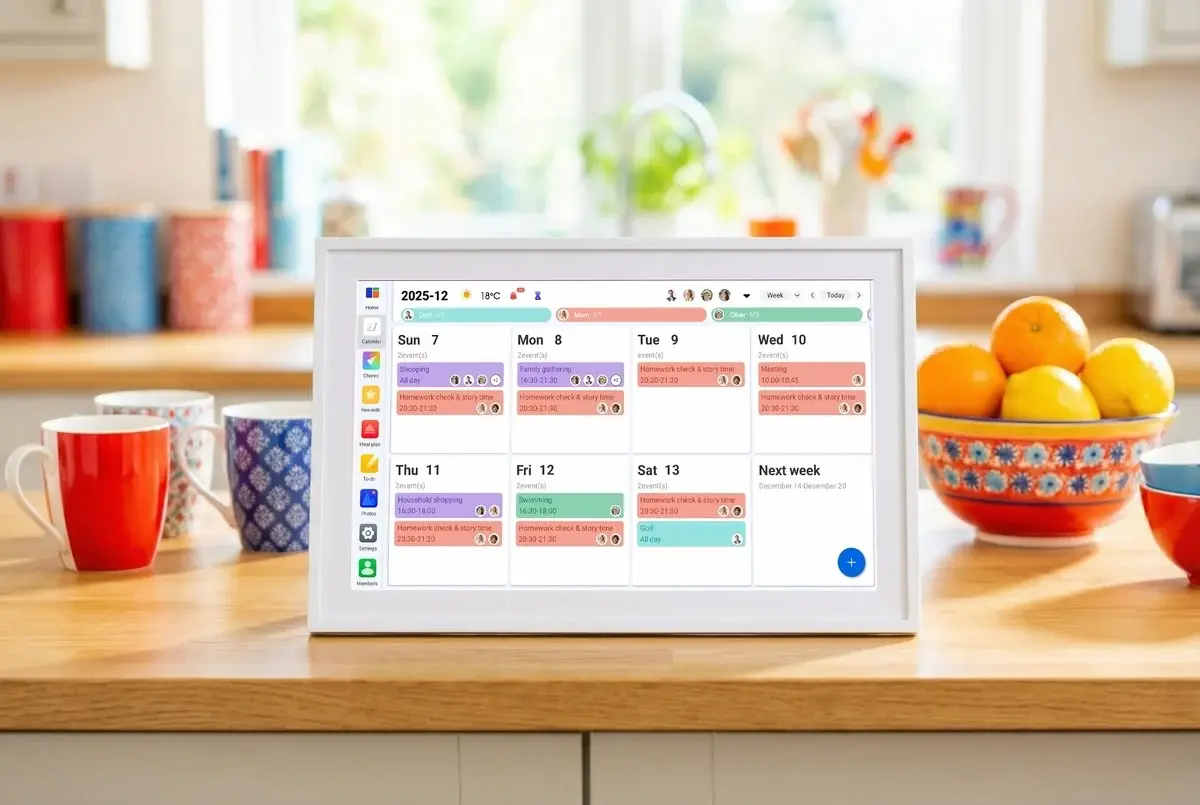
Rather than requiring users to abandon their preferred digital ecosystems, Linkdaze prioritized universal compatibility from day one. The platform integrated deeply with major calendar infrastructures, including Google, iCloud, Outlook, Yahoo, and specialized family-organization applications like Cozi. By consolidating these separate digital trails onto a single interface and applying intuitive color-coding, Linkdaze addressed the core pain point of domestic communication breakdowns without forcing behavioral changes on individual family members.
Furthermore, the brand expanded the utility of its hardware beyond simple time management. Recognizing that a smart display affixed to a prominent wall space must serve multiple functions to justify its footprint, Linkdaze incorporated chore tracking, reward systems, interactive shopping lists, and a digital photo frame mode capable of cycling through family memories when idle.
Supporting Context, Technical Metrics, and Feature Analysis
Cross-Platform Synchronization and Interface Design
The technical backbone of the Linkdaze system relies on its ability to ingest, aggregate, and display disparate data streams in real time. In a typical deployment, a parent’s work calendar from Outlook, a partner’s personal schedule from Google, and a child’s school calendar from Apple iCloud are fed simultaneously into the Linkdaze interface.
To prevent visual clutter, the system employs a sophisticated color-coding taxonomy. Each family member is assigned a distinct hue, allowing anyone walking past the display to instantly parse who needs to be where, and when. This passive awareness drastically reduces the mental load traditionally placed on a single "household manager"—a role historically disproportionately assumed by mothers—who previously had to field constant questions about logistics.
"Snap-to-Sync": The AI Meal Planning Breakthrough
While time management remains the primary use case for smart displays, Linkdaze’s most differentiating technical feature is its proprietary artificial intelligence tool known as "Snap-to-Sync."
Meal planning and grocery shopping represent two of the most time-consuming domestic chores. Traditionally, digital calendar and meal-planning apps require tedious manual data entry—typing out recipes, cross-referencing dietary restrictions, and manually building shopping lists item by item. Linkdaze bypasses this friction entirely through computer vision and generative AI.
With "Snap-to-Sync," users can physically photograph a paper recipe torn from a magazine, a handwritten family cookbook entry, or a school lunch menu sent home in a backpack. The Linkdaze device processes the image, extracts the culinary data, automatically translates it into a structured digital meal plan, and instantly generates a synchronized shopping list. While the underlying concept of OCR (Optical Character Recognition) and AI recipe parsing is not entirely novel in the broader software ecosystem, integrating it directly into a wall-mounted kitchen hardware display represents a significant leap forward in practical, hands-off household automation.

The Subscription Debate: Challenging the SaaS Business Model
In the modern consumer electronics landscape, Software-as-a-Service (SaaS) subscription models have become the default monetization strategy. Companies frequently sell hardware at or near cost, relying on recurring monthly or annual fees to ensure continuous revenue and fund ongoing software development.
In the smart family calendar sector, this trend has been normalized by competitors like Skylight, which charges an annual subscription fee (approximately $79 per year) to access advanced cloud-backed features and extended functionalities.
Linkdaze has taken a distinctly contrarian path by refusing to gate its core functionality behind a paywall. For consumers experiencing subscription fatigue—where streaming services, cloud storage, software utilities, and fitness apps nickel-and-dime household budgets on a monthly basis—the absence of recurring fees serves as a powerful purchasing incentive.
This decision represents a calculated gamble by Linkdaze management. In a crowded smart-display market, offering a robust feature set without a subscription either establishes a profound competitive differentiator that captures significant market share or introduces a constrained revenue stream that limits aggressive long-term software research and development. From the consumer’s perspective, however, the upfront purchase represents a complete, unbundled transaction.
Pricing and Hardware Tiers
When evaluated against its primary competitors, the pricing architecture of Linkdaze is aggressively competitive:
- Linkdaze 10.1-Inch Model: Retails at an MSRP of $119.99, with promotional retail placements frequently reducing the cost further (such as promotional discounts bringing the unit price down to approximately $66 on major e-commerce platforms like Amazon).
- Linkdaze 15.6-Inch Model: Designed for larger households or spaces with expansive wall real estate, offering maximum legibility from a distance.
- Competitor Benchmark (e.g., Skylight 10-Inch Model): Base hardware units start around $149.99 when factoring in or bundling required subscription tiers, placing a higher total cost of ownership on the end user over a multi-year lifecycle.
Market Implications and Diverse Use Cases
While marketed primarily toward busy parents navigating the academic year, the utility profile of the Linkdaze ecosystem extends well beyond the traditional nuclear family.
1. Modern Families and Multi-Generation Households
For households managing complex logistics involving both school-aged children and aging relatives, the centralized display acts as an operational anchor. Caregiver schedules, medical appointments, and transportation logistics can be shared transparently among siblings and professional aides without requiring endless group text threads.
2. College Apartments and Shared Living Spaces
Young adults and college students sharing off-campus housing frequently struggle with the division of labor. Coordinating cleaning rotas, shared grocery expenses, study sessions, and social calendars can become a flashpoint for roommate friction. A wall-mounted, subscription-free touchscreen provides an accountable, neutral ground where roommates can negotiate and visualize shared responsibilities.
3. Remote Professionals and Digital Nomads
For freelancers, entrepreneurs, and remote workers juggling multiple client deadlines, content publishing schedules, and interview commitments alongside personal life, smart calendars offer an ambient productivity boost. Glancing up from a desk to check daily milestones without unlocking a smartphone helps maintain deep work focus while minimizing context-switching fatigue.
Future Outlook
As smart home technology evolves beyond voice assistants and automated lighting, the domestic command center is cementing its place as an essential category of consumer hardware. The success of devices like Linkdaze points toward a future where hardware integration and software openness are valued above artificial ecosystem lock-in.
Moving forward, the primary challenge for Linkdaze will be sustaining its competitive edge in a fast-moving market. Without ongoing subscription revenue, the company must rely on hardware turnover, expanding accessory ecosystems, or enterprise partnerships to fund future iterations of its AI-driven features. Furthermore, as competitors inevitably experiment with similar AI integration tools like "Snap-to-Sync," Linkdaze will need to continuously refine its computer vision accuracy and expand its software partnerships to maintain its value proposition.
For consumers currently drowning in the logistical undertow of the back-to-school season, however, the immediate calculus is straightforward. By offering a subscription-free, multi-platform, AI-enhanced window into the chaotic moving parts of daily life, Linkdaze has delivered a practical, cost-effective antidote to modern domestic disorganization.
This article was adapted from initial reporting published on August 20, 2026. Editorial independence is strictly maintained; affiliate commissions earned through embedded product links do not influence the analytical integrity or evaluative conclusions of this publication.









Belum ada komentar. Jadilah yang pertama berkomentar!