

Executive Overview
By the close of 2026, cybersecurity had permanently graduated from the IT basement to the C-suite and the geopolitical war room. As the year unfolded, it became abundantly clear that digital infrastructure is no longer a separate, isolated domain of human activity. Rather, it is the underlying bedrock upon which modern global society operates.
While perennial geopolitical tensions, deepening socioeconomic inequalities, and persistent health threats loomed large over the global stage, a turbulent digital current consistently ran beneath them all. Wars were fought just as fiercely on digital fronts as on physical battlefields; governments weaponized citizens’ personal data against them; automated botnets subtly eroded democratic processes; nation-state actors targeted vital civilian infrastructure, from water systems to energy grids; and aggressive ransomware syndicates routinely held multi-billion-dollar institutions hostage. The attacks of 2026 grew demonstrably bolder, more destructive, and significantly harder to contain than those of any previous era.
As the international community moved into the final quarter of this tumultuous year of hybrid warfare and unprecedented data breaches, a sobering review of the period’s most severe cyber-incidents reveals systemic vulnerabilities. These events not only reshaped the corporate landscape but also fundamentally challenged national security paradigms across the globe.
Detailed Chronology of Major Incidents
1. The Shadow of DOGE: The Social Security Administration Exposure
More than a year after operatives associated with the Elon Musk-led Department of Government Efficiency (DOGE) swept through federal agencies to dismantle them from the inside, the full scope of the resulting data lapses continues to emerge.
Following DOGE’s intervention at the Social Security Administration, ongoing federal court battles have struggled to clarify the exact destination and fate of some of the nation’s most sensitive data. The most alarming allegation, raised by a federal whistleblower, suggests that DOGE uploaded a live, unmasked copy of the Social Security database to an unsecured third-party server. This repository allegedly contained the Social Security numbers and deeply personal identification data of the vast majority of living Americans.
While the Social Security Administration stated in court filings that it could not fully verify the contents of the compromised server, it admitted that DOGE had signed an agreement with an outside political advocacy group under the pretense of searching for evidence of voter fraud. This occurred despite repeated claims by the administration lacking empirical support. Cybersecurity experts and lawmakers expressed grave fears that the database could be repurposed to target citizens for spurious reasons. Two senior House Democrats leading the investigation into DOGE’s activities characterized the exposure as a candidate for "the largest data breach in our nation’s history."
2. Physical Chaos: Targeting U.S. Water Systems and European Energy Grids
A dangerous escalation in 2026 was the direct targeting of civilian lifelines, bridging the gap between digital incursions and physical destruction. Across Europe, a wave of cyberattacks targeted power plants and water dams in what security researchers identified as a troubling trend of hybrid warfare.
Attacks largely attributed to Russian actors sought to cause tangible harm to civilian populations. Late last year, Poland’s energy grid was struck with destructive wiper malware, a tactic mirrored in attacks against a Swedish thermal plant and a Norwegian dam that inadvertently discharged massive volumes of water. Earlier this year, Russian hackers breached Polish water treatment plants, confirming that Moscow’s aggressive posturing extended deep into civilian municipal systems.

Concurrently, fallout from geopolitical conflicts in the Middle East prompted Iranian-aligned hackers to execute opportunistic strikes against critical infrastructure across the United States. The Cybersecurity and Infrastructure Security Agency (CISA) confirmed that Iranian operators targeted over 100 water providers over the summer. Privately owned water utilities proved particularly vulnerable, often struggling with chronic underfunding and foundational cybersecurity deficits.
3. The Klue Cascade and the Extortion Economy
Market intelligence provider Klue became the epicenter of one of the broadest corporate supply chain breaches of the year, impacting nearly 200 companies, including prominent cybersecurity firms such as Jamf, HackerOne, and LastPass. The breach occurred less than a year after Klue laid off half of its workforce to pivot heavily toward artificial intelligence integration.
An extortion gang known as "Icarus" breached Klue’s systems by exploiting a static API credential issued during a limited pilot program back in 2022. This meant Klue had maintained an unmonitored, active backdoor for roughly four years. The attackers used this credential to harvest cloud service keys belonging to Klue’s customers, subsequently breaking into downstream environments to steal proprietary data stores and demand exorbitant ransoms.
Despite universal industry guidelines advising against yielding to cybercriminals, Klue reportedly reached a private agreement with the Icarus gang to prevent the publication of stolen data. However, the hackers added a cynical twist, notifying victims that a secondary, unrelated hacking collective had also acquired a portion of the customer data and was preparing independent extortion demands.
4. Meta’s AI Chatbot Exploitation
The line between a technical exploit and social engineering blurred early in the year when thousands of high-profile Instagram accounts were hijacked not through advanced malware, but by simply asking Meta’s proprietary AI chatbot for access.
Discovered initially by security researchers at 404 Media, the exploit leveraged Meta AI’s account recovery protocols. Attackers posed as targets within the chatbot interface, falsely claiming they had been locked out of their accounts. By instructing the AI to dispatch a password reset code to an attacker-controlled email address, malicious actors bypassed traditional security checkpoints entirely.
Tens of thousands of accounts were compromised before Meta patched the vulnerability. The incident represented a profound, embarrassing failure of trust and governance for a leading technology titan as it rushed to integrate generative AI tools into consumer-facing platforms.
5. National Security Breaches: The FBI and ATF Incidents
Federal law enforcement agencies were not immune to the year’s digital onslaught. In April, the Federal Bureau of Investigation (FBI) formally declared a "major cyber incident," triggering mandatory disclosures to Congress after detecting a breach within one of its core surveillance systems. The intrusion reportedly exposed sensitive phone numbers and metadata related to targets under active federal wiretap investigations.

Chinese state-sponsored espionage groups were widely suspected of penetrating the unclassified network, which housed delicate investigative parameters such as pen register returns. Because the breach mandated congressional notification, it crossed the high-water mark of causing demonstrable harm to U.S. national security.
Months later, in August, the Bureau of Alcohol, Tobacco, Firearms and Explosives (ATF) confirmed a parallel "major incident." A ransomware syndicate claimed responsibility for compromising an internal database containing profiles and details of subjects under ATF investigation.
6. The Software Supply Chain Meltdown
The open-source software ecosystem faced relentless, overlapping campaigns that weaponized developer tools to compromise downstream enterprise environments. Widely used security utilities—including Aqua Security’s Trivy scanner, Bitwarden’s command-line interface, and Checkmarx packages—were backdoored by malicious actors.
These compromises allowed attackers to harvest authorization tokens, credentials, and cryptographic keys from developer workstations. The tainted updates served as a springboard into major technology enterprises, enabling downstream breaches at organizations like OpenAI and Vercel. The European Union’s cybersecurity agency subsequently confirmed a massive data leak stemming from stolen cloud access keys. In August, Australian law enforcement authorities arrested two individuals linked to the notorious "TeamPCP" collective, which had orchestrated several of these supply chain heists.
7. The IDScan Catastrophe and Identity Document Spills
An immense data breach at identity verification firm IDScan threatened the privacy of virtually every driver in North America. Hackers established a dark web search engine capable of querying the personal photos and details of 150 million drivers across the United States and Canada.
This catastrophic leak compounded an already dismal year for personal identification security. Throughout 2026, various institutional lapses exposed more than 2 million sensitive documents:
- A hotel check-in system inadvertently published one million passports and driver’s licenses.
- A Canadian money transfer application left identity documents exposed on an unprotected Amazon server.
- A prison payphone provider leaked over 300,000 caller driver’s licenses.
- A U.K. visa portal exposed thousands of applicant passports and biometric selfies online.
These systemic failures undermined the very logic of "Know Your Customer" (KYC) mandates and emerging digital age-verification laws. As cybercriminals populate underground databases with millions of pristine identity scans, the utility of biometric and document-based verification systems is rapidly deteriorating.
8. Healthcare Sector Paralysis and DentaQuest
The healthcare sector absorbed crippling blows throughout 2026, impacting tens of millions of patients. The single largest healthcare breach of the year struck insurance giant DentaQuest, compromising the health records of 15 million individuals. Concurrently, an intrusion at CareCloud—a host of electronic patient medical records—exposed the sensitive data of at least 3.7 million patients. These incidents followed a late-previous-year breach at billing titan Aesto Health, which ultimately affected 9.5 million patients across dozens of dependent medical practices.

9. Hasbro’s Operational Blackout
Toy manufacturing giant Hasbro offered a masterclass in corporate unpreparedness when an undetected intrusion forced the 103-year-old enterprise offline for weeks. Unable to process orders or maintain public-facing web infrastructure, Hasbro was forced to delay its quarterly filings with the Securities and Exchange Commission (SEC) while emergency incident responders purged its network. Although the company announced in May that threat actors had been successfully evicted, the financial and reputational fallout highlighted the vulnerability of traditional consumer goods corporations to modern ransomware and extortion operations.
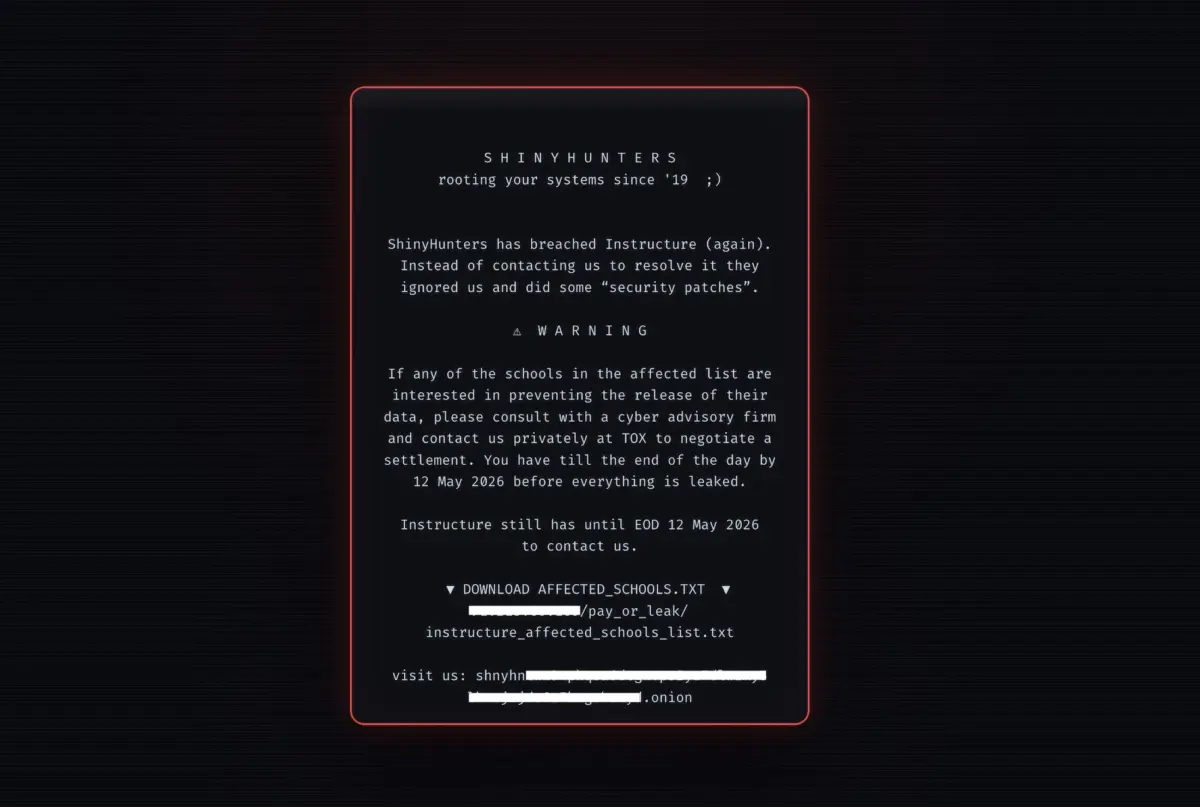
10. Instructure Canvas Defacements by ShinyHunters
The prolific extortion group ShinyHunters continued its aggressive campaign using sophisticated voice-phishing (vishing) techniques, masquerading as internal IT personnel or distressed employees to manipulate corporate help desks into handing over system access.
Education technology titan Instructure bore the brunt of this campaign when ShinyHunters breached Canvas, its flagship learning management system, compromising the private data of over 30 million students and faculty members. When Instructure initially resisted ransom demands, the hackers struck a second time, defacing Canvas login portals across the United States precisely during final exam week. The disruption paralyzed academic assessments nationwide, eventually forcing Instructure to yield and pay the ransom against federal recommendations. The group also claimed credit for multi-million-record thefts at internet provider Charter and Carnival Cruise Line.
11. Destructive Attacks on Medical Device Manufacturers: Stryker and Boston Scientific
In a departure from traditional espionage and data exfiltration, nation-state and proxy actors turned toward kinetic digital destruction. In March, Iranian-aligned hacktivist group "Handala" breached medical technology manufacturer Stryker, remotely wiping tens of thousands of employee endpoints in a single coordinated action. The attack severely disrupted global operations and materially impacted the firm’s first-quarter earnings.
In August, medical device manufacturer Boston Scientific suffered a parallel catastrophe. A sophisticated cyberattack disabled its global network, halting the production and distribution of critical life-saving equipment, including cardiac pacemakers. While the immediate operational outage was contained within two weeks, the downstream recovery timeline extended deep into the autumn months.
Supporting Context & Metrics
The collective weight of these incidents illustrates a profound economic and operational shift. According to preliminary metrics compiled by global incident response firms, the average cost of a corporate data breach in 2026 surpassed previous historical highs, driven largely by:
- The Rise of Destructive Wiperware: Moving beyond silent espionage, 27% of nation-state-attributed attacks incorporated destructive elements designed to render hardware permanently inoperable.
- Supply Chain Multiplication: A single compromised open-source package or third-party vendor credential (as witnessed in the Klue and Trivy incidents) now cascades downward to compromise an average of 35 downstream enterprise clients.
- Extortion Payout Realities: Despite government interdiction efforts and active threats of legal prosecution under sanctions laws, an estimated 42% of targeted corporations opted for quiet extortion settlements to prevent catastrophic operational downtime or public data dumps.
Official Statements and Regulatory Responses
Governments worldwide responded to the 2026 cyber crisis with a mix of legislative crackdowns and law enforcement victories.
The successful August operation by Australian federal police—which resulted in the apprehension of key architects behind the TeamPCP supply chain attacks—marked a rare bright spot for international law enforcement collaboration. CISA Director statements throughout the summer emphasized the acute vulnerability of municipal water utilities, prompting emergency directives requiring mandatory baseline security audits for privately held infrastructure operators.

Meanwhile, regulatory bodies such as the U.S. Securities and Exchange Commission faced mounting pressure to enforce disclosure mandates strictly, particularly following delayed filings from corporations like Hasbro. Lawmakers in Washington and Brussels alike signaled that voluntary compliance frameworks are nearing their expiration date, with mandatory minimum security baselines for critical software development increasingly viewed as an inevitable regulatory horizon.
Future Outlook: Navigating the Post-Resilience Era
As the global community reflects on the watershed events of 2026, the traditional concept of "cybersecurity resilience" requires a fundamental rewrite. Organizations can no longer operate under the assumption that perimeter defenses will hold; the sheer proliferation of AI-driven social engineering, supply chain backdoors, and state-sponsored wiper attacks dictates a strategy centered on zero-trust architecture and rapid operational recovery.
The normalization of hybrid warfare—where water treatment facilities, school exam portals, and medical pacemaker manufacturers find themselves on the front lines of geopolitical disputes—signals that the digital domain has become indistinguishable from physical security.
Looking forward, the proliferation of centralized digital identity verification models will remain a volatile risk vector. Until organizations, software vendors, and sovereign governments adopt uncompromisable data hygiene standards, the events of 2026 will serve not as an anomalous outlier, but as the turbulent baseline of a permanently altered digital age.









Belum ada komentar. Jadilah yang pertama berkomentar!