

Executive Overview
In the fast-paced, fiercely competitive landscape of Japanese convenience store (konbini) culture, innovation is the ultimate currency. From gourmet egg salad sandwiches to seasonal mochi confections, chains like Lawson, FamilyMart, and 7-Eleven constantly battle for the palates and attention spans of millions of daily consumers. However, every so often, a product transcends the standard culinary rotation of the everyday commuter to become a full-scale cultural phenomenon.
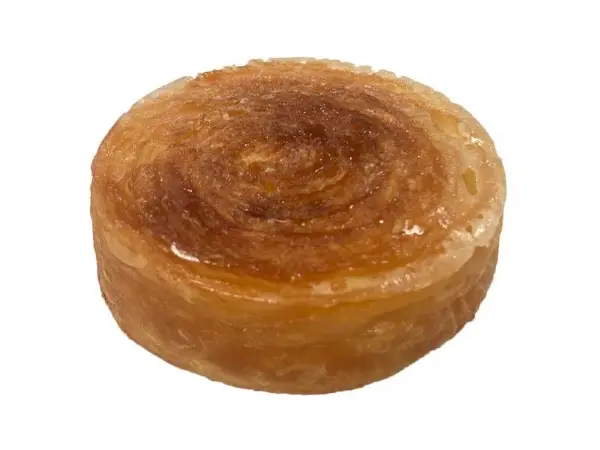
Enter the "Karikku Juwassan"—an unorthodox, flattened, disc-shaped pastry that recently took Japanese social media by storm.
Combining the Japanese onomatopoeia for crispiness (karikku), the sensory description of butter-dripping moisture (juwa), and a linguistic truncation of the French staple croissant (wassan), this unconventional baked good has redefined expectations for convenience store fare. When it first debuted in May, it shattered sales records, instantly claiming the top spot in the Seven Cafe Bakery category during its launch week.
Following a wave of public disappointment when its limited-run window closed, and subsequent floods of digital petitions demanding its return, 7-Eleven Japan has officially capitulated to consumer demand. The Karikku Juwassan has returned to shelves nationwide for a strictly limited engagement starting August 19. Priced affordably at 230 yen (approximately $1.55 USD), the pastry offers a masterclass in modern baking science and digital marketing synergy, proving that even a humble konbini can spark a viral food craze.
Detailed Chronology: From Concept to Viral Sensation and Return
To understand the trajectory of the Karikku Juwassan is to understand the modern lifecycle of a viral food product in the digital age. The journey of this rebellious pastry is marked by strategic rollouts, instantaneous digital validation, and unprecedented consumer pushback.
The May Debut: A Quiet Launch with Explosive Results
When 7-Eleven initially introduced the Karikku Juwassan in mid-May, it was treated as a standard seasonal experiment within the Seven Cafe Bakery line. Conceived as a fresh-baked item to be housed in dedicated in-store ovens, the product was designed to target morning commuters and afternoon snack-seekers looking for something beyond the traditional red-bean buns and melon bread.
However, within days of its launch for the week of May 18, sales metrics told a different story. The Karikku Juwassan outperformed every legacy item in its category, setting a new benchmark for launch-week popularity. 7-Eleven’s internal analytics quickly flagged the item as an outlier, while food bloggers, Instagram influencers, and TikTok creators began documenting the pastry’s bizarre aesthetic and complex texture.
The Digital Backlash: FOMO and the Cry for More
True to the nature of limited-edition konbini items in Japan, the Karikku Juwassan vanished from shelves almost as quickly as it arrived. This manufactured scarcity ignited a wave of Fear Of Missing Out (FOMO) across social media platforms like X (formerly Twitter) and Instagram.
Users who had missed out on the initial window posted lamentations, while those who had tasted it shared glowing reviews accompanied by close-up macro shots of its glistening, caramelised crust. As the weeks pressed on into early summer, corporate headquarters at 7-Eleven began receiving an unusual volume of direct inquiries and customer service requests demanding a single outcome: the resurrection of the flat croissant.
The August Revival
Recognizing the enduring momentum of the online discourse, 7-Eleven made the strategic decision to bow to public pressure. Announced for a revival starting August 19, the second coming of the Karikku Juwassan was engineered not just as a product restock, but as a deliberate capitalization on pre-existing digital hype. Food critics and routine konbini shoppers alike braced themselves for another rush on the limited daily batches, cementing the pastry’s status as the undisputed heavyweight champion of the summer 2026 convenience store snack roster.
Supporting Context & Metrics: The Anatomy of an Unorthodox Pastry
To purists of French baking, the Karikku Juwassan is borderline heresy. Traditional croissants demand volume, a towering honeycomb crumb structure, and an aerodynamic crescent silhouette designed to scatter flaky layers with every bite. The Karikku Juwassan rejects all of these conventions.
Defying Tradition: Form Meets Function
Flat, moist, and rounded like a dense pastry scroll or a flattened disk, the Karikku Juwassan looks less like a product of Parisian patisseries and more like an edible work of modern minimalist architecture. Yet, it is precisely this radical departure from form that initially captured the attention of internet scrollers. In an ecosystem saturated with thousands of identical food products, visual disruption is the key to stopping a user’s frantic thumb-scroll.
The Engineering of Texture: Three Tastes in One Bite
Beneath its unconventional exterior lies a remarkably sophisticated baking process. The foundation of the Karikku Juwassan rests upon specialized pastry sheets infused with rich, high-grade fermented butter. Rather than relying on simple rolling techniques, the dough is meticulously folded into 16 distinct layers, creating a complex internal architecture designed to trap moisture and fat.
Upon delivery to participating branches, the pastries are cooked in dedicated, in-store ovens. This ensures that customers receive items that approximate the experience of visiting a traditional artisanal bakery rather than unwrapping a mass-produced, pre-packaged snack.
Before hitting the heat, the surface of the dough is generously dusted with granulated sugar. As the pastries bake, this sugar undergoes intense caramelization, fusing with the bubbling butter to create a glassy, intensely crunchy exterior shell.
Food scientists and culinary reviewers have broken down the tactile experience of the Karikku Juwassan into three distinct sensory phases:
- The Crunch (Karikku): The initial bite shatters the caramelized sugar shell, providing an audible, highly satisfying crispness.
- The Butter Infusion (Juwa): As the teeth sink deeper, the inner 16 layers release trapped pools of fermented butter, flooding the palate with a rich, savory moisture that justifies the descriptor "sinfully delicious."
- The Chew: The core of the dough retains a dense, satisfyingly chewy resilience, balancing the brittle exterior and the melting butter.
Economic and Logistical Realities
Priced at an accessible 230 yen (approximately $1.55 USD), the Karikku Juwassan occupies the sweet spot of impulse-buy economics. However, acquiring one is not always straightforward. Because these pastries require dedicated in-store baking infrastructure and are produced in strictly limited daily batches, they are only available at select participating Seven Cafe Bakery locations across Japan. This localized scarcity further fuels the digital hype cycle, turning a routine convenience store run into a high-stakes treasure hunt.
Official Statements and Industry Perspective
While 7-Eleven Japan maintains a tightly managed corporate communication strategy, the retail giant has not shied away from leaning into the sensory appeal of its viral creation.
In official promotional materials distributed via PR Times, the corporation described the unique textural interplay of the pastry as "sinfully delicious." This provocative marketing language was intentionally chosen to bridge the gap between wholesome, everyday comfort food and indulgent, guilt-ridden dessert culture—a duality that plays exceptionally well on visual-first social media platforms.
Industry analysts view the Karikku Juwassan as a masterclass in modern konbini agility. In a market where consumer preferences shift at the speed of a viral algorithm, traditional product development cycles of six months to a year are increasingly obsolete. By monitoring real-time sentiment analysis and rapidly responding to consumer petitions with a secondary release window, 7-Eleven has demonstrated a sophisticated understanding of digital-age retail economics.
Furthermore, food retail commentators note that viral items like the Karikku Juwassan act as a "halo product" for the wider store ecosystem. When consumers venture into a participating 7-Eleven branch in search of the elusive flat croissant, they frequently impulse-buy complementary items, such as the recently popular freshly-baked melon pan cookies or specialty Seven Cafe drip coffees, driving up overall basket sizes across the board.
Future Outlook: What the Karikku Juwassan Means for the Future of "Konbini" Culture
The runaway success of the Karikku Juwassan signals a broader, permanent shift in how Japanese convenience stores approach product innovation, marketing, and consumer engagement.
The Rise of "Insta-Food" Engineering
Konbini items have long been celebrated for their astonishing baseline quality, offering culinary standards that easily rival standalone restaurants and bakeries at a fraction of the cost. However, the Karikku Juwassan proves that baseline quality is no longer enough. To capture the elusive Gen Z and millennial demographic, products must now be engineered with built-in "visual friction"—aesthetic quirks that demand to be photographed, recorded, and shared online.
As food scientists and product developers at convenience store giants look toward the future, we can expect to see an increase in intentionally disruptive food designs. Whether through texture-defying cross-pollinations of global pastries or hyper-sensory flavor profiles, the race to create the next viral konbini sensation has officially escalated.
Will the Trend Go Global?
As social media platforms like TikTok and Instagram flatten global culinary borders, viral food trends in Tokyo now have an immediate international audience. Foreign tourists visiting Japan have increasingly made convenience store food crawls a core part of their travel itineraries, frequently documenting their hunts for items like the Karikku Juwassan.
While supply chain constraints and the need for dedicated in-store baking ovens make an immediate international rollout unlikely, the global appetite for Japanese convenience store innovations has never been higher. For now, international fans must content themselves with living vicariously through digital creators—or booking a ticket to Tokyo to experience the butter-dripping crunch firsthand.
Final Advice for the Konbini Hunter
For those currently navigating the streets of Japan in search of this elusive pastry, a word of caution is warranted. Because availability is restricted to participating Seven Cafe Bakery locations and limited by daily baking schedules, finding a Karikku Juwassan requires a mix of persistence and good fortune.
Should you spot one resting beneath the glass display case of a local 7-Eleven, do not hesitate. Grab it, unwrap it, and experience firsthand why thousands of internet users flooded corporate complaint lines just to bring it back. In the fast-moving world of Japanese convenience store gastronomy, viral perfection is fleeting—making every single bite all the more precious.







Belum ada komentar. Jadilah yang pertama berkomentar!