

Executive Overview
Twelve years after the release of their self-titled debut, Ibibio Sound Machine remains one of the most vital, sonically adventurous, and culturally resonant ensembles operating at the intersection of European and West African musical traditions. Across their celebrated catalog, the London-and-Lagos-rooted collective has maintained a steadfast ideological commitment: an anticolonial perspective that mirrors the foundational philosophies of Afrobeat, original disco, and funk. Yet, permanence in their discography is paradoxically defined by perpetual transformation. Every record introduces a wholly distinct sonic architecture, driven by a vivid palette and an uncompromising dedication to exploring new aesthetic directions.
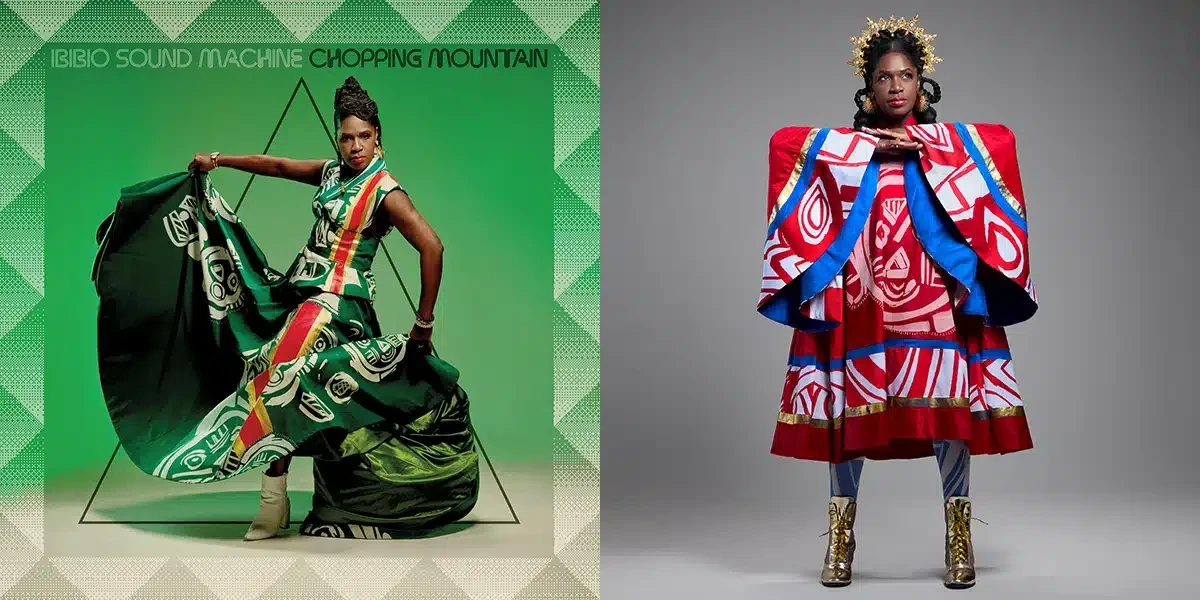
Their latest release, Chopping Mountain, marks a compelling evolution. Characterized by warm, gently rendered hues, it stands as the band’s most contemplative full-length project since their 2019 soul-infused release, Doko Mien. Notably, Chopping Mountain also reunites the group with saxophonist and synth player Max Grunhard in the role of lead producer—a position he last held on Doko Mien. Grunhard’s production stewardship yields a remarkably expansive emotional spectrum, flawlessly interpreted by an ensemble at the absolute height of its powers. Frontperson Eno Williams anchors this sonic voyage with her formidable expressive range, effortlessly shifting a listener from deep introspection to ecstatic movement.
By balancing contemporary anxieties—such as the escalating climate crises disproportionately impacting the Global South—with infectious dancefloor imperatives, Chopping Mountain successfully captures the profound uncertainties of the modern sociopolitical landscape. It is a masterclass in affective nuance, proving once again that Ibibio Sound Machine can challenge the intellect just as powerfully as they ignite the party.
Detailed Chronology: A Track-by-Track Narrative Arc
Chopping Mountain is not merely a collection of singles; it is a meticulously sequenced emotional journey. The album chronicles a transition from restless nocturnal rumination and geopolitical anxiety to hard-won resilience, communal solidarity, and ultimately, hard-earned peace of mind.
From Restless Nights to Resilient Rhythms
The album opens with “Burning in Lagos,” a track that rises from a dreamy, atmospheric waft into a state of rhythmic melancholy. Williams sets the scene immediately, contrasting the sweltering heat of the Nigerian metropolis with the quiet hours of the British capital:
“It’s burning in Lagos / It’s night time in London / My head fills with circles / Of sleep, and I’m wondering.”
Her wanderings remain brilliantly unresolved. Rather than offering simplistic resolutions, Williams moves through the sweltering unknown as a perceptive witness, enveloped by intricate layers of percussion, brass, and electronics. The lyrics implicitly invoke the devastating reality of climate-change-exacerbated heatwaves hitting the Global South hardest. The ensemble’s subdued yet crystalline delivery captures this heavy atmosphere perfectly.
However, Chopping Mountain explicitly refuses to settle into an elegy. The title track, “Chopping Mountain,” bursts forth with sparkling synth keys and sharper, more urgent beats. Emphatic flourishes of flutes, horns, and plugged-in strings elevate the arrangement. Williams sings movingly of rising from the ashes of discord like a phoenix. This injection of unyielding joy and strength paves the way for a glorious, highly kinetic sequence of dance-oriented tracks.
Among them, “When You Want to Dance” pairs staccato drum patterns with heavy dub effects, delivering a sleek, forward-thinking iteration of drum ’n’ bass. Later, “Concept of Love” and “Return to Sender” utilize heavier synthpop textures softened by the band’s signature, sun-warmed horn arrangements.
Communal Solidarity and Grooving into Serenity
The emotional apex of the record arrives with “Give Me Peace,” a stunning, transcendent rallying cry for freedom and love. The track benefits immensely from the inclusion of Afrobeat luminary Dele Sosimi, whose legendary career includes formative years performing alongside Fela Kuti’s Egypt 80 and Femi Kuti’s Positive Force. The synergy between Sosimi’s storied gravitas and Williams’ commanding vocal presence yields a soothing, deeply powerful communion of sound and spirit.
As the album enters its final third, the tempos relax, allowing the underlying grooves to breathe:
- “Menso” leans heavily into retro, bass-fueled funk territory.
- “Love” evokes the golden era of remastered 1960s soul.
- “Kukuru” boasts buoyant instrumentation that highlights Williams’ effervescent, celebratory side.
The record ultimately concludes in the wide-open spaces of the neon-tinged electrofolk piece, “River Don’t Rush.” Here, Williams imparts a closing piece of philosophical wisdom that gently counters the frantic, racing thoughts introduced at the album’s outset. While acknowledging that music cannot single-handedly solve the world’s systemic problems, she offers a profound meditation on surrender:
“I guess I could learn a thing or two about the water flow / River don’t rush, it just goes where it’s got to go / Why worry, what you can’t control / Why carry all this weight on your soul?”
Supporting Context & Metrics: The Evolution of Ibibio Sound Machine
To fully appreciate the artistic triumph of Chopping Mountain, one must examine the broader trajectory of Ibibio Sound Machine within the contemporary global music ecosystem. Formed in London in 2011, the band was conceived by producer Benji Bower and frontperson Eno Williams, bringing together a diverse collective of musicians with deep roots in both the UK jazz/electronic scenes and traditional Nigerian musical idioms.
| Album Title | Release Year | Lead Producer / Key Collaborators | Primary Sonic & Thematic Focus |
|---|---|---|---|
| Ibibio Sound Machine | 2013 | Benji Bower | Introduction of London-Lagos fusion; high-energy electronic Afro-funk debut. |
| Uyai | 2017 | Benji Bower | Expansion of sociopolitical commentary; famously addressed child kidnapping in Nigeria. |
| Doko Mien | 2019 | Max Grunhard | Soulful introspection, blending warm synth-pop with traditional Ibibio lyricism. |
| Electricity | 2022 | Hot Chip (Joe Goddard, Al Doyle) | Electronic dancefloor focus, vibrant synth-driven anthems. |
| Chopping Mountain | 2025 | Max Grunhard (featuring Dele Sosimi) | Contemplative moods, climate anxiety, resilience, and soothing electro-funk grooves. |
Throughout their twelve-year recording history, the band has consistently refused to shy away from complex geopolitical and social issues. On their acclaimed 2017 sophomore record, Uyai, they utilized their platform to demand an end to child kidnapping in Nigeria, proving that infectious dance rhythms and urgent social consciousness can coexist seamlessly.
Chopping Mountain continues this proud tradition, shifting the thematic lens toward the psychological and ecological toll of the 2020s. By enlisting Max Grunhard to helm the production desk once more—building upon the success of Doko Mien—the band has doubled down on an organic, nuanced approach that prioritizes texture, emotional resonance, and dynamic storytelling over monolithic club bangers.
Official Statements & Critical Perspectives
While direct press statements accompanying the release of Chopping Mountain have focused heavily on the collaborative spirit of the sessions, industry insiders and cultural critics have been quick to praise the album’s sophisticated tonal balancing act.
In pre-release production notes shared with cultural outlets, Max Grunhard emphasized the deliberate choice to embrace subtlety over sheer auditory volume:
"When you look at the pressures facing communities across both London and Lagos—from economic friction to environmental shifts—music cannot simply be an escape hatch. It has to be a mirror that reflects the heat, the confusion, and eventually, the resilience required to keep moving forward. With Chopping Mountain, our goal was to let the instruments speak with greater space and warmth."
Frontperson Eno Williams has similarly elaborated on the thematic weight driving tracks like “Burning in Lagos,” noting in interviews that the creative process heavily mirrored her own experiences of transcontinental displacement and environmental observation:
"You carry two worlds inside you at once. When you see the climate changing the rhythm of life in Lagos while you’re sitting under the gray skies of London, your mind starts spinning in circles. The music became a way to walk through that heat without getting burned up entirely—to find water at the end of the journey."
Critics across the international music press have lauded the album as a high-water mark for the group. The integration of veteran Afrobeat icon Dele Sosimi on “Give Me Peace” has been universally highlighted as a masterstroke, bridging generations of Nigerian musical royalty and validating Ibibio Sound Machine’s ongoing dialogue with the pioneers of political funk.
Future Outlook: The Path Ahead for Ibibio Sound Machine
As Ibibio Sound Machine prepares to take the material from Chopping Mountain onto the global touring circuit, the album’s release signals a mature new chapter for the transnational collective. The modern music landscape is increasingly saturated with ephemeral, algorithmically optimized tracks designed for short attention spans. In stark contrast, Ibibio Sound Machine continues to champion the long-form album as an immersive cultural artifact—one capable of holding space for grief, political critique, and unadulterated joy simultaneously.
Looking forward, the success of Chopping Mountain establishes a compelling benchmark for future releases. By proving that they can scale back the frenetic electronic pacing of past efforts in favor of contemplative warmth, acoustic flourishes, and deeply textured lyricism, the band has future-proofed their catalog against creative stagnation.
Furthermore, the seamless integration of cross-generational legends like Dele Sosimi underscores the group’s ongoing role as cultural curators. They are not merely borrowers of historical styles; they are active, evolving participants in a continuous, living lineage of African and diasporic art. Whether they choose to challenge listeners with the burning realities of a changing world or invite them to lose themselves entirely in a retro-funk groove, Ibibio Sound Machine remains an essential pillar of contemporary global music—proving, track by track, that the river of their creativity has no intention of rushing, but will always go precisely where it needs to go.









Belum ada komentar. Jadilah yang pertama berkomentar!