

Executive Overview
To understand the kaleidoscopic, smoke-shrouded mythos of Lee "Scratch" Perry, pop-culture historians typically fixate on the latter half of the 1970s. This was the era of the Black Ark—the legendary, makeshift Kingston studio that Perry constructed in 1973, saturated in spiritual oils, decorated with spray-painted graffiti, and ultimately burned to the ground by its creator in 1979 in an act of ritualistic destruction. It is the era of thundering, speaker-shattering dub effects, eccentric liner notes, and the global hip-hop and indie-rock crossover appeal that blossomed when British producer Adrian Sherwood rediscovered Perry in the 1980s.
Yet, treating the Black Ark as the absolute ground zero of Perry’s genius ignores a rich, foundational epoch. Before the mysticism calcified into avant-garde performance art, and before the studio walls were plastered with religious icons and newspaper clippings, Perry was simply one of Jamaica’s most relentlessly inventive and prolific producers.
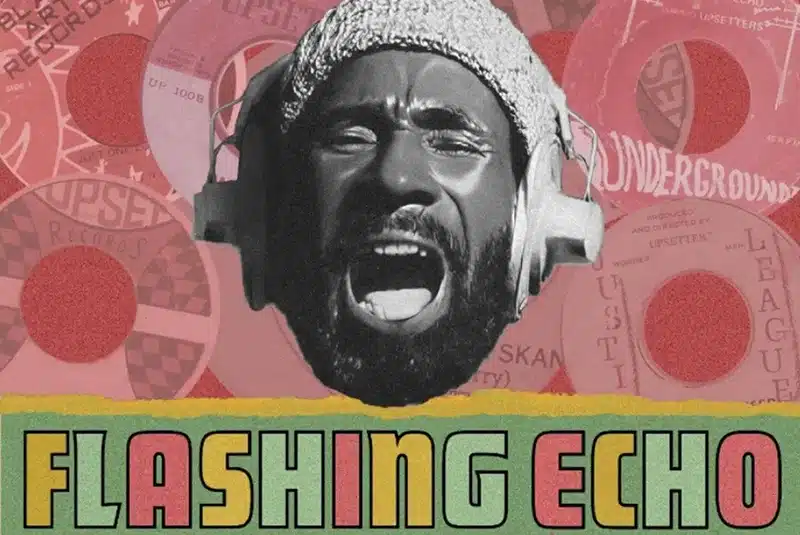
Enter the UK archival label Doctor Bird, an imprint of Cherry Red Records, which has dedicated itself to mapping this crucial, pre-Black Ark period with painstaking devotion. Their ongoing archival undertaking reaches a fascinating crescendo with Flashing Echo: The Jamaican Upsetter Singles 1973 Chapter 2. Released on August 14, 2026, this two-CD collection serves as the eighth installment in Doctor Bird’s exhaustive Jamaican Upsetter Singles series.
What makes Flashing Echo an indispensable release is its hyper-focused lens. Rather than attempting to summarize a decade, the compilation narrows its scope to a single, transformative six-month window: the latter half of 1973. It captures Perry at the absolute peak of his pre-Black Ark powers—a master craftsman working within traditional Jamaican studio formats just months before he broke ground on the sonic laboratory that would change reggae history forever. Across 48 tracks, the collection highlights a visionary operating on the cutting edge of roots reggae, early dub experimentation, and soul-inflected vocal harmony, offering modern listeners an authoritative look at the evolutionary steps of a musical titan.
Detailed Chronology: Tracing the Upsetter’s Path to 1973
To fully appreciate the gravity of the material compiled on Flashing Echo, one must trace Lee Perry’s trajectory through the tumultuous, hyper-competitive landscape of the Jamaican music industry spanning the 1960s and early 1970s.
The Studio One Apprenticeship and Early Ska
Perry’s entry into the music business dates back to the early 1960s, a time when Jamaican sound systems ruled the streets and the bouncy, upbeat rhythm of ska was beginning to capture the island’s post-independence euphoria. Perry found work under Clement "Coxone" Dodd at Dodd’s newly minted Studio One label. Operating initially as a general factotum, talent scout, and occasional singer, Perry absorbed the mechanics of record production from the ground up. He even recorded his own pioneering ska tracks during this tenure—material that Dodd famously never released, fueling an entrepreneurial hunger in the young producer that would never be fully satisfied.
Breaking Away: Joe Gibbs, Niney Holness, and the UK Charts
Frustrated by industry politics and compensation models, Perry broke away to work with rival producers, notably Joe Gibbs at Amalgamated Records. This partnership yielded significant fruits, but creative friction soon prompted Perry to strike out on his own under the banner of his newly founded Upsetter label.
Operating independently, Perry quickly proved his mettle on the international stage. In 1969, he scored a massive triumph when his instrumental production "Return of Django"—credited to The Upsetters—soared into the UK Top Five. This unexpected commercial crossover proved that Jamaican sounds could captivate European audiences without losing their local authenticity.
Discovering Bob Marley & The Wailers
Perhaps Perry’s most culturally seismic contribution to global music occurred at the dawn of the 1970s. At a time when Bob Marley, Peter Tosh, and Bunny Wailer were struggling to find consistent traction, Perry brought the newly rechristened Bob Marley & The Wailers into his stable.
Working together in various Kingston studios, Perry and the group forged a harder, more roots-oriented sound. Perry produced foundational tracks that would later become international standards after Marley signed with Chris Blackwell’s Island Records and ascended to global superstardom. Songs like "Duppy Conqueror," "Soul Rebel," and "Small Axe" were born out of this volatile, highly creative partnership, cementing Perry’s status as a premier architect of reggae’s golden age.
The Precipice of Black Ark: The Context of Flashing Echo
By mid-1973, Perry was at a professional crossroads. His Upsetter label was a dominant fixture of the local Jamaican singles market, and he had recently released Blackboard Jungle Dub (credited to Lee Perry and the Upsetters)—widely recognized as one of, if not the, very first full-length albums dedicated entirely to the dub style.
Yet, the legendary Black Ark studio was still a few months away from opening its doors. Flashing Echo documents precisely this transitional moment. It captures Perry working with external studio spaces, juggling commercial pressures, and pushing the sonic envelope just as the structural foundations of roots reggae and dub were being poured.
Supporting Context & Metrics: Inside the 48 Sides of Flashing Echo
Spanning two compact discs and 48 meticulously curated tracks, Flashing Echo presents a panoramic view of Jamaican popular music in 1973. While fans might look to this era expecting walls of mind-bending, speaker-shattering dub effects, what they find instead is a masterclass in versatility, arrangement, and production breadth.
Soul Covers and Vocal Harmony Groups
The collection highlights the deep cultural umbilical cord connecting Jamaican reggae to American rhythm and blues, soul, and doo-wop. The second CD of the compilation leans heavily into Motown and American soul covers, revealing how Jamaican artists reinterpreted overseas hits through an island sensibility.
- Annette Clarke delivers a captivating, soulful rendition of Doris Troy’s "Just One Look," showcasing Perry’s ear for spotting overlooked vocal talent.
- David Isaacs, known for his silky-smooth crooning, transforms the Chi-Lites’ "We Are Neighbors" into an uplifting anthem of communal solidarity.
- The Silvertones offer rich, three-part vocal harmonies on tracks originally made famous by Ben E. King and the Drifters. These performances function as a direct historical bridge, foreshadowing Perry’s iconic, heavenly vocal production work with groups like The Congos later in the decade.
The Rise of Roots Reggae and Leo Graham
By 1973, the term "roots reggae" was beginning to take shape. It denoted a distinct sonic shift, but more importantly, it signaled a thematic pivot toward realistic, unvarnished depictions of inner-city Kingston life, heavily filtered through the burgeoning Rastafarian spiritual movement.
On Flashing Echo, many of the definitive roots tracks are fronted by Leo Graham. While Graham possessed a relatively thin vocal instrument, he compensated with an emphatic, biting delivery that commanded attention. Songs like "News Flash" and the Psalms-referencing "No Dig Pit" serve as prime examples of early roots music functioning as sonic journalism and spiritual resistance.
Social Commentary and Political Consciousness
Perry himself stepped up to the microphone to deliver piercing social commentary. "Justice to the People"—a brilliant reinterpretation of the Chi-Lites’ "(For God’s Sake) Give More Power to the People"—features a lethargic, heavy-lidded pace. Driven by coed vocals, a crooning Perry, and a deadpan baritone delivery of the title phrase, the track bears the unmistakable atmospheric influence of Sly and the Family Stone.

Similarly, the self-descriptive "Blackman Time" features Perry posing hard-hitting rhetorical questions: "Why won’t they share the wealth? Why must the Black man suffer?" Propelled by incessant, bubbling keyboards and a deep, hypnotic bassline, the track marries political urgency with irresistible dancefloor rhythm.
The Evolution of the "Version" and the Birth of the DJ Style
One of the most valuable aspects of Doctor Bird’s archival work is its celebration of the B-side "version." In the ecosystem of 1970s Jamaican reggae, the flip side of a 7-inch single was rarely throwaway material.
Economic Necessity as Artistic Innovation
These instrumental or remixed replications of A-sides served multiple vital functions:
- Economic Efficiency: Producing a "version" allowed producers to maximize the utility of expensive studio time and limited multi-track tape.
- Technical Experimentation: Engineers and producers used B-sides as experimental laboratories, pushing mixing boards to their limits and often stumbling upon revolutionary audio techniques by pure accident.
- Sound System Culture: Sound system operators and DJs required clean rhythm tracks to support their live performances.
The Forerunners of Modern Rap
Long before hip-hop emerged in the Bronx, Jamaican sound system DJs were pioneering the art of "toasting"—talking, chanting, and flowing rhythmically over instrumental B-sides to hype up crowds and tell local stories.
Flashing Echo shines a bright light on this burgeoning DJ culture, showcasing master mic-controllers such as U-Roy (complete with his trademark ad-libbed "y’knows"), I-Roy, and Perry’s own handpicked protégé, Lester "Dillinger" Bullock. On these cuts, the DJs’ voices frequently swim in heavy spring reverb, or the rhythm drops out entirely just as a punchline is delivered—foreshadowing the radical structural decongestion of full-blown dub.
Early Dub and the Touch of King Tubby
While Perry supplied the raw, eccentric creative vision, some of the B-sides on the collection were mixed by Osbourne "King Tubby" Ruddock, the undisputed king of early dub engineering who frequently collaborated with Perry.
Tracks like "Kuchy Skank Kuchy Skank" offer a terrifyingly brilliant preview of deep dub futures, driven by a menacing rhythm, a ghostly, weeping melodica, and heavy phasing effects that create a claustrophobic, ominous atmosphere. Meanwhile, "Rejoicing Skank" pairs an eerie, echoing chorus of wordless vocalizations with bizarre sonic artifacts—resembling a cicada or a sci-fi laser beam—sweeping seamlessly in and out of the mix.
The Eccentricity of "Scratch"
Even amidst the sophisticated engineering and socio-political consciousness, the compilation captures glimpses of the mischievous, boundary-pushing madman who would come to dominate pop-culture folklore.
On "Bathroom Skank," Perry cheerfully invites the listener to "dig this musical sculpture coming from King Tubby’s headquarters" before launching into a surreal song about scrubbing his own body, complete with the sonic effect of tiny soap bubbles popping in the background. On "Kentucky Skank," he emerges briefly from his dub laboratory to issue a playful manifesto: "Welcome all you weenie boppers / This is your musical papa."
Official Statements & Industry Reception
The archival community and music critics have met Doctor Bird’s ongoing Jamaican Upsetter Singles series with universal critical acclaim, viewing it as an essential correctives to decades of fragmented, low-fidelity bootlegging.
In promotional materials accompanying the release, Cherry Red Records emphasized the historical weight of the compilation series:
"The Jamaican Upsetter Singles project is not merely a compilation of rare 7-inches; it is an archeological dig into the foundations of modern Jamaican music. By chronicling Lee Perry’s output month-by-month, we reveal an artist whose creative output was staggering in its diversity, quality, and relentless innovation."
Musicologists specializing in Caribbean audio history have noted that Flashing Echo successfully reframes the narrative surrounding Perry’s 1973 output. Rather than viewing this period as a mere precursor to the Black Ark era, critics argue that the recordings made during this transitional half-year represent some of the tightest, most commercially viable yet sonically adventurous work of Perry’s entire career.
Future Outlook: Preserving the Reggae Canon
As physical music collectors and digital archivists continue to demand higher fidelity and deeper contextualization, releases like Flashing Echo set a new gold standard for historical reissues.
The success of Doctor Bird’s multi-part series suggests a growing appetite for comprehensive, chronological deep-dives into foundational Caribbean music, moving away from greatest-hits compilations toward exhaustive curation. For music historians, the big question remains how far archival labels can dig into the vaults of Kingston’s golden age before unearthing long-lost lost tapes and unreleased alt-takes that could further rewrite the historical record.
For now, Flashing Echo: The Jamaican Upsetter Singles 1973 Chapter 2 stands as a triumphant monument to a restless genius at the height of his powers. Chronologically, it covers only a fleeting six-month chapter of a legendary life, but it is an astoundingly rich segment of musical history—essential listening for "weenie boppers" of all shapes, sizes, and generations.








Belum ada komentar. Jadilah yang pertama berkomentar!