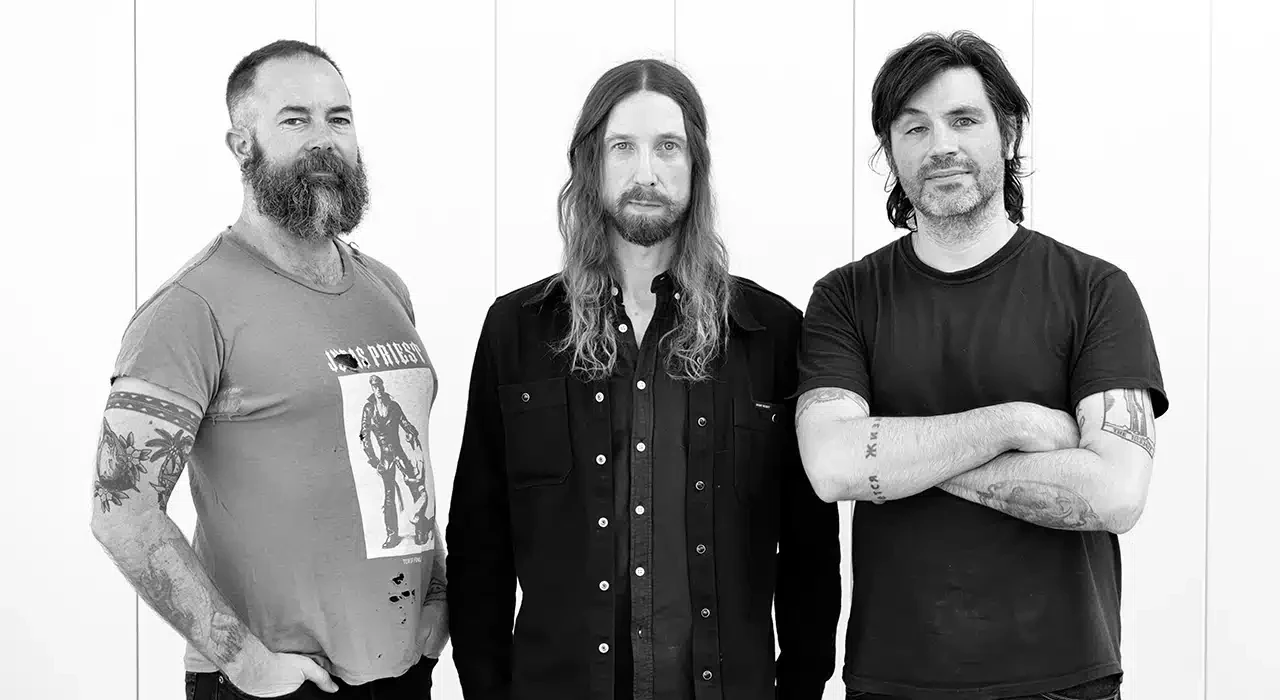
To speak the titles of Russian Circles’ discography—Enter, Station, Empros, Gnosis, Empath, Nine—is to feel as though you are rattling off a sequence of clandestine codewords engineered to breach a subterranean bunker hidden deep within an uncharted wilderness. The enigmatic quality of these terse, declarative mono-syllables is amplified by the band’s chosen medium. As a Chicago-based instrumental post-metal trio comprised of guitarist Mike Sullivan, bassist Brian Cook, and drummer Dave Turncrantz, Russian Circles operate in a frosty, texturally dense sonic terrain devoid of traditional lyrical handholds. There are no vocal hooks to decode, no choruses to unpack. Instead, the downtuned, heavily overdriven strings and concussive percussion do the heavy lifting, carving out vast, cinematic landscapes of tension and release.
Yet, with the release of their ninth studio album, Nine, via Sargent House, the band executed a rare stylistic and semantic pivot: they chose a title with an uncharacteristically literal referent. Out late last summer, just as the trio prepared to embark on a grueling North American tour, Nine marks a notable milestone—the ninth full-length of their enduring career, and the eighth featuring Cook, who anchored his bass down alongside Sullivan and Turncrantz for 2007’s breakout sophomore effort, Station.
Far from signaling a retrospective victory lap, however, Nine finds Russian Circles refining their idiosyncratic mechanics of composition. Through an exclusive interview with Mike Sullivan, this article explores the making of the record, the deep historical tethers linking it to their past work, the structural reality of DIY-adjacent heavy touring, and the enduring philosophy of a band that treats longevity not as an entitlement, but as an ongoing experiment in trust, expression, and sonic evolution.
Detailed Chronology: From Underground Beginners to Post-Metal Titans
To fully comprehend the weight of Nine, one must trace the trajectory of a band that has quietly become one of the most reliable and influential instrumental acts of the 21st century. Formed in Chicago in 2004, Russian Circles emerged from the Midwestern underground with a distinct vision: merging the crushing, atmospheric sludge of the post-metal explosion with the intricate, cyclical melodies of math-rock and classical minimalism.
Their 2006 debut, Enter, introduced audiences to a band uniquely capable of balancing pulverizing heaviness with delicate, looping harmonic work. By the time Cook joined the fold for Station (2007), the trio’s dynamic locked into a permanent formation. The ensuing decade and a half saw a steady, uncompromised stream of critically acclaimed releases: Geneva (2009), the masterpiece Empros (2011)—which remains a watershed moment in modern instrumental metal—Memorial (2013), Guidance (2016), and Blood Year (2019).
As the band looks ahead to their 20-year anniversary in the fall of 2026—two decades removed from Enter—their historical footprint within the Sargent House stable looms large. Looking back, Sullivan fondly recalls a landmark 2012 showcase at the El Rey Theater in Los Angeles. Headlined by Russian Circles, the bill served as an astonishing crystal ball for the future of underground heavy music, featuring Deafheaven (whose epochal blackgaze masterwork Sunbather dropped the following year), And So I Watch You From Afar (All Hail Bright Futures, 2013), and Chelsea Wolfe (Pain is Beauty, 2013).
Reflecting on that era and the years since, Sullivan maintains a stance of profound, almost humorous humility.
"As far as us and our trajectory: to me, it’s immense gratitude that people still care about us, and that we can prepare and tour records in a day and age where there’s so many bands and subgenres, people being splintered all over," Sullivan reflects. "It’s not lost on me that we still get to do it, so the older I get and the more I see how rare it is for bands to be around this long… it’s almost humorous, like, ‘This is funny, but let’s keep going, make sure that we take this seriously.’"
Supporting Context & Metrics: The Mechanics of Nine and Studio Chemistry
While chronological markers like "nine albums" often invite heavy thematic expectations, Nine carries no artificial grandiosity. Instead, it serves as another rigorous step in an aesthetic continuum. Interestingly, the number itself holds a quiet, internal significance for the members.
"It’s finding its own relevance, to be honest," Sullivan says of the album’s title. "I like threes; I think there’s something special about the number three itself, and how it divides us, being a three-piece. Not to get into numerology too much, but there is something special about nine that has proven to make more sense to us individually and as a collective as we go."
The "Tethers" and Linear Songwriting
A defining characteristic of Russian Circles’ recent LPs is the presence of internal "handshakes"—recurring motifs, thematic echoes, and structural threads that bind separate records together. Sullivan explicitly describes these as "tethers." On Nine, the second single, "Eluvial," shares a distinct familial resemblance to the title track of 2022’s Gnosis. Both are sprawling, nearly ten-minute sonic canvases that begin with reflective, ambient introspection before erupting into volcanic, blast-beated climaxes.
However, bringing "Eluvial" to life required a uniquely fragmented, multi-year writing process.
The Genesis: The thunderous, black-metal-orchestrated back half of "Eluvial" was actually conceptualized around 2022, right as Gnosis was being finalized.
The Hiatus: Sullivan put the riff aside, recognizing it demanded a substantial front half to justify its weight.
The Collaboration: Years later, Turncrantz and Sullivan developed the opening movement, into which Cook injected ambient electronic keyboards—a fresh stylistic detour for the trio.
"Those electronic elements were a cool addition because it was so different from where [‘Eluvial’] was when I was writing it first around Gnosis," Sullivan notes. "It’s not a continual process; it’s touch-and-go. We keep the original file, then return to it and ask what fits."
Kurt Ballou and the Hiwatt Formula
The pristine, punishing guitar tone defining Nine—and every Russian Circles release since 2016’s Guidance—is heavily indebted to engineer and Converge guitarist Kurt Ballou. According to Sullivan, Ballou’s primary genius lies not in deploying a uniform "bag of tricks," but in his ability to step back.
"He doesn’t have a bag of tricks he relies upon where he’s using some specific filter or piece of gear," Sullivan explains. "He leaves room for each musician to sound like themselves."
Working alongside Ballou, Sullivan leaned heavily on Hiwatt amplifiers, establishing them as the foundational staple of his live and studio rigs. The collaboration is rooted in a shared reverence for vintage gear; Sullivan fondly recounts an anecdote where, while auditioning Gibson Les Pauls for Guidance, Ballou dryly remarked, "Yeah, Gibson got a lot right in the late 1950s."
Official Statements & Creative Philosophy: "Opening the Marriage"
The internal dynamic of Russian Circles is built on an uncommon level of mutual trust and creative permeability. Eschewing the volatile egos that frequently fracture long-running rock bands, Sullivan describes their collaborative process using an unconventional metaphor:
"We trust each other: if Brian came up with a great banjo part, it’s whatever’s cool to us. If Dave pulled out a solo drum part, we’d be cool with that. A lot of our songs start with [Dave and I] sending a song to Brian, and he’ll add a minute and a half of intro with just his material. We’ve done everything, so everything’s open. It’s like we’re opening the marriage or something: try it out! We’re very aware of what we like, but we’re very hesitant to say no; we’ll try out every idea before we say no."
This democratic ethos manifests clearly in tracks like "Borehole" (initiated by Cook) and "E2," which features a hypnotically repetitive, Philip Glass-esque two-hand tapping riff. Rather than indulging in self-indulgent shredding, Sullivan views his fretwork through the lens of pure utility and emotional transference.
"That particular moment, I was intentionally building a circular part that just goes and goes, as something we could build upon," Sullivan explains regarding "E2." "It’s an uninteresting part by itself; it came from a guitar warm-up exercise… But we’re not playing music for guitar players; we’re playing music for expression, creating a different world."
This philosophy extends to Nine’s most unassuming moment: "Arletta," a two-minute, echo-drenched solo acoustic interlude. Far from a throwaway acoustic track, "Arletta" is actually a classical guitar "reverse engineering" of the black-metal tremolo-picked melody driving the back half of "Eluvial." Inspired by classical guitarist John Williams’ interpretation of Mikis Theodorakis’s Epitafios No. 3 in D Minor, Sullivan created two mirror-image variations of the exact same composition.
The Tool of the Trade: Sacha Dunable Guitars
Sullivan’s gear identity has also undergone a subtle evolution following a harrowing 2021 tour incident in Chowchilla, California, where thieves ransacked the band’s U-Haul and stole several instruments—including his prized 1985 Gibson Les Paul (which was miraculously recovered in 2024).
During the ensuing tour, Sullivan borrowed a guitar from Chelsea Wolfe built by luthier Sacha Dunable. Captivated by the ergonomic design and comfortable playability of Dunable’s instruments—which seamlessly blend classic Gibson tonewood specs (mahogany body and neck, maple top, ebony fretboard) with modern, counter-culture-friendly ergonomics—Sullivan collaborated with Dunable on a custom model.
"Sacha’s guitars are so comfortable, whether I’m on the couch watching a hockey game, playing a show, working on a riff," Sullivan says. "The most beautiful and expensive guitar means nothing to me if I don’t want to pick it up and play it."
Future Outlook: The Reality of the Road and Continued Evolution
As Nine establishes itself in the band’s catalog, Russian Circles face the unglamorous, high-friction reality of modern underground touring. Far from the mythologized, decadent rock-and-roll lifestyle of 1970s stadium acts, Sullivan likens the contemporary touring grind to "helping a friend move apartments."
"We’re not a ‘bus band,’ so it’s very much a laborious tour for us," he notes. "There’s not much fucking around in parking lots at venues before the crowd gets there. We’re just chatting with our buds in the van all day long, then you get to the club. You make sure your gear works, then you go eat dinner, then you go to the show, then you pack up, and the next day you go to a new city. We have limitations, and limitations are our strengths."
Looking beyond the horizon of the Nine touring cycle, Sullivan’s ambitions are focused inward and forward. He has no desire to race past the current material, but his ultimate metric for success is clear: to grow not merely as a guitarist, but as a holistic musician.
"I’m a firm believer in educating yourself, learning more; you don’t have to apply it always, but you never know when it’ll make its way in by osmosis," Sullivan concludes. "Take in a bunch of music and push your boundaries every way. I know what I like and don’t like, so I trust that, but you need to be an educated musician to write great music."
After two decades, nine defining releases, and countless miles on the highway, Russian Circles have proven that the architecture of heavy music does not require a human voice to tell a compelling story. It simply requires head, heart, and a relentless commitment to expression.












Belum ada komentar. Jadilah yang pertama berkomentar!