

Executive Overview
Rock ’n’ roll and political radicalism have shared a volatile history, yet few intersections remain as bizarre—or as historically fascinating—as the alliance struck in 1972 between Bloodrock, a bruising Texas hard rock band, and Daniel Ellsberg, the man who exposed the darkest secrets of the Vietnam War. At the height of the Nixon administration’s paranoia, when the White House branded Ellsberg "the most dangerous man in America," an unlikely tribute materialized on the B-side of a forgotten single.
This article explores the collision of high-stakes espionage and heavy rock music. It traces Ellsberg’s harrowing path from hawk to whistleblower, the leak of the 7,000-page Pentagon Papers, the legal battles that unseated a president, and the bizarre cultural footnote left by a Fort Worth hard rock outfit that traded its macabre doom-metal roots for progressive jazz-rock, only to immortalize a federal fugitive on vinyl.
Detailed Chronology: From the Pentagon Papers to the Fall of Saigon
The Genesis of Deception (1967–1969)
The story begins in 1967, deep inside the corridors of the American defense establishment. Secretary of Defense Robert McNamara commissioned a top-secret, exhaustive historical study officially titled the Report of the Office of the Secretary of Defense Vietnam Task Force. Documenting the United States’ political and military involvement in Vietnam from the conclusion of World War II onward, the report laid bare an uncomfortable and damning truth.
The documents revealed a systemic, bipartisan willingness across the Truman, Eisenhower, Kennedy, and Johnson administrations to maintain a deadly military commitment in Southeast Asia. This persisted despite classified internal consensus that no amount of American firepower could successfully prop up the fragile South or decisively defeat communist-backed North Vietnam. Successive administrations deliberately sustained massive troop deployments and devastating bombing campaigns, keeping the American public entirely in the dark about the futility of the enterprise.
Daniel Ellsberg’s Awakening
Enter Daniel Ellsberg, a former U.S. Marine Corps first lieutenant (1954–1957) turned military analyst for the RAND Corporation, a Santa Monica-based global policy think tank. Early in his career, Ellsberg was a committed hawk who actively championed and advised on U.S. military strategy in Vietnam. However, his worldview fractured upon reviewing the classified pages of the McNamara study.
Recognizing the monumental scale of governmental deception, Ellsberg—alongside colleague Anthony Russo—began secretly photocopying the 47-volume, 7,000-page dossier over the course of several months. Desperate to halt the bloodshed, Ellsberg first approached anti-war U.S. senators in hopes of forcing a congressional release. When they refused to act, he turned to investigative journalist Neil Sheehan of The New York Times. On June 13, 1971, the newspaper published its inaugural exposé on the Pentagon Papers, shattering the illusion of official infallibility.
The White House Retaliation and Legal Collapse
The fallout was immediate and catastrophic for the Nixon administration. National Security Advisor Henry Kissinger dubbed Ellsberg "the most dangerous man in America," while President Richard Nixon flew into a rage. In a freshly surfaced Oval Office recording, Nixon made his objectives explicitly clear:
"Just because some guy’s going to be a martyr, we can’t be in a position of allowing the fellow to get away with this kind of wholesale thievery or otherwise it’s going to happen all over the government… I just say that we’ve got to keep our eye on the main ball. The main ball is Ellsberg. We’ve got to get this son of a bitch."
The administration slapped the Times with a federal injunction to halt publication—though The Washington Post, The Boston Globe, and more than two dozen other papers quickly picked up the torch. Indicted under the Espionage Act of 1917, Ellsberg faced more than a century behind bars.
However, gross government misconduct—including a clandestine September 1971 White House "plumbers" break-in targeting Dr. Lewis Fielding, Ellsberg’s psychiatrist—blew the prosecution wide open. In May 1973, a federal judge dismissed all charges against Ellsberg. This legal collapse accelerated the unraveling of the Nixon administration. By July 1974, the House Judiciary Committee approved articles of impeachment over the Watergate scandal, prompting Nixon’s resignation in August. The Vietnam War officially drew to a close with the Fall of Saigon on April 30, 1975.
Supporting Context & Metrics: The Rise, Evolution, and Crash of Bloodrock
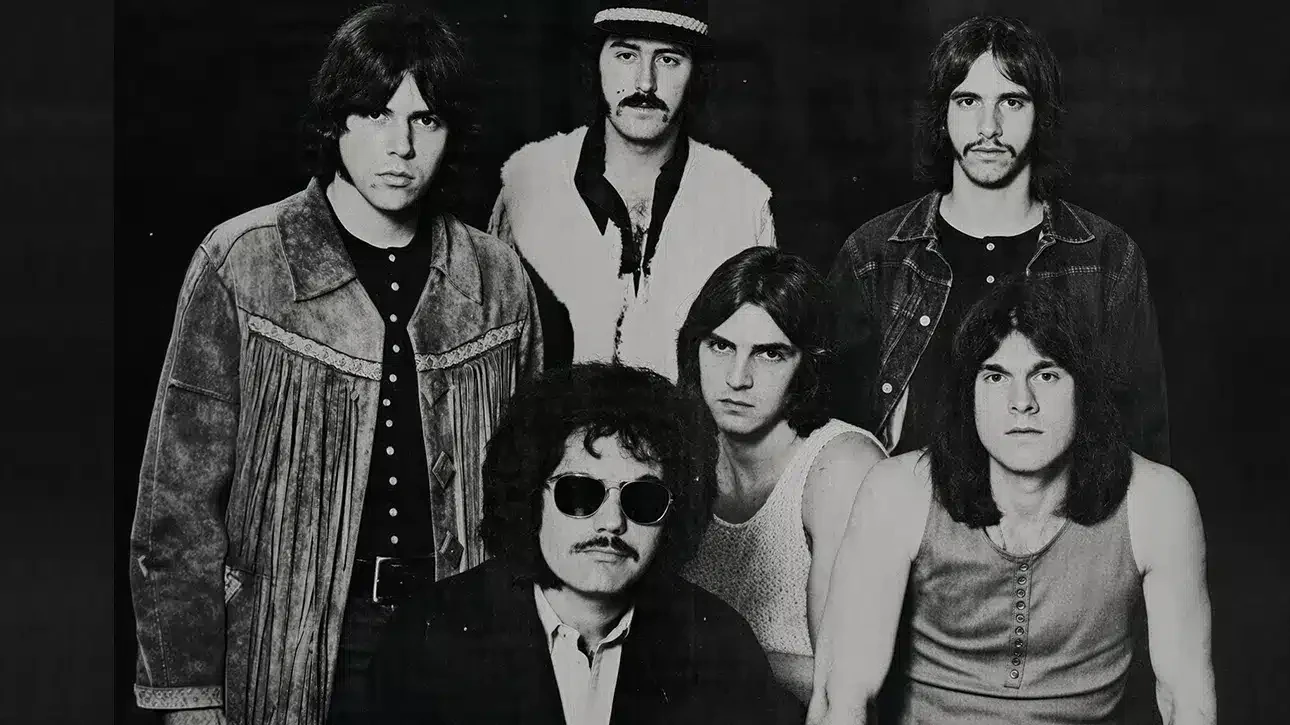
While the nation reeled from political scandals, the music world reacted to Ellsberg’s defiance in diverse ways. Early tributes included Rulie Garcia’s 1971 single The Ballad of Daniel Ellsberg and James Stein’s Written in the Mind of Man. Yet, the most culturally anomalous homage arrived from Texas hard rockers Bloodrock.
From Macabre Doom to Political Progressive Rock
Originally formed under the moniker Crowd + 1, Bloodrock signed with Capitol Records and released their self-titled debut in February 1970. Modeled after heavyweights like Deep Purple and Grand Funk Railroad, the band relied on aggressive lead vocals, screeching electric guitars, and heavy Hammond organ lines.
Remarkably, despite song titles steeped in pure morbidity—such as American Burn, Don’t Eat the Children, Gimme Your Head, Melvin Laid an Egg, and Rock & Roll Candy Man—the band secured an unlikely hit. Their 1970 sophomore album, Bloodrock 2, featured D.O.A., a grim, plodding, nine-minute first-person narrative sung from the perspective of a dying airplane crash victim:
"Life is flowing out my body / Pain is flowing out with my blood / The sheets are red and moist where I’m lying / God in heaven, teach me how to die."
Peaking at #36 on the Billboard Top 40 in early 1971, D.O.A. earned the band gold certification from the RIAA. However, by 1972, original guitarist Lee Pickens and drummer/vocalist Jim Rutledge departed. The restructured lineup abandoned its hard rock roots, pivoting toward a jazz-infused progressive rock sound marked by woodwinds, complex arrangements, and cerebral titles like Parallax and Stilled by Whirlwind Tongues.
Passage and the Ellsberg Tribute
This stylistic rebirth also marked a brief, unexpected detour into topical politics. Released in 1972, the progressive-leaning album Passage featured a B-side titled Thank You Daniel Ellsberg, paired with the lead single Help Is on the Way.
A slow, unvarnished blues number, the track served as a direct nod to the controversial whistleblower. While the musical craftsmanship was simple compared to contemporary folk-rock poets like Bob Dylan or Bruce Springsteen, the song’s ideological stance was bold for a commercial rock band of that era.
Curiously, the lyrics make explicit reference to a "Louis Packwood." Historians have found no direct link between a Louis Packwood and the Pentagon Papers leak. Some theorists suggest the name may have alluded to an LAPD criminal conspiracy unit investigator tied to the controversial 1971 prison death of Black Panther activist George Jackson—though Packwood did not testify publicly until 1976, four years after the song’s release. Whether an eerie coincidence or prescient insider knowledge, the reference remains an unsolved rock-history enigma.
Critical Disfavor and Cult Longevity
Bloodrock’s progressive experiment was short-lived. Their final studio album, Whirlwind Tongues (1974), failed to chart, spelling the end of the band.
History has not been kind to their recorded catalog. The 1979 edition of The Rolling Stone Record Guide famously awarded zero stars to all of Bloodrock’s albums, while critic Robert Christgau relegated them to the "Meltdown" appendix of his 1981 guide, grouping them alongside critically maligned acts like Uriah Heep and Angel. Despite critical dismissal, Bloodrock maintained a fiercely loyal cult following, placing six records on the charts and securing a permanent, if eccentric, footnote in rock history.
Official Statements and Archival Recognition
While Bloodrock faded into obscurity, Daniel Ellsberg spent the subsequent decades accumulating global recognition for his moral courage. He was honored with numerous prestigious peace awards, including:
- The Gandhi Peace Award (1978)
- The Right Livelihood Award (2006)
- The Dresden Peace Prize (2016)
- The Olof Palme Prize (2018)
- The American Book Award (2002) for his memoir, Secrets: A Memoir of Vietnam and the Pentagon Papers.
Ellsberg’s enduring legacy was further cemented by Judith Ehrlich and Rick Goldsmith in their Academy Award-nominated 2009 documentary, The Most Dangerous Man in America: Daniel Ellsberg and the Pentagon Papers. The film captures archival footage of Ellsberg delivering a timeless warning on civil obedience and state overreach:
"The courage we need is not the courage, the fortitude, to be obedient in the service of an unjust war to help conceal lies, to do our job by a boss who has usurped power and is acting as an outlaw government. It is the courage at last to face honestly the truth and the reality of what we are doing in the world and act responsibly to change it."
Future Outlook: The Resonant Echo of Whistleblowing
Daniel Ellsberg passed away at his home in California on June 16, 2023, at the age of 92. Yet, more than half a century after he smuggled the Pentagon Papers out of the RAND Corporation, his blueprint for civil disobedience continues to reverberate through modern geopolitical discourse.
In an era defined by digital leaks, state surveillance, and institutional transparency battles, Ellsberg’s life serves as a permanent reminder of the individual cost—and ultimate necessity—of moral accountability. Long after Bloodrock’s heavy metal dirges and progressive jazz experiments fell silent, the ethical challenge posed by Ellsberg remains active. His legacy reminds every generation that true patriotism occasionally requires breaking the law to serve the higher truth of the public good.









Belum ada komentar. Jadilah yang pertama berkomentar!