

Executive Overview
The Wikimedia Foundation has officially integrated its engaging daily historical trivia game, “Which came first?”, into the official Wikipedia application for iOS. Following a successful rollout on Android devices earlier this year, iPhone and iPad users can now experience the addictive, educational puzzle directly within their mobile reading ecosystem.
Designed to blend casual gaming mechanics with deep-dive educational content, the feature challenges users to correctly order historical events that occurred on the exact current calendar day in world history. By presenting players with five daily chronological riddles, the feature turns the world’s largest crowdsourced encyclopedia into a dynamic, gamified learning platform.
This strategic move reflects a broader industry trend among digital publishers and information repositories: transforming passive content consumption into active, habit-forming daily rituals. With built-in tracking for user metrics—such as gameplay streaks and average scores—alongside a comprehensive archive of past challenges, “Which came first?” promises to foster a loyal daily audience while encouraging deeper exploration of Wikipedia’s vast historical archives.
Detailed Chronology: From Concept to iOS Integration
The Evolution of Mobile Learning and Gamification
For over two decades, Wikipedia has stood as the quintessential repository of human knowledge. However, the ways in which users interact with information have undergone a seismic shift. Modern digital consumers—particularly younger demographics—gravitate toward interactive formats, bite-sized content, and gamified challenges popularized by cultural phenomena like Wordle.
Recognizing this shift, developers at the Wikimedia Foundation began exploring ways to make historical learning more approachable and entertaining. The conceptualization of “Which came first?” was born out of a desire to highlight the serendipitous nature of history—how seemingly unrelated events across different centuries share a calendar anniversary.
The Android Pilot Program
Before making its debut on Apple’s ecosystem, the game underwent rigorous user testing and refinement on Android devices. The Android rollout served as a vital testing ground for user engagement, UI/UX optimization, and server stability.
Feedback from the Android community highlighted a strong appetite for bite-sized historical trivia. Users praised the intuitive layout, the elegance of the chronological sorting mechanics, and the seamless transition from answering a question to reading the full Wikipedia article associated with the event. Buoyed by positive metrics and steady user retention during the Android pilot, the development team fast-tracked the iOS adaptation.
The iOS Launch
Starting today, the latest version of the Wikipedia iOS app introduces “Which came first?” to millions of Apple users worldwide. Accessible directly through the app’s curated Explore feed, the feature requires no separate downloads or third-party subscriptions. It operates entirely within the native framework of the Wikipedia mobile client, ensuring a smooth, secure, and privacy-respecting user experience true to the ethos of the Wikimedia Foundation.
Gameplay Mechanics: How "Which came first?" Works
The Daily Challenge Structure
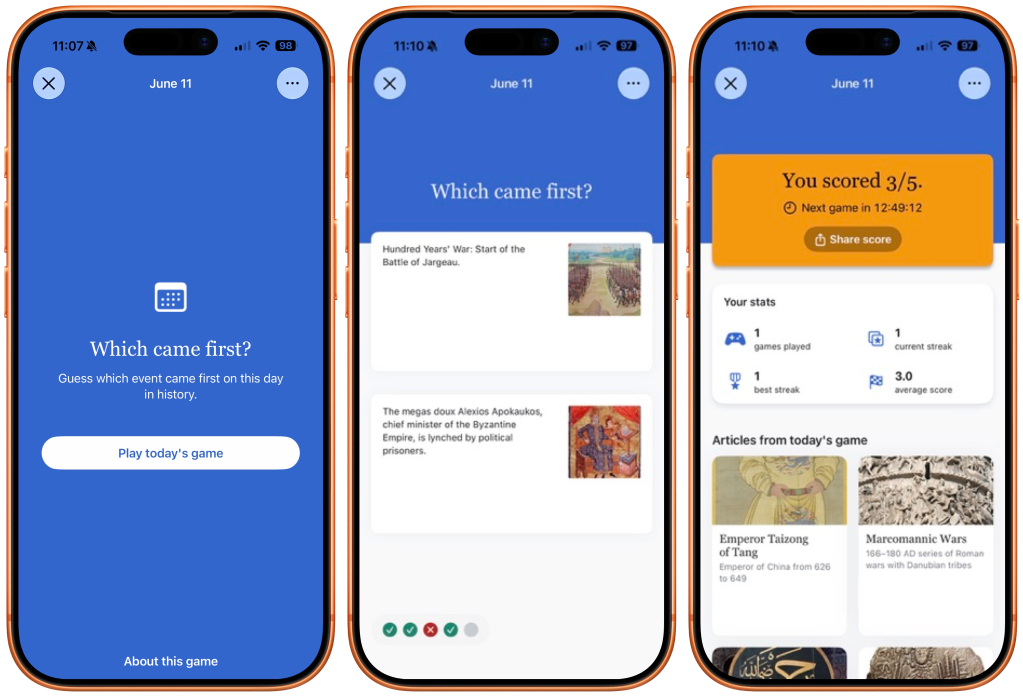
At its core, “Which came first?” is deceptively simple yet intellectually stimulating. Every day, the game generates a fresh set of five chronological questions.
- The Core Premise: Players are presented with two or more historical events that share a unique historical connection: they all occurred on the exact same calendar day (e.g., June 12th), albeit across different years, decades, or even centuries.
- The Objective: The user must successfully deduce or recall which event preceded the other, arranging them in the correct chronological order.
- The Educational Payoff: Upon making a selection—whether correct or incorrect—the game provides immediate feedback, accompanied by brief summaries and direct links to the relevant Wikipedia articles. This encourages users to dive deeper down the "Wikipedia rabbit hole" to learn the nuanced contexts surrounding each historical milestone.
Tracking Progress and Retention Metrics
To keep users coming back day after day, the game incorporates robust personal statistics tracking:
- Gameplay Streaks: Users can monitor their consecutive days played, creating a psychological incentive to maintain the habit.
- Average Scores: A rolling metric tracks overall performance, allowing history enthusiasts to measure their trivia prowess over time.
- The Archive: For those who missed a day or simply want more challenges, a built-in archive grants access to previous rounds of the game, ensuring that the entertainment value is never strictly limited to a single daily session.
Supporting Context & Metrics: The Shift Toward Gamified Reference Material
The Psychology of Daily Puzzle Games
The phenomenal success of games like Wordle, Connections, and various daily geography quizzes has proven that modern digital citizens enjoy routine, low-stakes mental challenges. By integrating “Which came first?” into its iOS app, Wikipedia is tapping into the psychological satisfaction of pattern recognition and historical deduction.
Unlike traditional trivia games that rely on obscure, static facts, Wikipedia’s game leverages its greatest asset: temporal coincidence. By asking users to compare events that happened on "this day in history," the game creates a thematic cohesion that makes the trivia feel relevant to the real world outside the screen.

Mobile App Engagement Trends
Data from mobile app analytics consistently show that utility and reference apps experience higher long-term retention when they incorporate interactive engagement loops. While millions of people open Wikipedia with transactional intent—to look up a specific fact, definition, or biography—features like “Which came first?” transform the app from a digital dictionary into a destination app.
Industry analysts note that this approach could significantly boost daily active user (DAU) metrics for Wikipedia’s mobile division, driving organic discovery of lesser-known historical articles that might otherwise go unread.
Official Perspectives and Educational Impact
Bridging Entertainment and Education
Educators and historians have long debated the best methods for transmitting historical literacy to younger generations. Traditional textbooks often struggle to compete with the high-velocity dopamine loops of social media feeds.
By framing history as an interactive puzzle, Wikipedia bridges this gap. Each round of “Which came first?” acts as a micro-lesson in historiography, teaching users to think critically about cause and effect, the passage of time, and the interconnected nature of human civilization.

Maintaining the Wikipedia Ethos
Importantly, the introduction of this gaming feature does not compromise Wikipedia’s core mission as a neutral, ad-free, donation-supported encyclopedia. The game remains entirely free of intrusive advertisements, pop-ups, or microtransactions. It stands as a value-add for the reader, reinforcing the foundation’s commitment to making knowledge accessible, engaging, and universally available.
Future Outlook: What’s Next for Wikipedia Mobile?
Potential Feature Expansions
With the successful cross-platform deployment of “Which came first?” across both Android and iOS, industry insiders are already speculating on what future interactive features the Wikimedia Foundation might introduce. Potential roadmaps could include:
- Localized Historical Challenges: Tailoring questions based on regional history or language preferences.
- Multiplayer or Social Sharing Modes: Allowing friends to compare daily streaks and scores directly through messaging apps or social media integration.
- Thematic Special Editions: Expanding beyond calendar dates to cover specific eras, such as the Renaissance, the Space Race, or ancient civilizations.
Conclusion: A New Era for the World’s Encyclopedia
Wikipedia’s launch of “Which came first?” on iOS marks a significant milestone in the evolution of digital reference platforms. By proving that education and entertainment can seamlessly coexist within a single mobile interface, Wikipedia is redefining how global audiences interact with history.
For iPhone and iPad users looking to sharpen their minds, learn fascinating forgotten facts, and test their historical intuition, the latest update offers a compelling reason to check the app every single day. To try the game for yourself, simply update your Wikipedia app to the latest version and navigate to the Explore feed.









Belum ada komentar. Jadilah yang pertama berkomentar!