

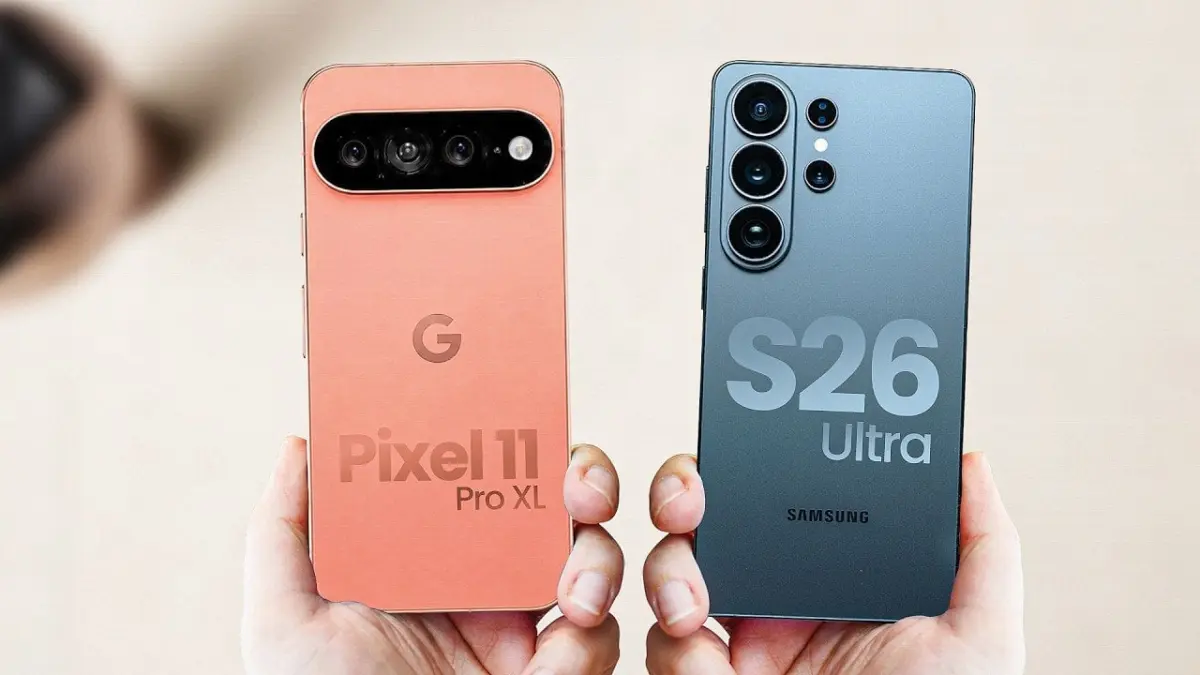
The ultra-premium smartphone market has reached an unprecedented plateau of engineering excellence, where devices no longer compete merely on whether they can perform tasks, but on the profound nuance of how they execute them. At the pinnacle of this year’s consumer electronics landscape sit two titans, both rumored and retailed at the formidable baseline starting price of $1,299: the Google Pixel 11 Pro XL and the Samsung Galaxy S26 Ultra.
While sharing an identical entry-level price point, these two powerhouses represent radically different philosophies in mobile computing. Google continues to champion an ecosystem driven by intuitive artificial intelligence, computational photography mastery, and software purity. Conversely, Samsung doubles down on hardware supremacy, raw processing muscle, versatile multi-lens optics, and uncompromising productivity integration via the signature S Pen.
For the discerning consumer, choosing between these devices is not a simple matter of checking specifications off a list. It is an exercise in aligning personal workflow, aesthetic preferences, and technological priorities with a device that will likely command pocket space for the next several years. As detailed in recent analyses by tech channels such as Techtics, both flagships carve out distinct territories in the high-end landscape. This comprehensive report will dissect every facet of the Pixel 11 Pro XL and the Galaxy S26 Ultra to determine which flagship deserves your hard-earned investment.
Detailed Chronology: Evolution of the Ultra-Tier Battleground
To understand the weight of the Pixel 11 Pro XL and the Galaxy S26 Ultra, it is essential to trace the evolutionary arc that brought these two ecosystems to their current ideological clash.
The Google Pixel Trajectory
Google’s journey from a pure software and stock Android purveyor to a vertically integrated hardware powerhouse has been methodical. With the introduction of the proprietary Tensor silicon lineage several generations ago, Google signaled its intent to stop relying on off-the-shelf components and instead build hardware entirely tailored to its machine learning ambitions.
The Pixel 11 Pro XL represents the maturation of this vision. By moving past the growing pains of early Tensor generations, Google has refined its hardware design language—most notably solidifying the iconic horizontal camera bar—while weaving ambient AI deeply into the fabric of the operating system. The Pixel is no longer just a camera with a phone attached to it; it is a proactive, context-aware assistant designed to anticipate user needs with minimal friction.
The Samsung Galaxy Ultra Legacy
Samsung’s Galaxy Ultra line, descending from the spiritual ashes of the beloved Note series, has long served as the Swiss Army knife of the mobile industry. Samsung has consistently adhered to a philosophy of maximalism: bigger screens, higher resolution sensors, more versatile zoom lenses, and the integration of a physical stylus.
The Galaxy S26 Ultra inherits this mantle, balancing cutting-edge display technology with desktop-class processing power. Despite arriving as a slightly older contender in some regional product cycles—which frequently triggers aggressive retail discounting—the S26 Ultra maintains its status as the default choice for power users, mobile gamers, and enterprise professionals who refuse to compromise on raw capability.
Supporting Context & Metrics: Spec-by-Spec Breakdown
When evaluating devices priced at $1,299, the devil is invariably in the architectural details. A side-by-side examination of memory configurations, build materials, display technologies, and processing power reveals where each manufacturer chose to allocate its engineering budget.
Price, Value, and Memory Configurations
At first glance, parity rules the pricing charts. Both the Pixel 11 Pro XL and the Galaxy S26 Ultra start at $1,299. However, the value proposition fractures when consumers look deeper into storage and RAM tiers.
- The Pixel 11 Pro XL Advantage: Google has heavily favored heavy multitaskers and local data hoarders in its 512GB configuration, equipping it with a robust 16GB of RAM. This additional headroom ensures that complex, on-device AI tasks, background processing, and memory-intensive applications run without stuttering or aggressive task-killing.
- The Galaxy S26 Ultra Positioning: At the equivalent 512GB storage tier, Samsung equips the S26 Ultra with 12GB of RAM. While 12GB is more than adequate for ninety percent of mobile workflows, power users may note the disparity. However, the S26 Ultra claws back significant value through market maturity: because it has maintained a presence on shelves longer, it is frequently subjected to carrier promotions, trade-in bonanzas, and direct price cuts, making it substantially more affordable in practice than its Google competitor.
Design, Build, and Ergonomics
Form factor dictates daily usability. The two phones approach physical design from divergent angles:
- Ergonomics vs. Stability: The Galaxy S26 Ultra is noticeably slimmer and lighter, a remarkable feat given its sprawling display real estate. This makes it more comfortable for extended, one-handed operations. The Pixel 11 Pro XL, while premium, carries a heavier, more uniform footprint.
- The Camera Bump Solution: Google’s signature horizontal camera bar serves a brilliant, unsung ergonomic purpose. When the Pixel 11 Pro XL is laid flat on a desk, it does not rock or wobble when tapped, a persistent annoyance found with the S26 Ultra’s vertical, isolated lens cutouts.
- Productivity and Notifications: The S26 Ultra proudly houses the S Pen, an indispensable tool for note-takers, sketch artists, and digital signers. Conversely, the Pixel 11 Pro XL introduces the Pixel Glow notification light, a clever design cue that allows users to parse incoming alerts instantly without waking the main display or lifting the device.
Display Technology: Brightness vs. Anti-Reflective Mastery
Both devices offer top-tier OLED canvases, but their underlying panel technologies target entirely different environmental use cases:
- Pixel 11 Pro XL (M16 OLED): Google deploys a cutting-edge M16 OLED panel that pushes the envelope in raw peak brightness and color accuracy. If your primary use case involves consuming high-dynamic-range (HDR) video, editing photos with precise color grading, or simply reveling in punchy, vibrant visuals, the Pixel’s display is peerless.
- Galaxy S26 Ultra (M13 OLED with Anti-Reflective Coating): Samsung relies on a slightly older M13 OLED generation, but couples it with a proprietary anti-reflective coating. In direct, blinding outdoor sunlight, the Galaxy S26 Ultra dramatically outperforms competitors by drastically cutting glare, making it vastly more legible and usable outdoors while also enhancing privacy.
Camera Systems: Computational Elegance vs. Professional Control
Photography remains the ultimate battleground for flagship smartphones:
- Google Pixel 11 Pro XL: Google continues to lean into its computational photography supremacy. The system is engineered to deliver natural colors, exceptionally low-light performance, and deeply accurate skin tones across diverse ethnicities. It is designed to be frictionless: point, shoot, and let the Tensor G6 chip and advanced algorithms handle white balance, exposure stacking, and shadow recovery automatically.
- Samsung Galaxy S26 Ultra: Samsung targets the photography enthusiast and content creator who demands higher-resolution sensors, a wider array of specialized lenses (including industry-leading multi-stage telephoto optics), and exhaustive manual controls. If you want granular command over shutter speed, ISO, RAW profiles, and focal lengths, the S26 Ultra acts as a pocket-sized DSLR alternative.
Performance and Silicon Longevity
- Tensor G6: Google’s custom silicon prioritizes neural processing efficiency, seamless OS integration, and thermal management for AI-heavy workloads. While it may not win raw synthetic benchmark wars, it excels at making everyday tasks fluid and responsive.
- Snapdragon 8 Elite Gen 5: Samsung equips the S26 Ultra with Qualcomm’s powerhouse processor. This chipset delivers staggering raw processing muscle, making the S26 Ultra the definitive choice for prolonged 3D gaming sessions, heavy video rendering, and rapid multitasking across split screens. It provides a greater safety net of long-term performance headroom.
Software Support and Ecosystem Philosophy
Both manufacturers guarantee an industry-standard seven years of software updates, ensuring that both $1,299 investments will remain secure and current well into the next decade.
- Google’s Clean Experience: The Pixel runs a streamlined, intuitive interface devoid of bloatware, deeply integrated with real-time audio transcription, smart contextual suggestions, and generative photo-editing tools.
- Samsung’s One UI: Samsung offers an embarrassment of riches via One UI. It is the most feature-rich, highly customizable skin in the Android ecosystem, tailored for users who love tweaking themes, managing advanced multi-window layouts, and utilizing deep S Pen shortcuts.
Official Statements and Industry Insights
Industry analysts and tech reviewers have closely monitored the positioning of these two devices. According to hardware breakdowns from leading evaluators like Techtics, the core dilemma facing consumers is not about which phone is objectively "better," but rather which engineering compromises a buyer is willing to accept.
"The smartphone industry has evolved past simple spec sheet victories," notes mobile technology analyst Marcus Vance. "When you spend $1,300, you aren’t paying for raw silicon anymore—you are paying for an ecosystem philosophy. Google is betting that you want an AI companion that thinks for you, while Samsung is betting that you want a modular workstation in your pocket that bends entirely to your will."
Furthermore, supply chain insiders have pointed out that Samsung’s aggressive retail discount strategy is an intentional effort to capture volume against fierce competition from both Apple and Google, giving budget-conscious buyers a backdoor into ultra-premium territory without paying full retail price.
Future Outlook: Looking Beyond the Horizon
As consumers weigh their options between the Pixel 11 Pro XL and the Galaxy S26 Ultra, a strategic question lingers: Is now the right time to buy, or should you hold out?
For those whose current devices are functioning adequately, industry watchers suggest that waiting for the upcoming Galaxy S27 Ultra cycle may prove to be a wise maneuver. Rumors suggest that future iterations may finally bridge the gap between Samsung’s anti-reflective display brilliance and Google’s computational photography prowess, while further streamlining battery and thermal efficiencies.
However, if you require an immediate upgrade:
- Choose the Google Pixel 11 Pro XL if your daily life revolves around effortless point-and-shoot photography, clean software updates, brilliant indoor display vibrancy, the convenience of the Pixel Glow notification light, and the extra RAM headroom in the 512GB model.
- Choose the Samsung Galaxy S26 Ultra if you demand raw processing power for gaming, unmatched outdoor sunlight legibility via anti-reflective coatings, professional-grade manual camera controls, S Pen productivity, and the financial advantage of current retail discounts.
Ultimately, both devices justify their lofty $1,299 price tags—they simply ask you to decide whether your digital life is better served by Google’s intelligent simplicity or Samsung’s uncompromising power.







Belum ada komentar. Jadilah yang pertama berkomentar!