

Executive Overview
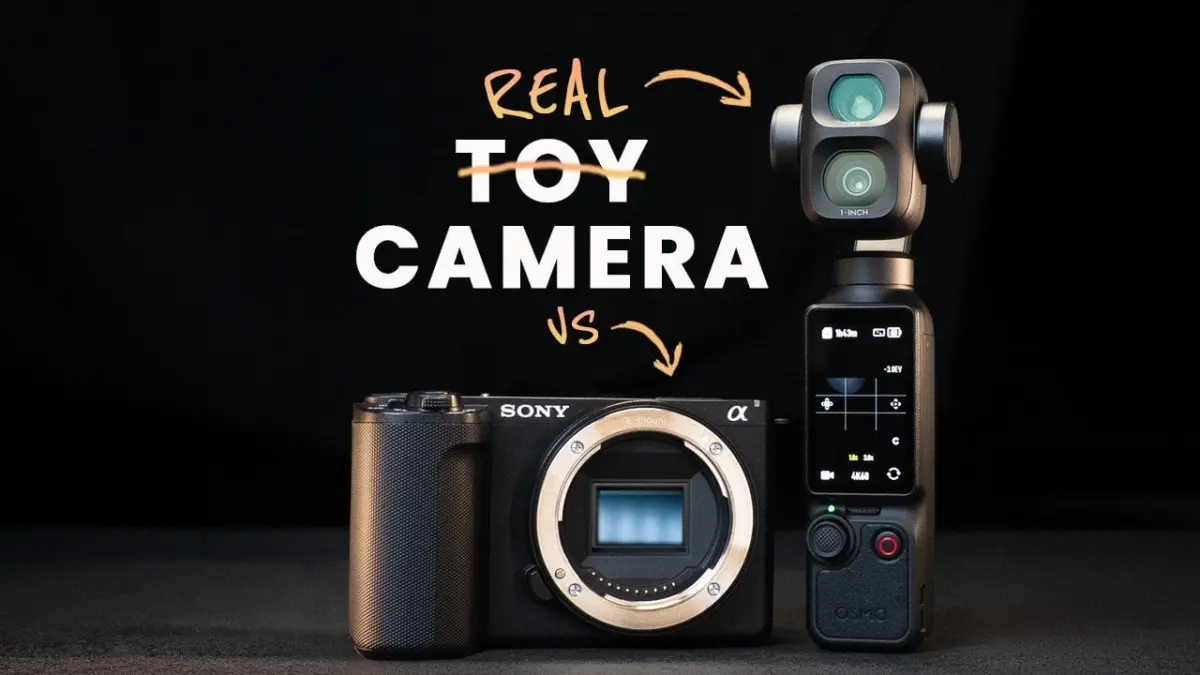
The modern landscape of content creation is defined by a constant tension between ultra-portable convenience and uncompromising professional fidelity. As vloggers, travel documentarians, and independent filmmakers demand increasingly powerful tools in smaller form factors, the debate between all-in-one pocket gimbals and interchangeable-lens mirrorless cameras has never been more intense. At the center of this technological tug-of-war are two standout devices: the DJI Osmo Pocket 4P and the Sony ZV-E10 Mark II.
While both cameras target the broad ecosystem of digital creators, they approach image-making from fundamentally different engineering philosophies. The DJI Osmo Pocket 4P prioritizes pocket-sized agility, leveraging a built-in mechanical gimbal and dual-sensor versatility to capture buttery-smooth, vibrant footage on the fly. Conversely, the Sony ZV-E10 Mark II caters to creators who demand professional-grade performance, anchoring its architecture around a larger APS-C sensor, an adaptable E-mount lens ecosystem, and superior low-light sensitivity.
Recent analysis from The Film Alliance highlights that choosing between these two devices is not simply a matter of picking the "better" camera; rather, it requires a nuanced evaluation of workflow requirements, budget constraints, physical availability, and creative ambitions. This comprehensive analysis will dissect how the Sony ZV-E10 Mark II manages to edge out the DJI Osmo Pocket 4P in critical environments—specifically low-light scenarios—while exploring the distinct operational advantages each system brings to the table.
Detailed Chronology and Market Positioning
To understand how these two disparate devices have landed in direct competition, one must examine their respective market trajectories and deployment timelines.
The DJI Osmo Pocket lineage has steadily evolved from a niche consumer gadget into a powerful production tool. With the iteration of the Pocket 4P, DJI sought to push the boundaries of miniature videography by introducing a dual-sensor layout and blistering high-frame-rate capabilities. However, its market introduction has been complicated by international distribution logistics. Retailing internationally at approximately $575, the Pocket 4P often faces restricted availability in domestic markets like the United States, frequently driving up real-world acquisition costs due to third-party import markups and limited official stock.
On the other hand, the Sony ZV-E10 Mark II represents the maturation of Sony’s dedicated vlogging lineup. Positioned firmly as an accessible yet deeply capable mirrorless hybrid, it launched in the U.S. market with a stable price point of around $998. Unlike its pocket-sized competitor, the ZV-E10 Mark II benefits from Sony’s robust global distribution network, ensuring wide availability, extensive accessory support, and immediate integration into existing prosumer ecosystems.
As creators increasingly cross-shop these options—weighing the sub-$600 novelty of an integrated gimbal camera against a $1,000 modular mirrorless setup—the market has divided into two distinct camps: those who value frictionless grab-and-go portability, and those who invest in long-term optical modularity.
Supporting Context, Hardware Metrics, and Deep-Dive Performance
1. Build Quality, Ergonomics, and Form Factor
- DJI Osmo Pocket 4P: Engineered entirely around ultimate portability. Its standout mechanical 3-axis gimbal eliminates micro-jitters inherently, providing mechanical stabilization that software algorithms alone struggle to replicate. The integration of dual sensors—catering to distinct wide-angle and telephoto perspectives—makes it an all-in-one marvel for casual users and spontaneous creators. However, its dependency on smartphone activation for full feature unlocking can present workflow hurdles and privacy considerations for certain professionals.
- Sony ZV-E10 Mark II: Built as a traditional, highly versatile mirrorless body. It features a larger physical footprint dominated by its APS-C sensor and an interchangeable lens mount. While it lacks a built-in mechanical gimbal, its larger screen size simplifies menu navigation, playback, and precise composition. Advanced multi-interface shoe connectivity allows for seamless attachment of professional shotgun microphones and external monitors without messy cable management.
2. Video Performance and Low-Light Superiority
The core battleground between these two devices lies in their video processing capabilities, dynamic range, and sensor physics.
- Resolution and Frame Rates: The Pocket 4P punches well above its weight class by offering 4K video recording at up to 240fps, delivering ultra-smooth slow-motion capture that is typically reserved for high-end cinema cameras. Meanwhile, the ZV-E10 Mark II caps its high-end slow-motion at 4K 120fps.
- The Low-Light Advantage: Despite the Pocket 4P’s high frame-rate prowess, the Sony ZV-E10 Mark II decisively beats the DJI Osmo Pocket 4P in low-light environments. Thanks to its significantly larger physical APS-C sensor, the Sony gathers substantially more light, retaining shadow detail, suppressing digital noise, and rendering cleaner footage when shooting at dusk, indoors, or in challenging mixed-lighting venues.
+------------------------+---------------------------+---------------------------+
| Performance Metric     | DJI Osmo Pocket 4P        | Sony ZV-E10 Mark II       |
+------------------------+---------------------------+---------------------------+
| Sensor Size            | Compact / Dual Sensors    | APS-C                     |
| Max 4K Frame Rate      | Up to 240 fps             | Up to 120 fps             |
| Low-Light Capability   | Good (Limited by sensor)  | Superior (Large APS-C)    |
| Stabilization          | Built-in 3-Axis Gimbal    | Electronic / External     |
| International Price    | ~$575 (Limited US stock)  | ~$998 (Widely Available)  |
| Lens System            | Fixed, Multi-perspective  | Interchangeable (E-Mount) |
+------------------------+---------------------------+---------------------------+
3. Color Science and Aesthetic Rendering
- Pocket 4P: Leans toward a punchy, vibrant aesthetic straight out of the box. Colors—particularly skin tones and open skies—are saturated and eye-catching, appealing directly to creators who want immediate social media readiness without deep color-grading sessions.
- ZV-E10 Mark II: Employs Sony’s refined color science to deliver more natural, balanced, and muted tones. It excels at managing difficult dynamic range challenges, such as backlit subjects or harsh high-contrast architectural lighting, maintaining tonal fidelity across difficult transitions.
4. Still Photography
When evaluating photography workflows, the ZV-E10 Mark II is the undisputed winner. Its larger APS-C sensor yields a vastly superior tonal range, high-resolution depth, and fine detail retention. The Pocket 4P is fundamentally optimized for video generation; while it can snap stills, it lacks the optical depth and sensor size required for professional-grade photography.
5. Stabilization Systems
- Pocket 4P: Relies on true physical mechanics. The built-in gimbal physically counters hand tremors and walking motions, allowing for floating camera movements without external hardware rigs.
- ZV-E10 Mark II: Relies on in-camera electronic stabilization and lens-based optical steady-shot, which can be further augmented by mounting the camera on gimbals, sliders, or tripods. While it demands extra setup time, this approach grants the operator total control over framing and cinematic movement.
6. Log Profiles and Post-Production Flexibility
For color graders and post-production specialists, both devices offer robust flat-profile recording:
- The Pocket 4P features Dlog-M II, striking an impressive balance between compressed dynamic range preservation and editing simplicity.
- The ZV-E10 Mark II incorporates S-Log 3, unlocking professional-grade dynamic range that rewards experienced editors with surgical control over highlights, shadows, and color grading vectors. Both systems, however, demand strict adherence to proper exposure discipline and locked white balances to avoid digital artifacts.
Official Statements and Industry Insights
Industry analysts and professional review boards have heavily scrutinized the positioning of both models. According to evaluations by The Film Alliance, the market segmentation is razor-sharp:
"Choosing between the DJI Osmo Pocket 4P and the Sony ZV-E10 Mark II is an exercise in balancing immediate physical convenience against long-term creative expansion. While DJI redefines what a pocket tool can achieve with high frame rates and mechanical stabilization, Sony establishes an uncompromising baseline for sensor size, optical flexibility, and low-light mastery that working professionals simply cannot ignore."
Furthermore, engineering commentaries emphasize that while miniature optics continue to improve at a staggering pace, the laws of physics still dictate that larger sensors—like the APS-C unit housed within the ZV-E10 Mark II—will retain the crown for low-light signal-to-noise ratios and dynamic range depth.
Future Outlook: Which Camera Fits Your Workflow?
As the digital creation space marches forward, the divergence between all-in-one consumer devices and modular mirrorless ecosystems will likely widen.
- Choose the DJI Osmo Pocket 4P if: You are a travel vlogger, lifestyle content creator, or casual shooter who values absolute minimalism. If your primary goal is to pull a camera out of your pocket, fire up 4K at blistering frame rates, and rely on a mechanical gimbal for instant stabilization without carrying lenses or rigs, the Pocket 4P is a phenomenal tool—provided you can navigate its regional availability.
- Choose the Sony ZV-E10 Mark II if: You are scaling up your production value, running commercial client shoots, or working extensively in poorly lit indoor environments. Its superior low-light performance, expansive E-mount lens library, professional S-Log 3 workflows, and true photographic capabilities make it a future-proof investment that grows alongside your creative career.
Ultimately, both cameras represent the cutting edge of their respective design paradigms. By carefully evaluating your shooting environments, post-production habits, and budgetary limits, you can select the precise instrument designed to elevate your visual storytelling.







Belum ada komentar. Jadilah yang pertama berkomentar!