


Executive Overview
Amazon’s dominance in the e-reader space has faced few serious challengers over the past decade and a half. However, as consumer appetites shift toward multimedia consumption and dynamic digital libraries, the tech giant has had to rethink the monochromatic limitations of traditional E-Ink technology. Following its initial foray into color e-readers in 2024, Amazon has significantly expanded its hardware ecosystem with a refreshed Kindle lineup encompassing a redesigned basic Kindle, an upgraded Paperwhite, and the crown jewel of the new release: the Kindle Colorsoft.
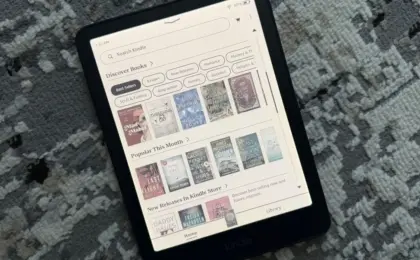
The newly released Kindle Colorsoft enters a maturing market with a distinct set of ambitions. Starting at $290 for the base model and scaling up to $320 for the heavily tested Signature Edition, the device represents a considerable financial commitment. Available in graphite or a sophisticated maroon-like "Fig" finish featuring a tactile, premium aluminum back, the Signature Edition doubles the storage capacity of the base model from 16GB to 32GB. While it retains the core 7-inch color E-Ink screen footprint of its predecessor—delivering a crisp 300ppi resolution for black-and-white content and a softer 150ppi for color output—the overarching design has undergone a noticeable weight-loss and thickness-reduction program.
For existing first-generation Colorsoft owners, the internal upgrades are largely iterative, making an immediate hardware swap hard to justify. Yet, for consumers who have lingered on the sidelines waiting for a mature, color-capable reading device that extends beyond standard black-and-white limitations, the new Kindle Colorsoft presents an intriguing, if expensive, proposition. This review provides a comprehensive analysis of the device’s physical redesign, its performance metrics, its software capabilities, and its ultimate positioning within the broader landscape of modern consumer electronics.
Detailed Chronology: The Evolution to Color E-Ink
The trajectory of Amazon’s Kindle line has been defined by steady, incremental refinements in lighting, screen resolution, and waterproofing. For years, the holy grail of e-reader development remained the quest for a color E-Ink display that could render illustrations, comic book panels, and magazine covers without sacrificing the battery efficiency and eye-comfort advantages of traditional electrophoretic displays.
The 2024 Inflection Point
When Amazon introduced the original Colorsoft in 2024, it marked a structural pivot for the brand. For the first time, users could view their digital bookshelves in original hues. However, first-generation hardware is rarely without its growing pains. Early iterations of color E-Ink often grappled with uneven lighting distribution, sluggish page refresh rates, and a pronounced "ghosting" effect—where residual text or images from prior pages lingered beneath new content.
The 2026 Refresh
Recognizing these consumer and journalistic critiques, Amazon’s engineering teams returned to the drawing board for the recent 2026 lineup overhaul. The latest iteration of the Kindle Colorsoft ditches the bulky bezels of past generations in favor of a sleek, edge-to-edge display glass panel.
During a multi-week testing period with the 32GB Signature Edition, several deliberate design corrections immediately came to light. Most notably, Amazon addressed a persistent ergonomic grievance from the previous generation: the placement of the power button. Previously situated squarely on the bottom edge of the device directly adjacent to the USB-C charging port, the power button was an accidental-press magnet, frequently shutting the device down mid-read when rested against a reader’s chest or lap. On the new Colorsoft, this button has been relocated to the top-right edge, resulting in a vastly more intuitive, interruption-free user experience.
Supporting Context & Metrics: Display Performance and Hardware Architecture
Evaluating an e-reader requires looking past conventional smartphone metrics like ultra-high refresh rates and vivid OLED color saturation. E-Ink technology operates on a fundamentally different physical principle, utilizing microscopic charged pigment particles that move within microcapsules when voltage is applied.

Resolution and Color Fidelity
The Kindle Colorsoft features a 7-inch color E-Ink panel. When displaying standard text-based novels, essays, or documents, the screen delivers a sharp 300ppi (pixels per inch) resolution, indistinguishable from the high-end Paperwhite models. However, when rendering chromatic elements—such as a vibrant comic book cover, a colorful infographic in a textbook, or an editorial magazine spread—the resolution scales down to 150ppi.
It is vital to calibrate expectations regarding color saturation. The colors produced by the Colorsoft are purposefully muted, avoiding the self-illuminated punchiness of an Apple iPad or an Android tablet. This subdued aesthetic is deliberate; it mimics the look of high-quality paper comic books or matte textbook prints rather than a backlit LCD screen. This restrained palette shines for specific use cases:
- Graphic Novels and Comics: Panels retain their artistic integrity without causing eye strain during extended reading sessions.
- Cookbooks: Dietary photography and step-by-step culinary guides become far more digestible when ingredients and finished dishes are accurately color-coded.
- Color-Coded Highlighting: Students and researchers who utilize multi-colored highlights for passages will find the system significantly more intuitive, as their color-coded notes remain distinct and easily filterable.
Lighting and Eye Comfort
Reading in variable lighting environments is managed via an advanced front-light matrix. The Colorsoft allows users to manually or automatically adjust the screen’s color temperature, shifting from a cool blue-white daylight spectrum to a warm, amber-toned yellow light designed to mitigate melatonin suppression during late-night reading sessions. Furthermore, the inclusion of an auto-adjusting brightness sensor dynamically adapts to ambient room lighting, removing the need for manual slider adjustments.
Refresh Rates and Ghosting Mitigation
One of the most impressive technical strides observed in the new Colorsoft is its software-hardware synergy regarding screen refreshes. On larger color E-Ink devices—such as the Kindle Scribe Colorsoft—screen flashes and full-page refreshes can occur with frustrating frequency as the processor struggles to clear lingering pigment cells.
By contrast, the 7-inch Colorsoft manages page transitions with remarkable grace. During testing, ghosting was virtually nonexistent under normal reading conditions, and the display required far fewer intrusive full-screen flashes to scrub residual images than its larger stablemate.
Battery Longevity and Durability
While standard everyday electronics demand daily charging, e-readers operate on a different temporal scale. Amazon rates the Colorsoft for up to eight weeks of battery life on a single charge under standard usage conditions (defined as 30 minutes of reading per day with wireless off and light brightness set to 13). Though this falls short of the class-leading 12-week endurance boasted by the monochrome-only Kindle Paperwhite, eight weeks of untethered operation means users can comfortably pack the device for extended trips without scrambling for a charging brick.
Additionally, the device features robust IP-rated waterproofing. Whether readers prefer reading in a filled bathtub or lounging poolside on a sunny afternoon, accidental splashes, dunks, or drink spills pose no existential threat to the internal circuitry.
Official Statements and Industry Perspective
Amazon’s product strategy for the 2026 hardware cycle centers on choice and vertical segmentation within the reading market. Speaking around the launch of the refreshed ecosystem, company representatives emphasized that the goal is not to force every consumer into a color device, but rather to tailor hardware to specific reading habits.

Industry analysts have noted that while color E-Ink technology remains an expensive niche due to the complex manufacturing processes required to overlay color filter arrays on top of electrophoretic backplanes, consumer demand for non-glare, eye-safe multimedia devices is steadily rising.
TechCrunch consumer news reporter Aisha Malik, who conducted extensive hands-on testing of the Signature Edition, summarized the market dichotomy clearly in her review:
"The biggest drawback of the Colorsoft is its price. It’s a steep investment for a device that’s just used for reading. That said, if you really want a color display, the Colorsoft is definitely worth considering. For everyone else, it’s a nice upgrade, but far from a must-have. Many readers would be better off with the basic Kindle or Paperwhite…"
This sentiment underscores a critical tension in modern consumer tech: the friction between feature accumulation and financial pragmatism.
Future Outlook: The Path Forward for E-Readers
As we look toward the horizon of digital publishing and hardware development, the Kindle Colorsoft provides a clear window into where the industry is heading—and where its physical boundaries still lie.
- Cost Reduction and Mass Market Adoption: The primary barrier preventing color E-Ink from dethroning monochrome displays is unit economics. As manufacturing yields improve and component supply chains mature over the next several years, expect to see the price delta between standard e-readers and color variants narrow significantly. Once color e-readers approach the $150–$200 sweet spot, monochrome devices will likely be relegated entirely to entry-level status.
- Advancements in Pigment Technology: Research into electrophoretic display technologies continues to accelerate. Future iterations of color E-Ink panels will almost certainly achieve higher native resolutions (pushing past 150ppi for color content) and broader color gamuts without sacrificing the low-power consumption and outdoor readability that define the medium.
- Ecosystem Integration: As publishers embrace richer digital layouts—incorporating embedded audio clips, interactive graphics, and dynamic educational modules—devices like the Kindle Colorsoft will serve as testbeds for a new generation of hybrid digital literature that bridges the gap between traditional books and tablet computers.
For now, the Kindle Colorsoft remains a specialized luxury tool—an exceptional piece of engineering tailored for graphic novel aficionados, students, and gadget enthusiasts who are willing to pay a premium for a splash of color on an eye-friendly canvas. For the average reader whose library consists predominantly of text-based fiction, the basic Kindle or the formidable Paperwhite remain the most logical financial choices. Yet, make no mistake: the transition to color E-Ink is no longer an experimental science project; it is a permanent, evolving pillar of the modern reading ecosystem.








Belum ada komentar. Jadilah yang pertama berkomentar!