

Executive Overview
Apple’s ongoing push to unify and elevate the gaming experience across its sprawling device ecosystem is taking another incremental yet significant step forward. With the official public rollout of iOS 26.2 slated for next month, developer betas are already offering a clear look at how the tech giant plans to polish its software suite before the end of the year. Chief among the beneficiaries of this upcoming minor point release is the Games app—a relatively new system application that made its debut earlier this cycle alongside iOS 26.
Introduced as a centralized dashboard designed to aggregate gaming activity, achievements, friend interactions, and library management across the iPhone, iPad, and Mac, the Games app represents Apple’s most concentrated effort yet to position its hardware as a serious, cohesive gaming platform. While the initial launch provided a functional foundational hub, user feedback quickly highlighted areas where interface friction and navigation could be optimized.
Responding to this early telemetry and consumer input, Apple has packed iOS 26.2 Developer Beta 2 with a series of quality-of-life enhancements. Although these updates—initially introduced in Beta 1 and more prominently showcased via a fresh splash screen in Beta 2—do not reinvent the application from the ground up, they directly address usability bottlenecks. By focusing on refined filtering options, cleaner library management, and smoother navigation, Apple is demonstrating a commitment to iterative improvement for its newly minted ecosystem services. This report provides a comprehensive breakdown of the iOS 26.2 Games app updates, analyzes their significance within Apple’s broader gaming strategy, and explores the long-term outlook for the platform.
Detailed Chronology: The Evolution of Apple’s Gaming Hub
To fully understand the significance of the iOS 26.2 refinements, it is necessary to examine the timeline of how Apple’s dedicated gaming infrastructure has evolved over recent software generations.
The Genesis: iOS 26 and the Birth of a Dedicated Hub
For years, Apple’s approach to gaming on iOS, iPadOS, and macOS was somewhat decentralized. Game Center operated largely in the background as a matchmaking and achievements layer, while the App Store served as the primary commercial storefront. Users looking to track their playtime, view friend activity, or manage installed titles across multiple devices often had to navigate disparate menus or rely on third-party solutions.
That paradigm shifted dramatically with the release of iOS 26. Apple introduced two entirely new system apps to the iPhone home screen, the most notable for gamers being the Apple Games app. Positioned as a unified command center, the app brought together local titles, App Store discoveries, Apple Arcade subscriptions, and social features into a single, cohesive interface. Designed from the ground up to synchronize seamlessly across iPhones, iPads, and Macs, the app signaled to developers and consumers alike that Apple was elevating gaming from a secondary feature to a core pillar of the Apple ecosystem experience.
The Transition to iOS 26.2: Early Betas and User Feedback
Following the initial high-profile launch of iOS 26, Apple has adhered to its standard iterative update cadence. The upcoming iOS 26.2 update, scheduled for a public release next month, has progressed rapidly through its testing phases.
- November 5, 2025: Apple sets expectations for the broader feature set and timeline of iOS 26.2, confirming a mid-to-late December public deployment window.
- November 12, 2025: Apple releases iOS 26.2 Developer Beta 2 to registered testers. While Beta 1 quietly introduced under-the-hood adjustments and early interface tweaks to the Games app, Beta 2 brought these changes to the forefront with a dedicated, user-facing splash screen. This onboarding prompt highlights the new features explicitly, ensuring that early adopters and developers actively test the revised functionalities.
Supporting Context & Metrics: Analyzing the iOS 26.2 Refinements
The enhancements arriving in iOS 26.2 are best categorized as micro-adjustments aimed at reducing friction rather than flashy, headline-grabbing feature additions. None of the newly introduced adjustments are intended to aggressively court entirely new users to the platform; rather, they are precision-engineered to improve the day-to-day engagement loop for individuals already utilizing the hub.

Deconstructing the Changes
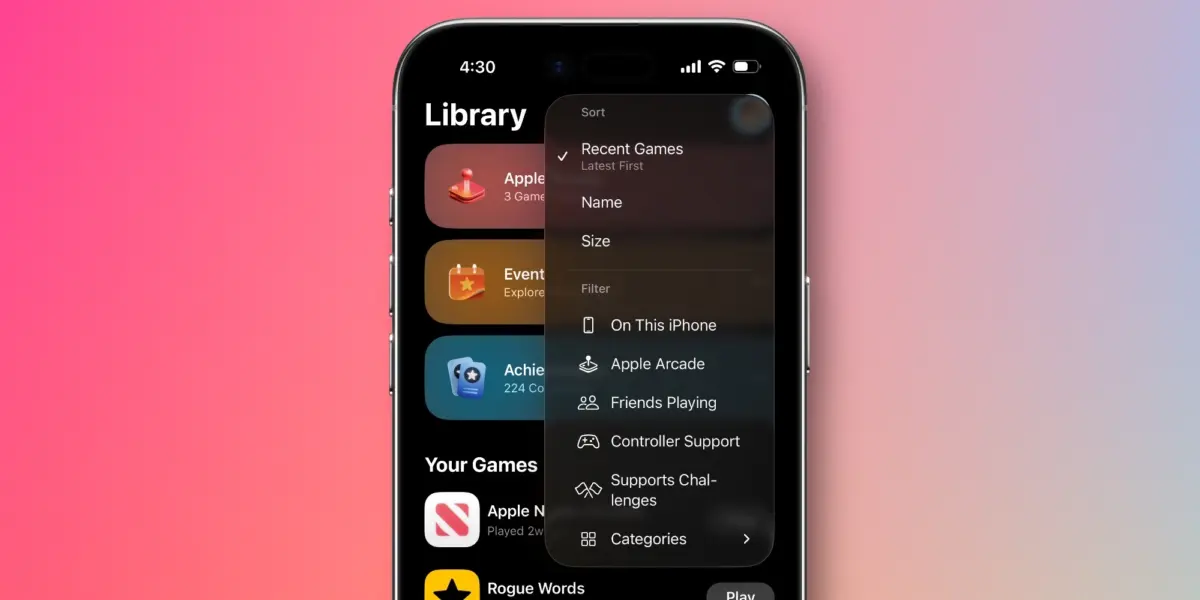
While comprehensive release notes from Apple continue to detail the broader system stability patches, early data and visual evidence extracted from Developer Beta 2 point toward three primary improvements within the Games app interface:
- Enhanced Filtering Capabilities: Navigating a rapidly expanding library of titles—spanning local installations, cloud-based play, and Apple Arcade subscriptions—can quickly become cumbersome. The updated filter parameters in iOS 26.2 allow users to sort their libraries with greater precision, separating genres, offline-capable titles, and ecosystem-specific achievements much faster than before.
- Streamlined Library Organization: Early user telemetry indicated that managing titles across disparate hardware nodes (such as shifting between an iPhone and an iPad) occasionally resulted in sorting anomalies. The new update implements more robust indexing protocols, ensuring that a user’s preferred layout and title visibility settings remain consistent across devices.
- Optimized Social and Activity Feeds: Interaction elements, such as checking friend scores or viewing recent achievement unlocks, have been visually streamlined to load more efficiently, minimizing interface stutter when transitioning between tabs.
The Philosophy of Quality-of-Life Updates
In the software development lifecycle of major operating systems, point releases like .2 often serve as the crucial crucible where initial consumer friction is smoothed out. Apple’s decision to swiftly address feedback regarding the Games app indicates that the company is monitoring engagement metrics closely. By investing engineering resources into these smaller design optimizations, Apple is signaling that the Games app is not merely a static feature checkbox, but a living ecosystem product that will require ongoing maintenance and refinement.
Official Statements and Developer Insights
While Apple typically lets its software updates speak for themselves through release documentation and developer documentation, industry observers and ecosystem analysts have weighed in on what these ongoing adjustments mean for the future of Apple silicon and gaming.
In recent developer documentation accompanying the iOS 26 developer cycles, Apple’s engineering teams have repeatedly emphasized cross-platform synergy. The integration between Metal—Apple’s advanced graphics API—and the Games app dashboard is designed to give players deep insights into hardware performance, graphical capabilities, and compatible peripherals (such as MFi-certified controllers).

Independent developers have expressed cautious optimism regarding the centralized hub. By providing a singular point of discovery and engagement, the Games app lowers the discoverability barrier for titles that might otherwise get lost in the immense volume of the standard App Store. One prominent iOS game developer noted:
"A centralized hub changes how players interact with their libraries. When Apple invests in making the Games app faster, cleaner, and easier to navigate, it directly benefits independent studios whose games rely on community visibility and quick session launches. These iOS 26.2 tweaks show that Apple understands the importance of reducing UI friction."
Future Outlook: Where Apple Gaming is Headed
As we look past the imminent release of iOS 26.2 and toward the horizon of future operating system iterations, the trajectory of Apple’s gaming ecosystem is becoming increasingly clear.
Bridging Mobile and Desktop Class Gaming
Apple’s long-term hardware strategy—anchored by powerful M-series chips in iPads and Macs, alongside increasingly capable A-series processors in flagship iPhones—has unlocked unprecedented graphical fidelity. AAA titles that were once exclusive to dedicated consoles and high-end PCs are finding their way onto iOS and macOS.

However, hardware power alone is insufficient; software infrastructure is what retains users. The Games app is the linchpin of this software infrastructure. Moving forward, industry analysts expect Apple to expand the capabilities of the hub to include deeper social integration, such as native voice chat overlays, cross-platform cloud save management improvements, and potentially more robust streaming or remote-play capabilities within the ecosystem.
What to Expect Next
As iOS 26.2 moves through its remaining beta iterations toward a public release next month, developers and early adopters will continue to test the limits of the updated Games app. While the immediate future holds only these minor, highly targeted quality-of-life improvements, they lay a sturdy foundation for more ambitious feature rollouts in subsequent updates.
For now, users actively utilizing the Apple ecosystem for their gaming needs can look forward to a cleaner, faster, and more responsive hub when iOS 26.2 drops.
Have you been using the Apple Games app on your iPhone, iPad, or Mac? Do any of the upcoming iOS 26.2 changes align with features you’ve been hoping for? Let us know your thoughts in the comments below.







Belum ada komentar. Jadilah yang pertama berkomentar!