

Executive Overview
Beneath the hum of modern global industry—flowing through the veins of oil refineries, chemical plants, nuclear reactors, and municipal water treatment facilities—lies a massive, hidden network of industrial piping. Keeping this infrastructure functional requires millions of heavy, manual interventions. For generations, the grueling task of fastening and unfastening bolted flange joints—the heavy-duty hardware that connects sections of industrial piping—has fallen squarely on the shoulders of skilled pipefitters.
It is high-stakes, physically punishing labor. Workers frequently endure 12-hour shifts for months at a time, wrestling with heavy torque tools in cramped, hazardous environments. The toll is visible: chronic physical injuries, debilitating fatigue, and a compounding labor shortage that has plagued North American heavy industry for decades.
Enter Lindsey Elliott, a former ExxonMobil engineer and planner who has spent her career immersed in the mechanics of heavy infrastructure. Recognizing the unsustainable pressures facing the blue-collar workforce, Elliott founded Nexterity, a venture-backed hardware startup designed to fundamentally modernize industrial maintenance. Selected as one of the elite Startup Battlefield 200 participants at TechCrunch Disrupt, Nexterity has developed a compact, remote-controlled robotic system designed to take over the arduous task of bolting and unbolting industrial flanges.
By introducing automation to an overlooked corner of the industrial economy, Nexterity aims to boost stagnant productivity metrics, slash injury rates, and keep aging critical infrastructure running smoothly. Operating under the mantra "more dork, less torque," the company is poised to disrupt a foundational multi-billion-dollar market.
Detailed Chronology: From ExxonMobil Planning to the Bolting Symposium
To understand the Genesis of Nexterity, one must trace Lindsey Elliott’s professional evolution from corporate energy planning to the specialized, highly technical niche of industrial bolting.
During her tenure at ExxonMobil, Elliott’s day-to-day responsibilities involved scrutinizing the complex logistics required to maintain and optimize the infrastructure moving oil, gas, and petrochemicals. While many engineers focus on chemical reactions or fluid dynamics, Elliott gravitated toward a more fundamental physical bottleneck: the connection points.
The Realization on the Factory Floor
Through years of visiting job sites and speaking directly with trade professionals across the United States and Canada, Elliott identified a systemic efficiency crisis. North American pipefitting productivity was notoriously low, dragging down capital project timelines and inflating maintenance budgets.
The root cause was multifaceted. The industrial sector is facing a severe demographic shift, with veteran tradespeople retiring faster than apprentices can be recruited. Those who remain on the job are subjected to grueling schedules—such as working 12-hour shifts for three consecutive months during turnarounds and maintenance shutdowns. Fatigue sets in, safety margins narrow, and injuries accumulate.
Immersion in the "Torque Dork" Community
To engineer a viable solution, Elliott immersed herself in the specialized subculture of industrial fastening. She became a regular attendee at the annual Bolting Symposium—attending its 13th iteration, where she fondly recalls competing in "Bolting Bingo" alongside self-proclaimed "torque dorks" and mechanical engineering purists.
It was at these industry gatherings and through close collaboration with members of the Pressure Vessels & Piping Division of the American Society of Mechanical Engineers (ASME) that Elliott uncovered the critical data point that unlocked her startup’s product strategy.
Through her research, she learned that approximately 80% of industrial piping falls between two to eight inches in diameter (technically designated as NPS2 to NPS8). This high degree of dimensional standardization presented an extraordinary, largely untapped opportunity for targeted automation. If a robotic system could be engineered to handle this specific, highly repeatable range of pipe dimensions, it could address the vast majority of industrial flange connections without requiring custom engineering for every deployment.
Supporting Context & Metrics: The Scale of the Bolting Challenge
While the average consumer rarely thinks about industrial piping, its footprint across the global economy is staggering. The market for infrastructure maintenance, joint integrity, and piping accessories represents a massive economic engine.
Cross-Sector Applicability
Although Elliott’s initial insights were forged in the oil and gas sector, the applications for Nexterity’s technology extend far beyond fossil fuels. The exact same standard piping architecture is utilized across a diverse array of mission-critical industries:
- Water and Wastewater Treatment: Ensuring municipal grids can maintain and expand their processing facilities safely.
- Food and Beverage Manufacturing: Meeting stringent hygiene and continuous-uptime demands in industrial processing plants.
- Mining Operations: Maintaining slurry and mineral transport lines in remote, hostile environments.
- Nuclear Energy: Servicing piping systems where worker exposure to radiation and physical strain must be strictly minimized.
- Green and Sustainable Manufacturing: Supporting the buildout of next-generation green hydrogen facilities, carbon capture plants, and advanced biofuel refineries.
Anatomy of the Nexterity Robot
To penetrate these massive markets, Nexterity designed a hardware solution that prioritizes mobility, modularity, and ease of use.
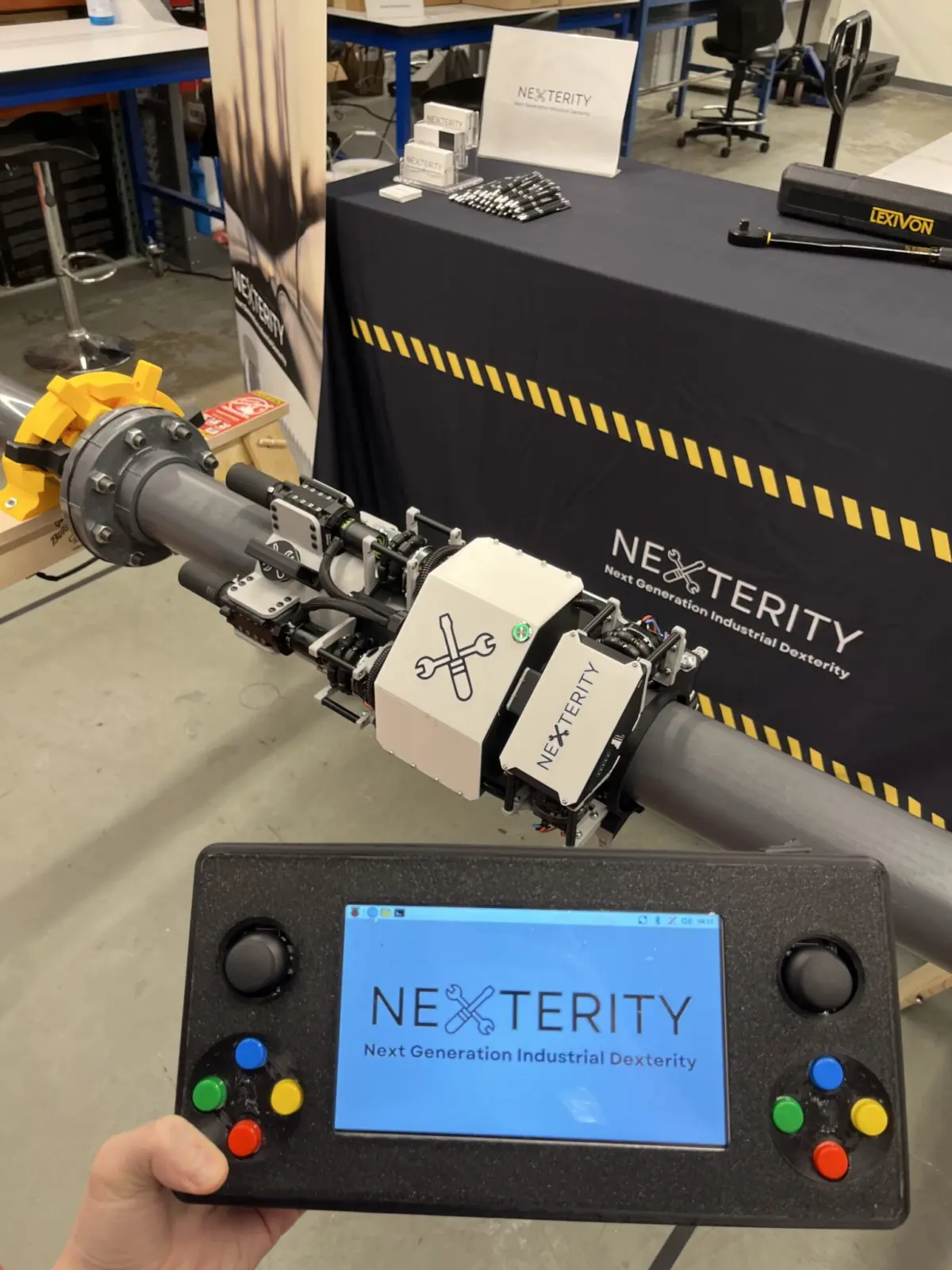
The system breaks down into two primary mechanical components that clamp securely around a pipe. Powered by high-capacity onboard batteries, the robot features an integrated drive mechanism that allows it to slide smoothly along the exterior of the pipe once mounted.
Upon reaching a targeted bolted flange joint, the robotic unit engages, rapidly and precisely loosening or tightening four bolts simultaneously. This parallel processing drastically reduces the time required to break down or seal a joint compared to traditional single-spindle manual or pneumatic tools.
Furthermore, engineering constraints dictated the physical footprint of the device. Nexterity developed multiple configurations to accommodate standard pipe variations within the NPS2 to NPS8 range. Crucially, every variation is engineered to be compact enough to fit inside a standard Pelican case, allowing a single worker to transport, deploy, and operate the system.
The Rental Equipment Business Model
Nexterity’s go-to-market strategy reflects a deep understanding of construction and industrial procurement cycles. Rather than forcing plant operators or mechanical contractors to purchase expensive, specialized robotic capital equipment outright, Nexterity treats its units like rental construction equipment.
This flexibility makes adoption frictionless for contractors. Crews can rent the Pelican-case-sized units for specific turnaround windows, deploy them immediately to remote job sites without heavy logistical overhead, and return them when the maintenance cycle concludes.
Official Statements and Industry Perspective
The intersection of blue-collar trades and advanced robotics is a delicate space. Industry veterans are often skeptical of automated solutions that promise to replace human touch in high-risk environments. However, Elliott emphasizes that Nexterity’s goal is augmentation and protection, not outright displacement.
Reflecting on the grueling realities of the trade, Elliott shared her observations with TechCrunch:
"Those people get really tired when they’re asked to work 12 hours a day for three months in a row. I’ve talked to pipefitters across the U.S., across Canada, and just repeatedly have been told North American pipefitting productivity is notoriously low."
By removing workers from the physical line of fire—eliminating repetitive strain injuries, awkward body mechanics, and the sheer exhaustion of manual bolting—the technology preserves the physical well-being of a depleted workforce.
Addressing the sheer scale of the addressable market, Elliott noted:
"I think it would shock a lot of people just how big this market is. I mean, day to day, most of us don’t think about piping infrastructure, but even water, wastewater, water treatment, food and beverage, mining, nuclear, any kind of green and sustainable manufacturing facility — they all use the same kind of piping."
By speaking the language of the "torque dorks" and leveraging precise engineering data regarding pipe diameters, Elliott has positioned Nexterity as a credible, insider-driven disruptor in a historically conservative industrial sector.
Future Outlook: Transforming the Blue-Collar Job Site
As Nexterity steps onto the stage at TechCrunch Disrupt’s Startup Battlefield 200, the company stands at a critical inflection point. The convergence of labor shortages, tightening safety regulations, and rising operational costs has created a generational window of opportunity for industrial automation.
The Road Ahead for Nexterity
Over the coming quarters, Nexterity’s primary objectives will center on field validation, scaling its manufacturing capabilities, and expanding its rental fleet availability across North America. Pilot programs with major industrial contractors will serve as the proving ground to solidify metric-driven productivity gains—demonstrating precisely how many hours and physical strain-points the robots can shave off a scheduled plant turnaround.
Broader Implications for Industrial Robotics
Nexterity’s trajectory highlights a broader shift in the venture capital and tech startup ecosystems. For years, the spotlight has been dominated by software, artificial intelligence, and consumer gadgets. However, founders like Lindsey Elliott prove that profound economic value lies in solving unglamorous, heavy-industrial problems.
By applying clever mechanical engineering to the humble bolt, Nexterity is not merely building a better tool; it is writing a new playbook for industrial labor. If successful, the future of pipefitting will feature significantly less physical torque, far fewer workplace injuries, and a smarter, more sustainable approach to maintaining the infrastructure that powers our modern world.









Belum ada komentar. Jadilah yang pertama berkomentar!