

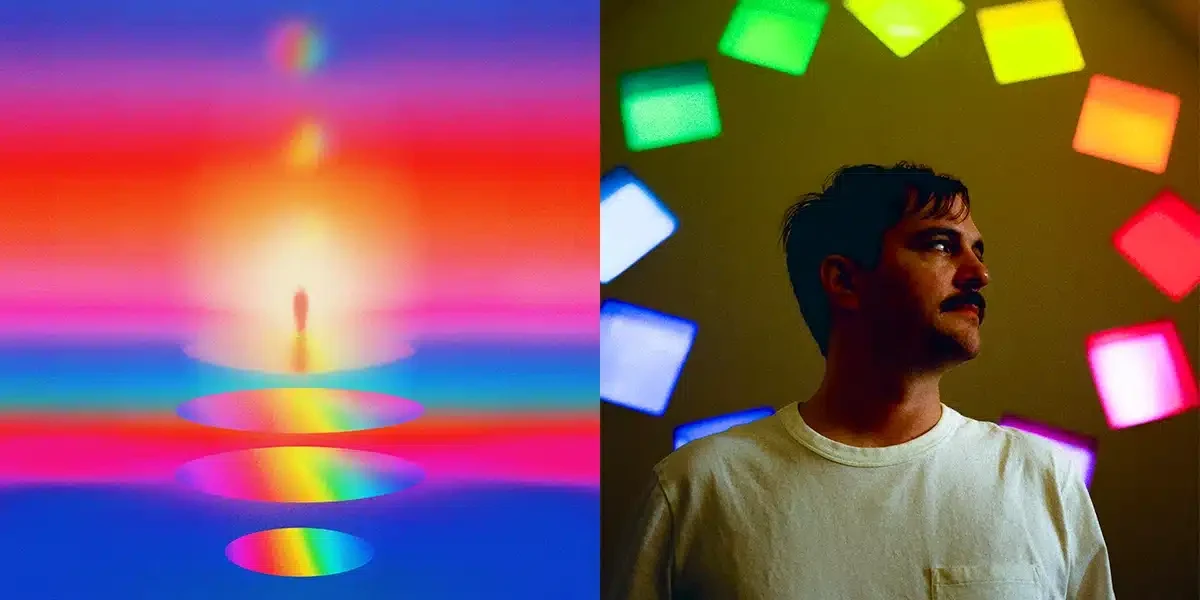
Executive Overview
When the Texas-based multi-instrumentalist Roger Sellers—recording under the moniker Bayonne—first surfaced with his critically lauded 2016 sophomore LP, Primitives, music critics scrambled for suitable lineages. A particularly perceptive review in PopMatters famously quipped: "If Debussy and Phil Collins fell in love, Bayonne would be their baby. (That’s a good thing.)"
Nearly a decade later, that evocative formulation remains remarkably apt. With his fourth full-length studio release, Filters, Bayonne deepens his artistic inquiry into expansive, highly polished pop-rock traditions, drawing overt inspiration from adult-contemporary luminaries like Phil Collins and Enya. Yet, Filters is no mere exercise in retro-pastiche or nostalgic 1980s mimicry. Instead, Bayonne filters these grand, widescreen pop aesthetics through the meticulous, loop-centric production techniques of contemporary bedroom pop and electronic sound design.
The result is a compelling paradox: an album of astonishingly pristine sonic architecture where every acoustic resonance, synthetic pad, and field recording locks into place with mathematical precision. Across tracks like the portentous opener "Unexpected," the percussive pulse of "January," and the cavernous, drum-driven climax of "Alone For Now," Bayonne constructs an immersive ecosystem entirely of his own making.
However, this unprecedented level of solitary control introduces a profound artistic tension. Filters is a masterclass in texture, harmony, and seamless audio integration, yet its most electrifying moments arrive precisely when its immaculate surface begins to fracture—when a digital glitch warps a synthesizer or a galloping drum beat pushes past the gain threshold. This review-driven investigative deep dive examines the anatomy of Filters, exploring how Bayonne navigates the fine line between breathtaking sonic perfection and the creative necessity of friction in modern electronic production.
Detailed Chronology: The Evolution of Bayonne’s Sonic World
To understand the methodological sophistication underpinning Filters, one must trace the developmental arc of Bayonne’s career. Originally performing under his birth name, Roger Sellers, the artist built a reputation as a dynamic live-looping eccentric in Austin, Texas. Transitioning to the Bayonne moniker marked a pivotal pivot toward maximalist electronic textures, where organic instrumentation was continually broken down, sampled, and rebuilt through the rigorous logic of looping software.
From Primitives to Filters
- Primitives (2016): The breakthrough album that established Bayonne’s signature sound. It married cyclical, minimalist rhythmic patterns with sweeping melodic sentimentality, earning comparisons to both classic impressionist classical composers and polished 1980s pop auteurs.
- Temporary Mind (2019): A refinement of his loop-based methodology, showcasing a heightened emphasis on vocal melodies and broader structural dynamics, proving that his bedroom-pop origins could successfully scale to festival-sized arrangements.
- Filters (Current Era): Representing his most fully realized studio statement to date, the album synthesizes his affinity for organic-electronic hybridity. It abandons traditional band dynamics entirely in favor of an entirely self-contained orchestration model, where traditional folk instruments, orchestral hallmarks, and vintage synthesizers are funneled through digital processing filters.
Track-by-Track Structural Analysis
The chronological sequence of Filters plays out as a carefully paced architectural journey:
- "Unexpected": Serving as the programmatic gateway to the record, the track builds from gently plucked acoustic guitars and a mist-like piano into a cascading wall of sound. Here, vibraphones, woody marimbas, and airy harp glissandos establish the record’s primary tonal palette. Notably, an oscillating synthesizer is intermittently warped by digital pitch-bending, simulating the degradation of a vintage cassette tape—an early warning sign of the delightful imperfections lying beneath the record’s polished veneer.
- "January": A masterclass in organic integration, this track introduces a pedal steel guitar so seamlessly blended into the arrangement that its pitch-bending bends the listener’s perception of reality, granting the steel guitar the ethereal, celestial qualities usually reserved for orchestral harps.
- "Alone For Now": The dramatic emotional peak of the album. Driven by a relentless, galloping tom-tom rhythm executed by session percussionist Matt Toman, the track builds in emotional and sonic intensity until the raw audio data exceeds the digital gain threshold, ultimately disintegrating into a vast, cavernous echo. It stands as the album’s most daring subversion of its own immaculate production values.
Supporting Context & Metrics: The Anatomy of Modern "Sophisti-Hop"
The sonic signature of Filters relies on a deliberate, carefully cataloged set of instrumental pairings and production strategies that reflect contemporary listening habits and technological capabilities.
Instrumental Pairing Matrix
| Instrument Category | Specific Elements Used | Primary Sonic Function | Reference Point |
|---|---|---|---|
| Keyboard / Mallet | Resonating Piano, Vibraphone, Marimba | Mist-like foundation; chiming overtones falling like raindrops | Joe Jackson’s percussive Latin piano |
| Strings & Fretwork | Acoustic Guitars, Pedal Steel, Orchestral Harp | Warmth, celestial glissandos, textural harmonic expansion | Talk Talk (Spirit of Eden era) |
| Synthetic / Digital | Synthesizer Pads, Synthetic Rain, Loop Modules | Atmospheric conditioning, cyclical rhythmic momentum | 1980s Adult Contemporary & Enya |
| Field Recordings | Hiking trip audio, rain pads | Environmental realism, grounding digital perfection | Ambient soundscape design |
The "Sophisti-Hop" Paradigm
Critics have occasionally struggled to categorize music that adopts the lush, expensive sheen of 1980s adult-contemporary pop while relying on the modular, loop-based structural logic of 21st-century hip-hop and bedroom production. One might playfully coin the term "sophisti-hop" to describe this intersection.
Unlike traditional pop arrangements built in professional commercial studios by dozens of session players, Filters is constructed modularly. Loops are stacked upon loops; frequencies are carved out with surgical EQ precision; and acoustic instruments are captured, chopped, and looped to mimic the hypnotic repetition of electronic music. This methodology allows Bayonne to achieve a rare acoustic density: every frequency spectrum is occupied, yet the mix never feels congested or muddy.
Official Statements & Critical Perspectives
While Bayonne maintains absolute autonomy over the composition, recording, and arrangement processes of his music, the broader critical and musicological reception of Filters highlights a compelling artistic debate regarding the limits of solitary studio control.
The Aesthetics of Absolute Control
In promotional commentary surrounding his creative process, Bayonne has frequently emphasized the liberating nature of modern multi-instrumentalism. Armed with digital audio workstations, MIDI controllers, and physical instruments ranging from the marimba to the pedal steel, a modern auteur no longer needs to rely on the erratic schedules, disparate musical tastes, or interpersonal frictions of a traditional band lineup.
As noted in recent critical assessments of the album:
"Bayonne’s method offers almost the opposite possibility [of a traditional band]. He can conceive, perform, and arrange most of his musical world himself, giving him an extraordinary degree of control. That control is the source of Filters’ beauty, but also, at times, its limitation."
The Necessity of Musical Friction
Musicologists and long-time observers of adult pop-rock history—such as the lineage belonging to Phil Collins—frequently point out that Collins’ legendary 1980s output derived much of its emotional grit from the unpredictable interplay of world-class session musicians. When legendary guitarists, bassists, and horn players bounce ideas off one another, they introduce a natural human resistance. A player might miss a cue, introduce an unintended blue note, or execute a rhythmic syncopation that forces the primary songwriter to pivot in an unexpected direction.
By contrast, when a single creator acts as the architect, builder, and inspector of their own sonic environment, the risk shifts toward over-refinement. On Filters, everything sits together with remarkable, almost supernatural harmony. Yet, as critical listening reveals, the human ear instinctively craves tension—a dissonant chord, an unresolved cadence, or an accidental key change that shatters the glass ceiling of perfection.
Future Outlook: The Next Phase for Bedroom-Pop Auteurs
As Filters establishes Bayonne as a preeminent force in contemporary ambient pop, it simultaneously opens up fascinating questions about the future trajectory of solitary, loop-based composition.
The Technological Horizon
The boundary between physical performance and virtual simulation continues to blur at an exponential rate. On Filters, listeners are left to wonder: Is Bayonne actually playing the harp? Is it a session musician? Or a pristine virtual instrument plugin?
As physical modeling synthesizers and artificial intelligence-assisted audio generators become increasingly sophisticated, the burden of proof in acoustic authenticity will only intensify. Artists like Bayonne are at the bleeding edge of this evolution, proving that digital tools can be imbued with organic warmth and emotional resonance, provided they are guided by a distinct artistic vision.
Where Do We Go From Here?
The ultimate takeaway from Filters is not merely that one person can now construct an entire symphony orchestra and rhythm section from the comfort of a bedroom studio. That feat, while impressive, has become increasingly common in the modern digital age.
Instead, the true intrigue lies in what happens when a creator of Bayonne’s immense technical capability deliberately invites disruption. Whether through unexpected collaborations, intentional sonic decay (such as the glorious gain-threshold explosion at the end of "Alone For Now"), or structural unpredictability, the next frontier for bedroom pop lies in introducing friction into the machine.
Bayonne has already mastered the art of building a flawless sonic world. The thrilling question for his next creative epoch is simple: What happens when someone—or something—pushes back?









Belum ada komentar. Jadilah yang pertama berkomentar!