

Executive Overview
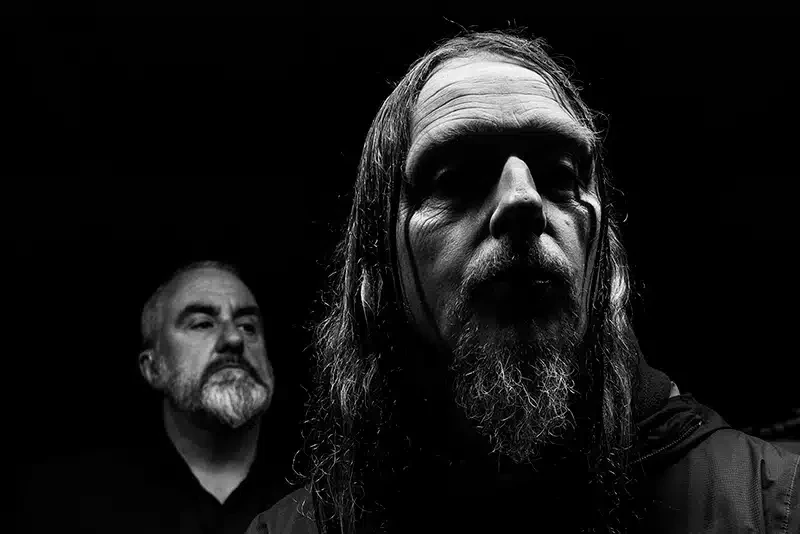
Since their emergence from the industrial heartlands of the United Kingdom in the late 1980s, Godflesh has stood as the unyielding monolith upon which modern industrial metal was forged. Long before mainstream alternative culture embraced the mechanized beats and distorted despair of the genre, the foundational British duo of vocalist, guitarist, and machinist Justin Broadrick and bassist Ben Green established a new vocabulary for heavy music. They married the inhuman precision of drum machines with down-tuned, subterranean basslines and agonizingly raw guitar feedback.
Now, more than three decades after their monumental 1988 self-titled debut, the band faces a definitive twilight. With the release of their tenth studio album, Decay—their first full-length offering for Relapse Records—Godflesh approaches the precipice of their announced dissolution. This is not merely another routine cycle of touring, recording, and promotional obligations; it is the penultimate chapter of an iconic career.
However, the impending conclusion of Godflesh arrives not as a artistic retreat, but as a mandatory cessation dictated by physical reality. Following medical warnings regarding severe abdominal strain and chronic hernia risks incurred by decades of visceral vocal exertion, Broadrick announced in March that Godflesh will never again perform live. Consequently, Decay occupies a unique and poignant position within their legendary discography.
Carved from the same pandemic-era recording sessions that yielded 2023’s Purge, Decay serves as both a companion piece and an aggressive evolution. Where Purge presented a relatively standard, albeit satisfying, masterclass in industrial weight, Decay frequently attempts to surpass the band’s own historical benchmarks. Divided into surgically precise tracks that hammer away at their patented design from fresh, hostile angles, the album sacrifices nothing for mass adulation. It is a uncompromising, heavy-handed testament to a band that never compromised its vision, proving once and for all that while Godflesh may be returning to dust, no contemporary act has ever truly usurped their throne.
Detailed Chronology: From the Ashes of Napalm Death to Industrial Supremacy
The Genesis and the 1988 Self-Titled Debut
To understand the cultural and sonic gravity of Decay, one must trace the harrowing lineage of Godflesh back to its inception. Justin Broadrick, having already cut his teeth as the teenage guitarist for grindcore pioneers Napalm Death and later alongside doom-metal innovators Head of David, sought to construct something entirely unprecedented. Teaming up with bassist Ben Green, Broadrick envisioned a hybrid genre that fused the minimal, hypnotic repetition of hip-hop beats—inspired heavily by early Public Enemy and Run-DMC—with the crushing, tectonic weight of extreme metal and industrial soundscapes.
The resulting 1988 self-titled debut EP (later expanded and recognized as a foundational full-length release) sent seismic tremors through the global underground. Tracks like "Avalanche Master Song" discarded traditional rock dynamics in favor of a cold, mechanized pulse. The human drummer was entirely replaced by a programmed rhythm box that sounded less like a percussion instrument and more like a factory assembly line crushing bone. This debut did not merely pave the way for industrial metal’s impending revolution; it codified the parameters of the entire subgenre, influencing generations of musicians who recognized the bleak, dystopian poetry in Broadrick and Green’s sonic architecture.
The 1990s: Critical Acclaim and Commercial Isolation
Throughout the 1990s, Godflesh released a succession of landmark albums that expanded their creative vocabulary while steadfastly refusing to court commercial radio. Masterpieces such as 1989’s Streetcleaner and 1992’s Pure established them as critical darlings. Streetcleaner, in particular, is frequently cited by musicologists and critics as one of the heaviest, most suffocating heavy metal records ever recorded. Its oppressive atmosphere captured the claustrophobia of urban decay and industrial alienation with terrifying fidelity.
Despite earning the deep reverence of peers like Metallica, Faith No More, and later generations of heavy music luminaries, Godflesh never achieved the mainstream commercial penetration experienced by contemporaries such as Ministry or Nine Inch Nails. While those acts climbed the Billboard charts and found rotation on MTV, Godflesh remained entrenched in the lower reaches of commercial viability. They were too abrasive for mainstream radio, too rhythmic for traditional metal purists, and too structurally complex for casual listeners. Yet, this commercial isolation shielded them from creative compromise, allowing the duo to refine a singular, uncompromising artistic identity.
Hiatus, Reformation, and the Modern Era
The pressures of the music industry, combined with internal friction and personal exhaustion, took their toll. Following the departure of founding bassist Ben Green and various lineup shifts, Broadrick put Godflesh on an indefinite hiatus in 2002—a period that ironically coincided with a broader mainstream decline in industrial metal’s commercial prospects. During this downtime, Broadrick channeled his creative energies into his ambient and post-metal project, Jesu, which eventually garnered critical acclaim from indie rock circles and figures as diverse as singer-songwriter Phoebe Bridgers.
To the elation of extreme music fans worldwide, Godflesh reformed in 2010, returning to the live stage with renewed vigor. This second act proved that their foundational blueprint had not aged a day; if anything, the modern sociopolitical landscape had finally caught up to the dystopian prophecies Broadrick had barked into microphones decades prior. Albums like 2014’s A World Lit Only by Fire and 2017’s Post Self demonstrated a ferocious creative resurgence, culminating in the 2023 release of Purge, which set the stage for their final recorded statement: Decay.
Supporting Context & Metrics: The Anatomy of Decay
Studio Mechanics and Production Values
Decay was forged in the isolation of Avalanche Studio, utilizing source material harvested during the same extended recording sessions that produced Purge. Freed from the physical demands of touring and the constraints of standard promotional schedules, the studio environment allowed Broadrick and Green to push their sonic extremes further than they had in years.
The album’s opening track, "Master and Slave," establishes an immediate power dynamic that reinforces the band’s trademark impenetrable trance. The drum machine’s cold, metallic crack cuts through the mix with surgical precision, serving as the heartbeat for a track that slowly suffocates the listener in layers of feedback and subterranean bass frequencies.
Unlike Purge, which favored a relatively standardized, cohesive industrial metal plate, Decay operates as its more volatile, experimental twin. Roughly half of the album’s 40-minute runtime is subdivided into shorter, punchier compositions. This structural choice allows the duo to dissect their patented design from sharply contrasting angles:
- "Feral Colony" accelerates the tempo to a feverish, blistering degree, riding a groove that boils like infected blood.
- "Fodder" abruptly shifts gears, utilizing a sluggish, death-rattle tempo that drags its listeners through industrial sludge.
- "Fear of Man" achieves the record’s most successful balancing act, successfully navigating the narrow channel between creeping psychological dread and soul-crushing, down-tuned chugs.
Lyrical Themes and Vocal Execution
As with much of Godflesh’s historic catalog, the lyrical content of Decay is fiercely economic. Broadrick utilizes as few words as humanly possible, favoring blunt, aphoristic statements that stress the irreversible decay of modern civilization. On tracks like "Living/Ending," Broadrick barks commands over a razor-sharp riff designed to drill through the thickest skulls.
Critics and long-time fans may note the physical toll on Broadrick’s delivery. Decades of shouting through abdominal strain have naturally altered the raw, visceral projection of his vocals. However, any critique regarding a perceived softening in vocal intensity misses the contextual reality of his medical condition. Even when operating at a measured cadence, Broadrick’s inside voice retains the capacity to induce spine-chilling unease. When the message erupts from his gut, as it frequently does on standout tracks like "Living/Ending," the emotional impact remains devastating.
Official Statements & Industry Impact
The Medical Reality Behind the Retirement
The announcement that Godflesh will permanently cease live performances sent shockwaves through the heavy music community in March. Speculation regarding creative differences or standard retirement was quickly put to rest by candid disclosures from Justin Broadrick himself. Decades of extreme vocal performance—relying entirely on intense, diaphragm-driven projection—have inflicted severe, cumulative damage upon his abdominal wall.
In official statements addressing the cancellation of all future touring obligations, Broadrick explained that continuing to perform live posed an unacceptable, recurring risk of severe hernias and debilitating physical injury. In the interest of long-term health and survival, the live incarnation of Godflesh was laid to rest.
This medical reality fundamentally reframes the nature of Decay. Rather than a calculated marketing rollout or a triumphant victory lap, the album is the product of an artist racing against the biological limitations of his own instrument. It is creation born of necessity, closure engineered through relentless sonic assault.
Peer Reverence and Legacy
While mainstream chart metrics have never told the full story of Godflesh’s influence, their cultural footprint within the heavy music ecosystem is immeasurable. Long before crossover acts and indie darlings began acknowledging industrial and post-metal influences, metal royalty understood Godflesh’s unique genius. Kirk Hammett of Metallica and members of Faith No More have routinely cited Godflesh as a primary touchstone for modern heavy music experimentation.
In an era where extreme metal frequently compromises its integrity for streaming algorithms and mass adulation, Godflesh stands as a monument to uncompromising artistic vision. Decay proves that they have nothing left to prove to the industry, to the critics, or to themselves.
Future Outlook: The End of an Era
As Godflesh prepares to release their tenth and final studio album through Relapse Records, the heavy music community confronts a landscape devoid of its most authentic industrial innovator. Decay ensures that the band will not go gently into the night.
Even the album’s lengthy closer, "Consume Me," exemplifies their uncompromising approach. Dragging heavily out of the gate, it eventually drops an industrial whip that brings all followers to their knees with each tortured, rhythmic scream. The repeated refrain, "Become me," echoes as a challenge to the countless younger bands who have attempted to replicate their formula and fallen hopelessly short.
Godflesh may be returning to dust, and the live stages of the world will never again vibrate to the mechanical pulse of Broadrick and Green in the flesh, but Decay cements an unassailable truth: when it comes to the harrowing, mechanized art of industrial metal, no band has ever come before them, and none shall ever truly replace them.









Belum ada komentar. Jadilah yang pertama berkomentar!