

Executive Overview
In the literary imagination, few figures loom as large—or retreat as completely—as Don DeLillo. For decades, the master architect of American postmodernism has operated beneath a self-imposed cloak of ascetic privacy, channeling his critique of media saturation, corporate hegemony, and existential dread through monumental novels like White Noise, Libra, and Underworld. DeLillo is famously reclusive, an author whose early public appearances yielded legendary deadpans, such as the time he produced a business card simply reading, “I don’t want to talk about it.”
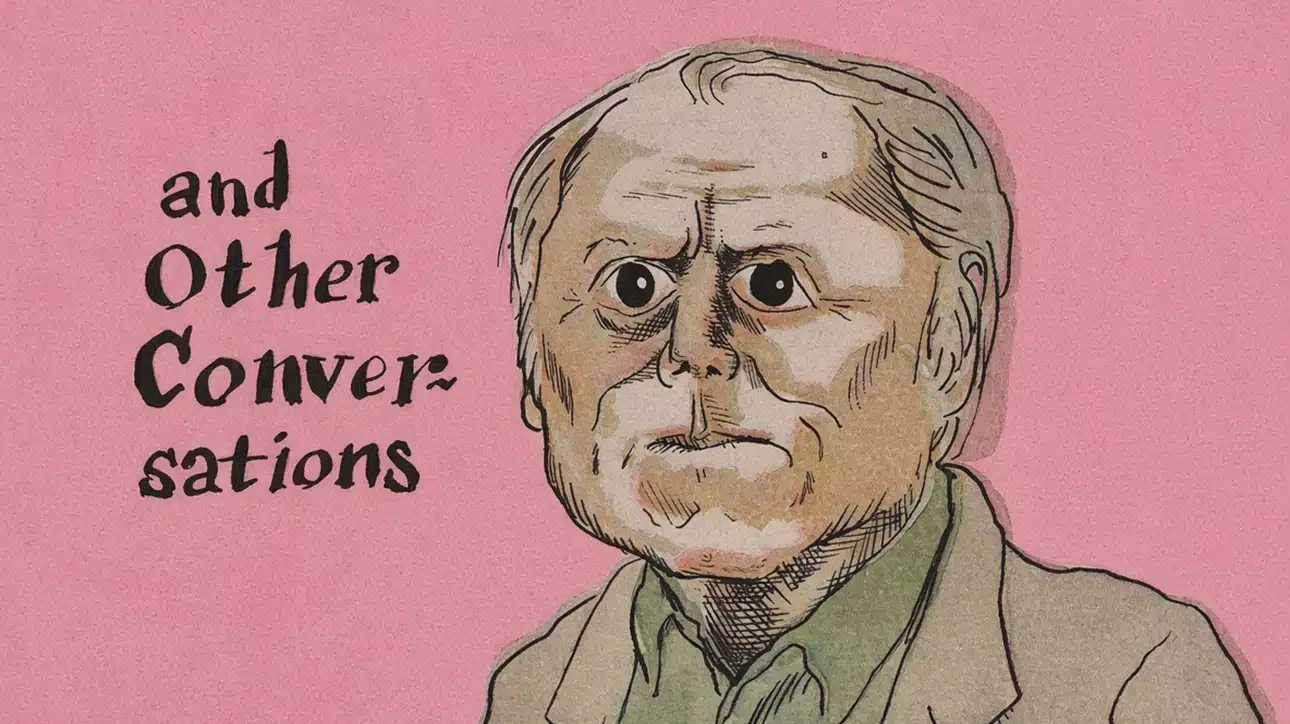
Yet, for artist and writer Drew Lerman, the lack of dialogue has only encouraged a richer, deeply personal form of creative ventriloquism. Enter Conversations with Don DeLillo, a new comic collection slated for 2026 that shares its title with Thomas DePietro’s 2005 anthology of actual interviews, but completely subverts its premise. Lerman’s book chronicles a series of entirely imaginary, peripatetic strolls and chats with the nearly nonagenarian literary titan.
Blending high-art literary criticism with the absurd, deadpan cadence of classic newspaper comic strips, Lerman’s work explores what happens when an obsessed fan renders his idol approachable, social, and remarkably game for surreal banter. Far from a mere parody, the project evolved into an intimate meditation on artistic ambition, New York creative life in the early 2010s, and the universal urge to seek counsel from our greatest cultural architects. As viewed through the lens of long-time readers, scholars, and the artist himself, this comic collection sits at the fascinating intersection of literary hero-worship and avant-garde cartooning.
Detailed Chronology: From High School Revelation to 2026 Comic Reality
To understand the genesis of Lerman’s project, one must trace a trajectory that spans two decades of reading, writing, and artistic evolution.
The Seed: Summer 2005
The foundational stone for Lerman’s comic universe was laid two decades ago, during the summer he graduated from high school. While many of his peers were consuming lighter fare, Lerman encountered Underworld (1997), DeLillo’s panoramic, thousand-page epic exploring the shadow history of the Cold War, baseball, waste management, and the macrocosm of millennial America. The impact was immediate and irreversible. DeLillo vaulted to the status of Lerman’s favorite living writer—a position he would hold through every subsequent phase of the artist’s creative development.
The New York Years: Early 2010s
As Lerman moved to New York City to chase the arduous, often isolating dream of becoming a novelist, he found himself immersed in the specific anxieties of the young urban creative. The early 2010s were marked by the relentless hustle of pitching manuscripts, navigating editors, and surviving the economic and cultural pressures of the metropolis. Unbeknownst to Lerman at the time, the intellectual residue of these struggles—the self-doubt, the introspection, and the persistent internal monologues—was quietly cataloging itself, waiting for the right artistic vehicle.
The Real-Life Interruption: 2012
A pivotal moment in the public lore of contemporary American letters occurred at a New York Public Library event featuring Don DeLillo. During the proceedings, fellow heavyweight author Jonathan Franzen famously interrupted DeLillo—a real-life incident that would later be immortalized in Lerman’s comic strips as a recurring comedic barricade, preventing the protagonist from ever finishing long-awaited answers.
The Conception and Execution of the Comic
Fast-forward to the mid-2020s. Lerman realized that DeLillo occupied a unique cultural sweet spot. While equally foundational as peers like Thomas Pynchon or David Foster Wallace, DeLillo possesses an "inside-baseball" aura that makes him ripe for subtle, deadpan humor. "It just felt right to steal the title; as soon as it occurred to me it was decided," Lerman notes regarding his cheeky appropriation of Thomas DePietro’s 2005 interview collection.
As the comic strips began to take shape, Lerman noticed a surprising shift. What started as a conceptual joke—placing a famously cryptic literary icon into casual, mundane dialogue—transformed into something deeply personal. The frustrations, aspirations, and memories of Lerman’s early days trying to make it as a writer in New York bled into the strips, anchoring the absurdist humor in genuine emotional vulnerability.
Supporting Context & Metrics: The DeLillo Phenomenon and the Comic Form
To fully appreciate the weight of Lerman’s satire, one must examine the cultural footprint of Don DeLillo and the structural mechanics of the comic strip format.
The Prescience of Don DeLillo
DeLillo’s body of work is frequently celebrated for a single, terrifying quality: prescience. Long before the digital age reduced human consciousness to an endless stream of notifications, DeLillo was diagnosing the malady. Consider the literary timeline:
- 1985 (White Noise): Foresees the rise of psychopharmaceuticals, academic consumerism, and "toxic events" entering daily parlance.
- 1991 (Mao II): Anticipates the shift of global conflict and terrorism into the realm of media spectacle nearly a decade before the War on Terror.
- 2001 (Cosmopolis): Predicts the financial collapse and anti-corporate uprisings (akin to Occupy Wall Street) six years prior to their actualization.
- 2003 (Libra): Explores conspiratorial thinking and information overload as the fundamental fabric of modern paranoia.
- 2020 (The Silence): Publishes a novella envisioning a sudden, global technological blackout just as the world retreated into pandemic lockdowns.
Given this track record of prophetic cultural observation, readers of DeLillo are left with a lingering, almost compulsive question: What would Don DeLillo say about the bewildering state of the modern world? Lerman’s comic is, in many ways, an elaborate, artistic answering of that exact question.
Structural Rigidity: The Comedy of Repetition
Lerman’s comic strips do not merely rely on dialogue; they adopt the structural rigor of classic twentieth-century newspaper comics like Krazy Kat or Count Screwloose. Every single strip concludes with the exact same beat: Don DeLillo (or occasionally another literary guest) offering unprompted, effusive praise for Drew Lerman’s artwork.
This refusal to deviate from the formula is an intentional artistic challenge. As Lerman explains, the core mechanic asks how an author can repeat the same basic joke for years or decades while keeping it fresh and engaging for both creator and reader. The contrast between DeLillo’s real-world reputation—guarded, taciturn, and philosophically aligned with James Joyce’s maxim of "silence, exile, cunning"—and the comic avatar’s warm, supportive mentorship creates an exquisite comedic tension.
Official Statements & Perspectives
The interplay between the real Don DeLillo, his scholarly community, and the creator of the comic reveals a multi-layered dialogue about art, fandom, and institutional legacy.
The Scholar’s View
From the perspective of long-time readers, academics, and institutions dedicated to preserving the author’s footprint—such as the Don DeLillo Society—Lerman’s fictional conversations ring remarkably true. Good fiction, after all, creates its own internal logic.
Reading White Noise or Underworld invariably triggers a psychological transformation in the reader. One walks the streets seeing the world differently, catching cadence in everyday signage, and occasionally spouting spontaneous DeLillo-esque aphorisms: "All plots move deathward," or "The family is the cradle of the world’s misinformation." Finding another human being who has not only internalized these rhythms but visualized them in cartoon form offers a profound sense of validation to the broader community of DeLillo devotees.
The Creator’s Reflections
Drew Lerman is candid about the construction of his cartoon avatar and the liberties he took with the subject’s likeness and behavior:
"He’s not generally the greatest interview subject—he’s not especially forthcoming or chatty, and often repeats the same ideas from interview to interview. And so I just tried to recreate in cartoon form the person I’ve gleaned from his public remarks and appearances. I didn’t worry too much about nailing his physiognomy in the strips, although I am pleased with how I drew him on the cover."
This loose approach to physiognomy permits brilliant absurdist moments. Comic DeLillo is subjected to inquiries about Instagram—a platform the ontological theorist of White Noise might understand on a systemic level, but would likely view with supreme skepticism—or quizzed about Lenny Bruce in Miami during the Cuban Missile Crisis, only to offer a flat, perfectly in-character: "Vaguely."
Furthermore, Lerman uses the medium to take lighthearted, affectionate swipes at the broader literary ecosystem. The alt-rock band The Airborne Toxic Event (named directly after a toxic cloud in White Noise) receives passing nods, while Jonathan Franzen acts as the permanent narrative foil. In Lerman’s panels, Franzen bursts into scenes to interrupt DeLillo, shouting, "I’ll never read your comics! Never!" before eventually breaking down in tears to admit, "Your comics are beautiful, Drew."
Anticipating the Master’s Verdict
What would the real Don DeLillo think if he were to stumble upon Conversations with Don DeLillo? Lerman remains remarkably grounded regarding his subject’s likely reaction:
"I don’t think he’d be bothered by it, or especially amused. Just more cultural detritus floating through America."
Yet, true to the spirit of the project, Lerman leaves the door open for the ultimate surreal encounter:
"Pero," Lerman concludes, "if he ever does read it, and feels inspired to take a walk with me, I’m ready."
Future Outlook: The Legacy of Conversations with Don DeLillo
As the 2026 release of Conversations with Don DeLillo approaches, the book stands as a testament to the evolving nature of literary fandom in the digital age. We live in an era where fan fiction, meme culture, and graphic literature frequently intersect with high-brow academic critique. Lerman’s work bridges these worlds effortlessly, proving that reverence and irreverence are not mutually exclusive.
For literary scholars, Conversations with Don DeLillo provides a fresh pedagogical lens—a reminder that great literature invites play, not just solemn, archival worship. For comic enthusiasts, it offers a masterclass in structural joke-writing and character-driven absurdist humor. And for anyone who has ever closed the back cover of Underworld or White Noise and wished they could walk side-by-side with the author through the amber waves of American consumerism, Lerman’s book offers the next best thing: a beautifully rendered, deeply sentimental daydream where the master smiles, nods, and tells you that your work is beautiful.









Belum ada komentar. Jadilah yang pertama berkomentar!