

Executive Overview
The global semiconductor landscape is undergoing a monumental, historic paradigm shift. For decades, the high-performance computing market operated under an immutable duopoly anchored by a singular, towering giant: Intel Corporation. For generations of PC enthusiasts, enterprise data architects, and financial analysts alike, Intel was the undisputed king of silicon, dictating market margins, technological cadences, and baseline industry expectations.
Today, that decades-old hierarchy is not merely being challenged—it is actively being dismantled.
Advanced Micro Devices (AMD) has officially posted another record-shattering quarter, pulling in a staggering $13.38 billion in revenue alongside a robust net income of $2.43 billion. More significantly, forward-looking financial guidance provided by AMD Chief Financial Officer and Treasurer Jean Hu indicates that this upward trajectory will only accelerate. AMD has projected a monumental revenue target of approximately $17 billion for the upcoming quarter.
To put this figure into proper historical perspective, rival Intel’s projected revenues hover between $15 billion and $16 billion, figures that have remained largely flat or experienced slight sequential contractions. Should AMD’s Q4 projections materialize as forecasted, it will mark a watershed moment in corporate technology history: the first time AMD generates higher quarterly revenue than Intel.
For industry watchers who survived the dark days of the mid-2010s—when AMD was routinely written off as a beleaguered underdog fighting for survival with uncompetitive architectures—this turnaround under the visionary leadership of CEO Dr. Lisa Su is nothing short of miraculous. This report explores the financial mechanisms, historical data trajectories, and strategic market maneuvers driving this unprecedented shift in the computing hardware echelon.
Detailed Chronology: From the Brink of Insolvency to Silicon Supremacy
To fully comprehend the magnitude of AMD’s current financial triumph, one must look backward to understand the depths from which the company climbed. In the mid-2010s, AMD was trapped in a seemingly inescapable loop of uncompetitive products. Its "Bulldozer" processor architecture proved to be a massive misstep in the consumer and server markets, crippled by poor power efficiency and underwhelming instruction-per-clock (IPC) performance compared to Intel’s formidable Core series. Debt mounted, stock prices languished in the single digits, and industry pundits frequently questioned whether the fabless chipmaker could avoid bankruptcy.
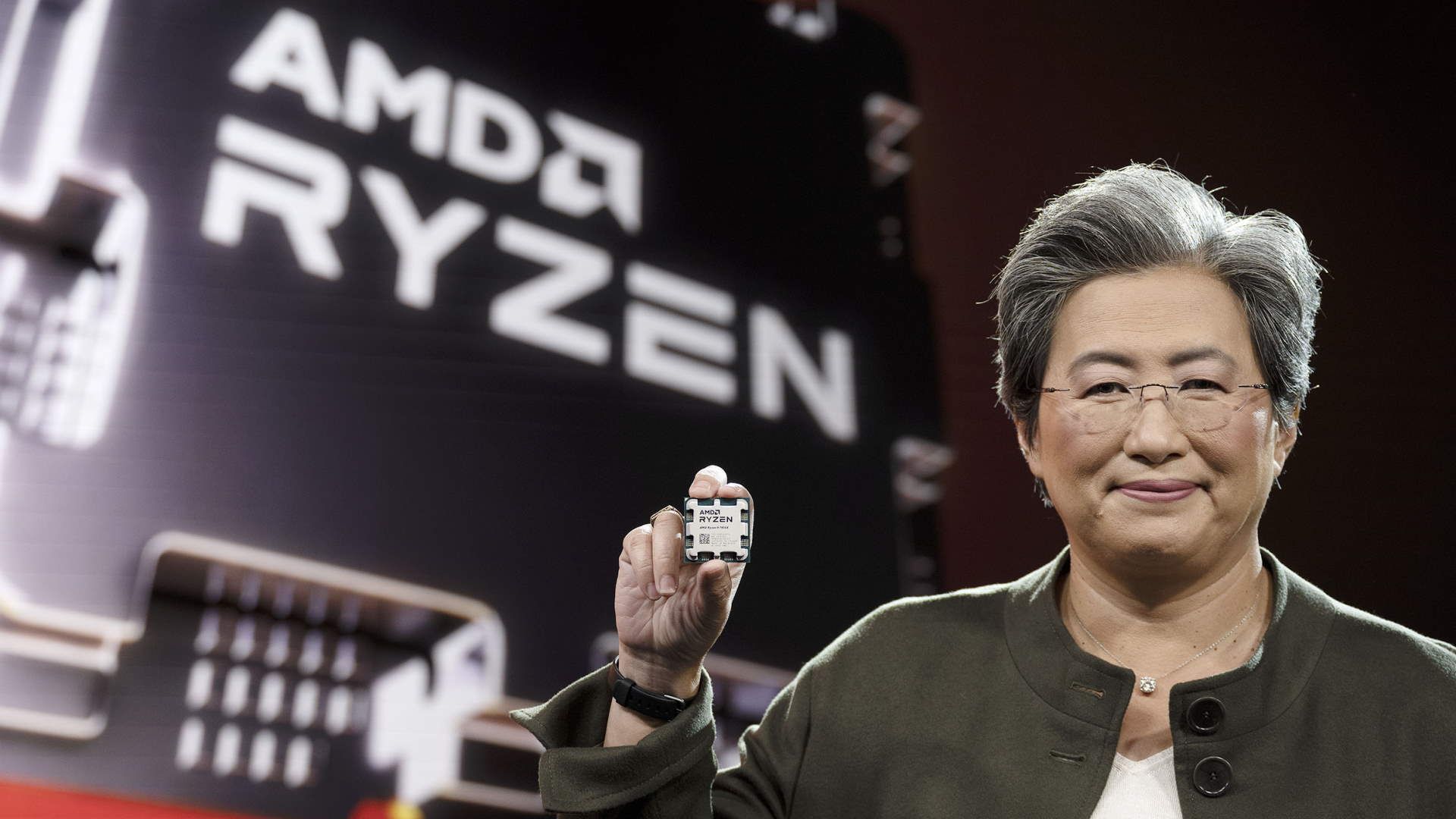
The turning point arrived in 2014 with the appointment of Dr. Lisa Su as Chief Executive Officer. A seasoned engineer with a Ph.D. in electrical engineering from MIT, Dr. Su immediately instituted a long-term strategic pivot: focus intensely on high-performance computing, embrace modular chiplet designs, and forge unbreakable partnerships with leading-edge fabrication foundries like TSMC.
The fruit of this patient, high-stakes gamble materialized in 2017 with the launch of the Zen processor architecture. Zen fundamentally altered the calculus of the x86 CPU market. By delivering massive multi-threaded performance gains, superior energy efficiency, and aggressive generational cadence, AMD began methodically clawing back market share in the consumer desktop, mobile, and—crucially—the hyper-profitable enterprise data center sectors.
As detailed in financial records tracking the semiconductor industry through the early 2020s, AMD’s strategy began bearing compounding financial fruit:
- 2018–2020: AMD consistently returned to profitability, slowly rebuilding its war chest while Intel faced persistent manufacturing delays, node transitions (struggling with the transition from 14nm to 10nm and 7nm), and leadership shuffles.
- 2021: The post-pandemic PC boom fueled massive growth. In Q1 2021, Intel still commanded massive dominance with nearly $19.7 billion in quarterly revenue, while AMD pulled in a comparatively modest $3.44 billion. Yet, the growth vector was heavily skewed in AMD’s favor.
- 2022–2023: The macroeconomic environment cooled, hitting the consumer PC market hard. While Intel suffered catastrophic quarterly net losses—including a brutal $2.75 billion net loss in Q1 2023—AMD maintained operational resilience, absorbing market shocks while continuing to expand its server footprint with the EPYC processor line.
- 2024: A historic inflection point. Intel reported a staggering, catastrophic annual loss of $18.7 billion for the fiscal year, heavily impacted by restructuring charges, foundry missteps, and shifting market demand. Meanwhile, AMD quietly banked $1.6 billion in net income over the same turbulent timeframe.
- 2025–2026: The acceleration phase. Buoyed by explosive demand for AI-accelerating hardware, high-end data center solutions, and resilient desktop adoption (exemplified by phenomenal reception of products like the Ryzen 7 9800X3D), AMD’s quarterly revenues surged past the $10 billion threshold by late 2025 and eclipsed $13.3 billion by Q3 2026.
Supporting Context & Metrics: The Hard Data of a Changing Market
Financial narratives are often driven by corporate rhetoric, but concrete metrics reveal the raw, unvarnished reality of the silicon race. An analysis of quarterly financial filings from Q1 2021 through Q3 2026 paints a vivid picture of convergence and divergence between the two semiconductor titans.
Intel vs. AMD Quarterly Financial Trajectory (Selected Metrics)
| Quarter | Intel Revenue ($M) | Intel Net Income ($M) | AMD Revenue ($M) | AMD Net Income ($M) |
|---|---|---|---|---|
| Q1 2021 | 19,673 | 3,360 | 3,445 | 555 |
| Q3 2021 | 19,192 | 6,823 | 4,313 | 923 |
| Q1 2022 | 18,353 | 8,113 | 5,887 | 786 |
| Q4 2022 | 14,042 | -664 | 5,599 | 21 |
| Q1 2023 | 11,715 | -2,758 | 5,353 | -139 |
| Q4 2023 | 15,406 | 2,669 | 6,168 | 667 |
| Q3 2024 | 13,284 | -16,639 | 6,819 | 771 |
| Q4 2024 | 14,260 | -126 | 7,658 | 482 |
| Q2 2025 | 12,859 | -2,918 | 7,685 | 872 |
| Q4 2025 | 13,674 | -591 | 10,270 | 1,511 |
| Q2 2026 | 16,128 | -11,033 | 11,536 | 2,297 |
| Q3 2026 | 16,513 | 3,320 | 13,377 | 2,428 |
Data Source: Public corporate financial filings / compiled industry data.
Analyzing this extensive dataset highlights several crucial market realities.

First, Intel’s revenue engine has largely plateaued, oscillating within a tight band between $12 billion and $16.5 billion over a multi-year period, punctuated by massive volatility in net income due to write-downs, restructuring costs, and capital expenditures related to its ambitious Integrated Device Manufacturer (IDM 2.0) strategy and foundry spin-off efforts.
Second, AMD’s expansion has been linear, relentless, and compounding. Within a remarkably short span, AMD has successfully doubled its quarterly revenue metrics compared to where they stood just two short years prior. By Q3 2026, AMD’s quarterly revenue of $13.38 billion closed to within striking distance of Intel’s $16.51 billion—a feat that would have been dismissed as pure fantasy during the peak of Intel’s Skylake era.
Furthermore, AMD’s profitability has stabilized at an enviable scale. Posting a net income of $2.43 billion in Q3 2026 demonstrates that AMD is not merely trading volume for margin; rather, it is successfully capturing high-value segments across consumer gaming, professional workstations, enterprise cloud servers, and artificial intelligence infrastructure.
Official Statements and Corporate Strategy
The stark contrast in corporate health is mirrored in the public posture and strategic commentary emanating from both executive suites.
During AMD’s recent earnings call, CFO and Treasurer Jean Hu projected an aura of absolute confidence, pointing to robust multi-sector demand as the primary driver behind the anticipated $17 billion Q4 revenue target. Hu’s projections underscore a fundamental structural advantage: as a fabless semiconductor company, AMD focuses exclusively on chip design and architecture, partnering with world-class foundries like TSMC to leverage cutting-edge manufacturing nodes (such as advanced 3nm and forthcoming 2nm classes) without bearing the crushing capital expenditure burdens associated with building and maintaining multi-billion-dollar silicon fabrication plants.
Conversely, Intel has been forced to navigate a grueling, high-stakes organizational restructuring. Faced with punishing losses—such as the staggering $11.03 billion net loss reported in Q2 2026—Intel leadership has had to make painful strategic retreats. These include shifting manufacturing capacity (such as reallocating Panther Lake production lines toward high-margin data center chips), managing severe supply-chain constraints driven by broader memory crises impacting the wider PC ecosystem, and fighting to defend its stock price after a punishing erosion of market confidence.
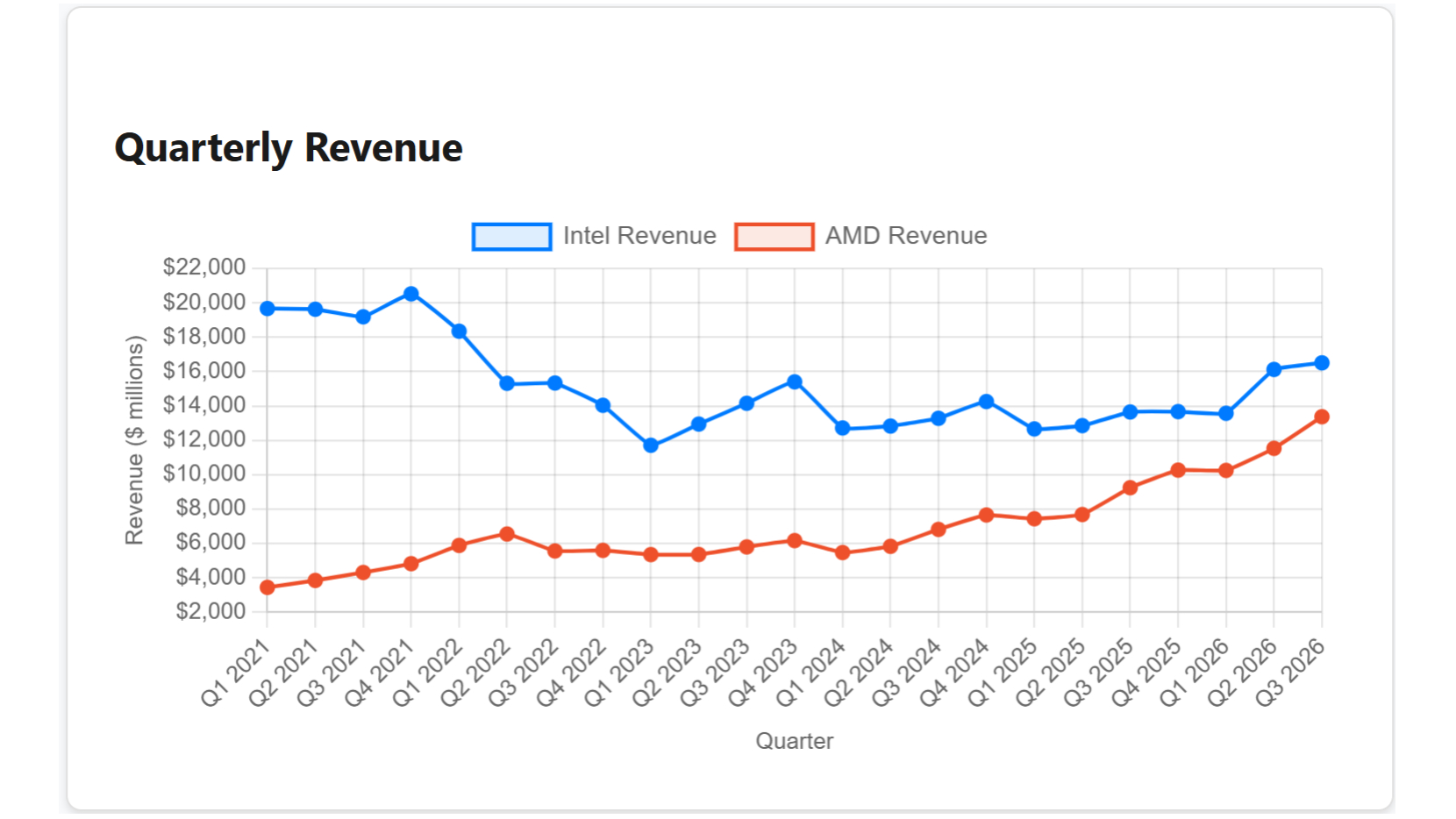
While Intel has managed intermittent returns to profitability—such as its $3.32 billion net income rebound in Q3 2026—the structural volatility of its balance sheet stands in stark contrast to AMD’s steady, predictable margin expansion.
Future Outlook: The Next Frontier in Silicon Dominance
As the industry looks toward the closing quarters of the decade, the competitive dynamics between AMD and Intel are entering an entirely new phase.
For AMD, the immediate challenge will be successfully scaling operations to meet its ambitious $17 billion quarterly hurdle while managing supply chain allocations across an increasingly diverse product portfolio. The company’s deep integration within the AI accelerator market, combined with sustained dominance in enthusiast PC processors via platforms like AM5 and cutting-edge 3D V-Cache implementations, positions it strongly to maintain momentum.
For Intel, the imperative is clear: execute flawlessly on its manufacturing roadmaps, stabilize its foundry operations, and deliver compelling consumer and enterprise architectures that can successfully blunt AMD’s relentless market-share encroachment. The historical weight of Intel’s legacy infrastructure provides immense resources, but agility, execution discipline, and architectural superiority have definitively become the currency of the modern computing realm.
Ultimately, the transformation of AMD from an embattled budget alternative into an earnings powerhouse equal to—and soon to surpass—historical titan Intel stands as one of the most remarkable corporate ascents in modern business history. As Dr. Lisa Su and her executive team steer the company toward its next milestones, the semiconductor world watches not with idle curiosity, but with the profound realization that the old rules of the hardware wars have been rewritten forever.








Belum ada komentar. Jadilah yang pertama berkomentar!