

Executive Overview
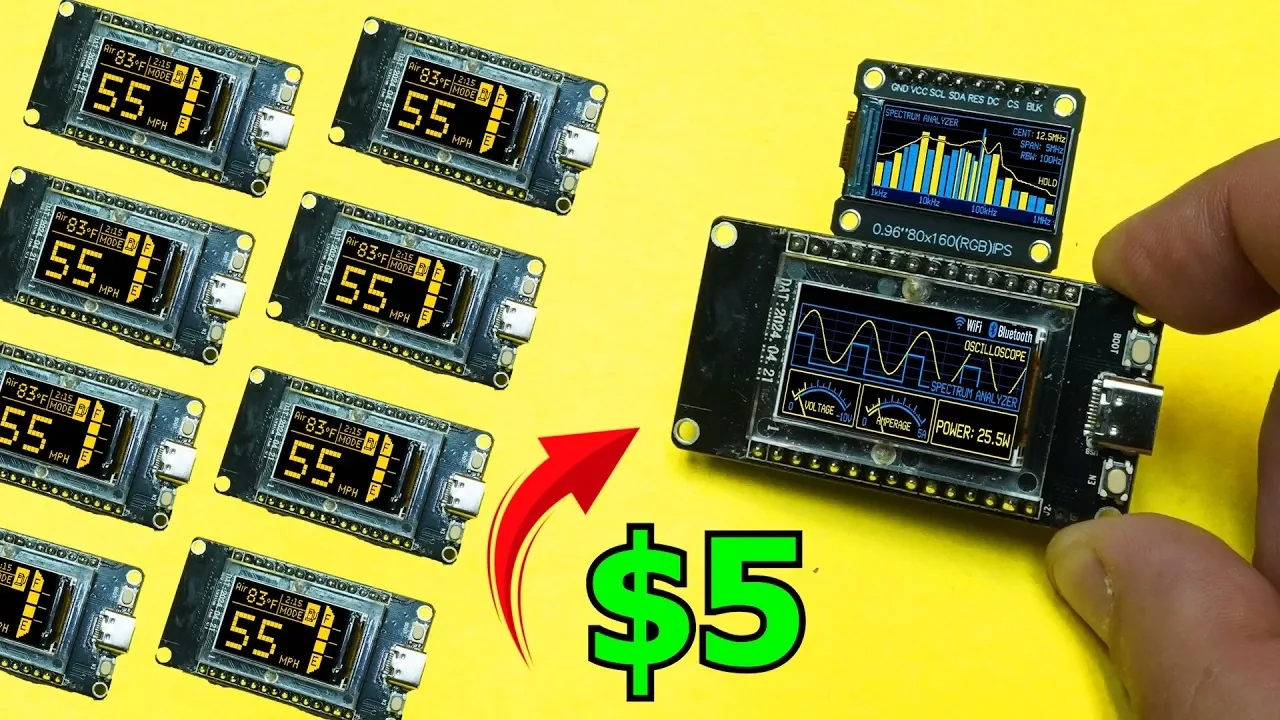
The landscape of embedded systems and Internet of Things (IoT) hardware has undergone a seismic shift, driven by the relentless pursuit of high-performance microcontrollers at disruptive price points. At the epicenter of this hardware evolution is Espressif Systems’ microarchitecture strategy, which has recently culminated in a remarkably capable, ultra-compact development board priced at an astonishing $5. Centered around the ESP32-S3 System-on-Chip (SoC), this tiny circuit board punches well above its weight class, packing a robust dual-core Xtensa LX7 processor, integrated wireless connectivity, and deep support for modern graphical interfaces and edge AI algorithms.
For hobbyists, educators, and enterprise-grade embedded engineers alike, the introduction of this $5 module represents more than just a cost-saving measure—it is an expansion of what is possible in low-power, localized computing. As demonstrated by popular electronics creators such as "Hacktuber," this micro-form-factor board is capable of driving interactive TFT displays, operating as a localized cryptographic tracker, and executing complex machine learning inferences at the edge. By lowering the financial barrier to entry while simultaneously boosting computational overhead, this iteration of the ESP32-S3 series bridges the historical gap between restricted microcontrollers and resource-heavy single-board computers like the Raspberry Pi.
This comprehensive overview explores the hardware specifications, performance benchmarks, graphical capabilities, real-world utility, and competitive standing of the $5 ESP32-S3 board, offering a definitive guide to why this micro-controller is reshaping the DIY electronics and professional IoT design space.
Detailed Chronology of the ESP32-S3 Architecture
To truly appreciate the engineering triumph of the $5 ESP32-S3 development board, one must examine the evolutionary arc of Espressif Systems’ product lines. The original ESP8266 ignited a global revolution in low-cost Wi-Fi modules, proving that network connectivity did not need to be expensive or complex. This was succeeded by the wildly successful ESP32, which introduced a dual-core architecture and Bluetooth connectivity, cementing Espressif as a dominant force in the maker and industrial IoT markets.
However, as the demands of the embedded landscape shifted toward artificial intelligence at the edge (Edge AI), machine learning, and richer human-machine interfaces (HMI), the original silicon architectures revealed performance ceilings. Espressif responded by developing the "S" series—specifically engineered for smart devices requiring robust security and heavy computational throughput.
- Silicon Inception and Vector Instructions: The ESP32-S3 architecture was initially designed to address the growing need for vector-accelerated processing in machine learning. Unlike its general-purpose predecessors, the S3 silicon incorporated specialized vector instructions that drastically accelerate neural network computing and digital signal processing (DSP) workloads.
- Ecosystem Maturation: Following the release of the bare silicon chips to module manufacturers, third-party developers and hardware designers began optimizing circuit layouts. The culmination of this design iteration is the current "super mini" or ultra-compact form factor board that integrates essential peripheral support—such as onboard lithium battery charging circuits and robust voltage regulation—into a footprint barely larger than a postage stamp.
- Mainstream Maker Adoption: Through deep-dive hardware showcases by independent tech educators and platforms like Hacktuber, the $5 S3 board transitioned from a niche component for enterprise prototyping to a viral sensation among DIY electronics enthusiasts, powering localized weather stations, touch-sensitive dashboards, and portable data terminals.
Supporting Context, Hardware Specifications, and Metrics
At the hardware level, the $5 ESP32-S3 module is a masterclass in space-constrained engineering and cost optimization. Despite its microscopic physical dimensions—often small enough to be laid flat against a standard coin—the board does not compromise on computational grunt or peripheral flexibility.
Core Processing and Wireless Performance
The beating heart of the module is a Dual-core Xtensa LX7 microcontroller capable of clock speeds reaching up to 240 MHz. This dual-core layout allows developers to bifurcate workloads: dedicating Core 0 to real-time wireless stack management (Wi-Fi and Bluetooth) and Core 1 entirely to application logic, graphical rendering, or sensor data acquisition.
For wireless connectivity, the board features 2.4 GHz Wi-Fi (802.11 b/g/n) alongside Bluetooth 5 (featuring Bluetooth LE). This ensures long-range connectivity, higher data transmission speeds, and robust mesh-networking capabilities essential for smart home integrations and industrial sensor arrays.
Memory Configurations
Memory bottlenecks have historically plagued low-cost microcontrollers. The ESP32-S3 mitigates this by offering flexible, highly scalable memory tiers:
- Internal SRAM: 512 KB of ultra-fast on-chip static RAM.
- Flash Memory: Factory options ranging from 4 MB to 16 MB of external SPI flash, providing ample space for extensive firmware binaries, localized web servers, and asset storage.
- PSRAM (Pseudo-Static RAM): Optional configurations spanning 2 MB to 8 MB of external PSRAM, unlocking the memory overhead necessary for frame buffers, high-resolution graphics, and complex machine learning models.
Comprehensive Peripheral Array
The board breaks out an impressive 45 programmable GPIO pins, allowing engineers to interface with virtually any external sensor, actuator, or communication bus (I2C, SPI, UART, PWM). Crucially, despite its budget pricing, many iterations of this board include developer-friendly additions such as:
- An integrated programmable RGB LED for instant status signaling.
- A built-in lithium battery charging and management circuit, allowing for truly untethered, portable battery-powered deployments.
- Native USB-on-the-chip capabilities, streamlining firmware flashing and enabling USB-HID (Human Interface Device) emulation.
Display Support, Customization, and Visual Engineering
One of the defining engineering breakthroughs of the ESP32-S3 relative to older budget chips is its native hardware support for complex graphical user interfaces (GUIs). Traditional low-cost microcontrollers often struggled to drive anything beyond rudimentary monochrome OLED screens. The S3, however, opens the door to full-color visual feedback.
Supported Display Technologies
The module’s flexible pin mapping and processing overhead allow for seamless integration with a wide variety of display panels:
- TFT LCD Displays: Capable of driving vibrant, high-refresh-rate color screens.
- E-Paper / E-Ink Displays: Ideal for ultra-low-power, sunlight-readable applications like electronic price tags, reading devices, or ambient information hubs.
Optimized Resolutions and Visual Fidelity
The module is exceptionally well-optimized for crisp, highly readable resolutions such as 80 × 160 pixels and 135 × 240 pixels. This pixel density is ideal for compact form-factor projects, enabling developers to build:
- Real-time weather monitoring stations displaying dynamic meteorological icons.
- Miniature desktop cryptocurrency tickers tracking live market valuations.
- Smart home automation nodes with responsive touch-sensitive interfaces.
Through the use of lightweight graphics libraries like LVGL (Light and Versatile Graphics Library), developers can implement smooth animations, anti-aliased fonts, and responsive touch controls without choking the microcontroller’s processing pipeline.
Real-World Applications: From Edge AI to DIY Gadgets
The true metric of any development board’s value lies in its application domain. Because the ESP32-S3 balances high-end processing with ultra-low power consumption and a microscopic price point, its utility spans an astonishing variety of use cases.
1. Edge AI and Machine Learning
Thanks to Espressif’s software development kit (ESP-IDF) and specialized vector instructions, developers can deploy machine learning models directly onto the microcontroller. Using frameworks like TensorFlow Lite for Microcontrollers, the ESP32-S3 can process data from connected microphones or cameras to perform tasks such as:
- Keyword spotting (local voice recognition without cloud dependency).
- Simple computer vision tasks (object detection or presence sensing).
- Predictive maintenance sensing (analyzing motor vibration patterns via attached accelerometers).
2. Advanced Internet of Things (IoT) Nodes
In smart building and industrial automation contexts, the board serves as an intelligent edge node. It can aggregate data from environmental sensors, encrypt the telemetry locally, and securely transmit it via MQTT over Wi-Fi to a centralized server or cloud database.
3. Portable Gadgets and Wearables
Because the board includes battery management circuitry and power-saving sleep modes that draw mere microamperes, it is a prime candidate for wearable electronics and handheld DIY gadgets. Makers have successfully deployed the board into custom game controllers, portable security tokens, and localized environmental data loggers.
4. Educational Toolsets
For educational institutions, the $5 price point allows computer science and engineering departments to equip every student with a powerful, modern development board. Students can learn the fundamentals of C/C++ programming, real-time operating systems (FreeRTOS), networking protocols, and hardware abstraction without prohibitive hardware costs.
Comparative Analysis: ESP32-S3 vs. ESP32-C3
To understand where the ESP32-S3 sits in the modern market, it must be contrasted with its sibling in Espressif’s lineup: the ESP32-C3.
| Feature | ESP32-C3 | ESP32-S3 |
|---|---|---|
| Core Architecture | Single-core 32-bit RISC-V | Dual-core 32-bit Xtensa LX7 |
| Max Clock Speed | 160 MHz | 240 MHz |
| Wireless Connectivity | Wi-Fi 4 & Bluetooth 5 (LE) | Wi-Fi 4 & Bluetooth 5 (LE) |
| AI / Vector Acceleration | Basic | Advanced (Vector Instructions) |
| Max GPIO Pins | ~22 | 45 |
| Display Support | Basic (Limited UI) | Advanced (Native TFT, E-Paper, LVGL support) |
| Target Market | Cost-sensitive, simple IoT switches | Compute-heavy IoT, HMI displays, Edge AI |
While the ESP32-C3 remains an unbeatable choice for ultra-low-cost, single-function connected devices (such as smart plugs or simple relay switches), the ESP32-S3 is the definitive winner for projects demanding dual-core processing, heavy peripheral interfacing, rich graphical outputs, and localized machine learning.
Future Outlook: The Democratization of Smart Hardware
The release and rapid adoption of the $5 ESP32-S3 development board signal a broader trend in the technology sector: the radical democratization of high-performance computing.
In the past, developing a device with a color display, wireless networking, and local intelligence required expensive prototyping hardware, proprietary licensing, or complex, power-hungry single-board computers. Today, for the price of a cup of coffee, an engineer, student, or hobbyist can acquire a fully realized, network-connected computational node capable of executing machine learning inferences at the edge.
As software toolsets continue to mature—with deeper integration into Arduino IDE, PlatformIO, MicroPython, and Espressif’s native ESP-IDF—the friction required to bring hardware concepts from ideation to production drops ever lower. The ESP32-S3 is not merely a piece of silicon; it is an enabler of grassroots innovation. For anyone looking to dive into the next wave of smart devices, IoT architecture, or DIY electronics, this $5 powerhouse provides an accessible, infinitely flexible foundation upon which to build the future.







Belum ada komentar. Jadilah yang pertama berkomentar!