

Executive Overview
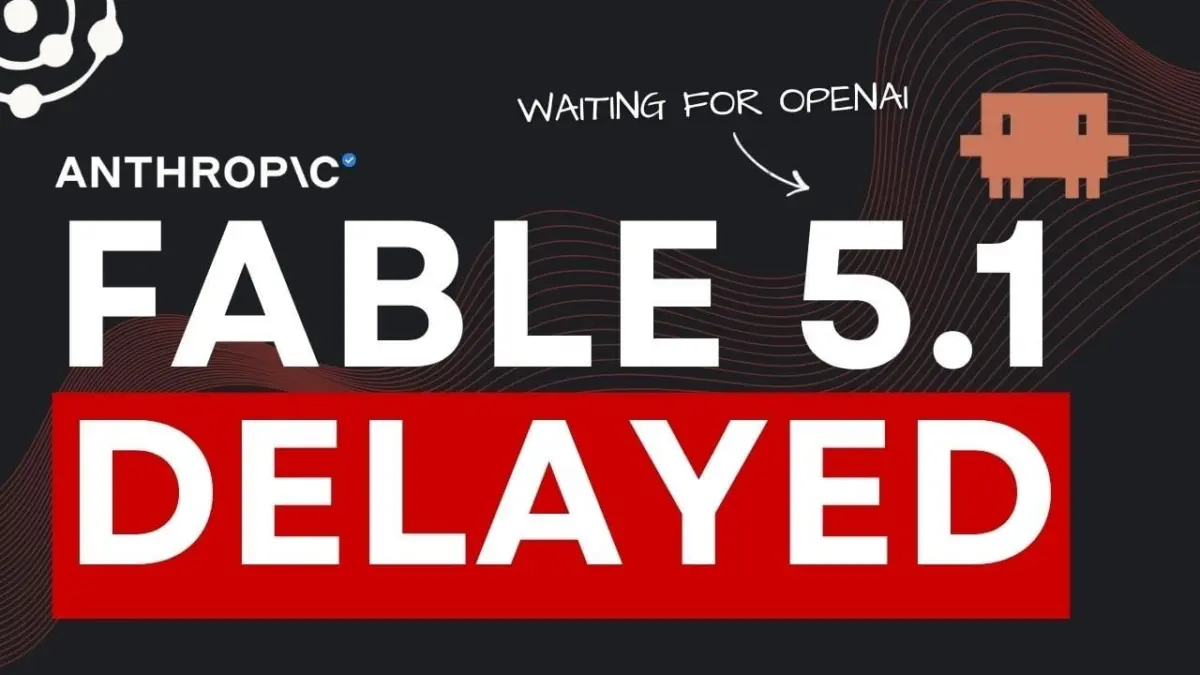
The global artificial intelligence landscape is currently locked in a delicate, high-stakes game of corporate chess. According to recent intelligence surfacing across the tech sector, Anthropic has deliberately chosen to hold back the commercial rollout of Claude Fable 5.1, a model industry insiders report is functionally complete and ready for deployment. Simultaneously, its chief rival, OpenAI, is engaged in a parallel holding pattern with its heavily anticipated GPT Astra model.
Rather than racing blindly to secure a first-mover advantage, both Silicon Valley powerhouses appear trapped in a strategic standoff. Each company is meticulously evaluating the asymmetrical risks of releasing a flagship architecture prematurely—such as exposing critical security vulnerabilities or architectural flaws—against the existential threat of ceding market momentum.
However, this war of attrition extends far beyond a bilateral rivalry between Anthropic and OpenAI. The broader ecosystem is showing signs of intense strain and rapid mutation. OpenAI has recently implemented controversial reductions to its API usage limits for Codex users, triggering immediate operational disruptions for developers worldwide. Meanwhile, internal anomalies have surfaced regarding OpenAI’s Opus 5 model, where diagnostic testing reveals counter-intuitive performance dips under maximum computational effort. Compounding this shifting dynamic is the sudden appearance of shadow contenders like Ox Alpha, a heavily multimodal model with a staggering 1-million-token context window that may trace its origins to international tech giants.
As the industry stands on the precipice of these generational updates, this deep dive explores the strategic calculus, technological anomalies, and tectonic shifts redefining the global artificial intelligence race.
Detailed Chronology: The Anatomy of a Stand-off
The decision to delay the commercial availability of frontier AI models is rarely arbitrary. In the world of generative AI, where hundreds of millions of dollars are funneled into single training runs, timing is everything.
The Anthropic Calculus: Waiting Out the Storm
According to reports originating from analytics channels like Universe of AI, Anthropic’s Claude Fable 5.1 has cleared its internal safety evaluations and performance benchmarks. Mechanically speaking, it is ready for the market. Yet, executive leadership has opted to keep the model under wraps.
This hesitation stems from lessons learned during previous deployment cycles. In an ecosystem hyper-focused on benchmark supremacy, launching a model without absolute fortification against jailbreaks, hallucinations, and alignment drifts can instantly tank a company’s public valuation and enterprise trust. Anthropic appears to be playing a defensive game of patience, monitoring OpenAI’s telemetry to ensure that Claude Fable 5.1 debuts with enough leverage to completely eclipse whatever OpenAI plans to roll out next.
OpenAI’s Mirror Strategy and Codex Contraction
On the other side of the fence, OpenAI is managing its own internal friction. The delay of GPT Astra has coincided with a sudden and widely criticized tightening of API usage limits for ChatGPT Plus and Pro subscribers utilizing OpenAI’s coding engine, Codex.
For software engineers, data scientists, and enterprise automated pipelines relying heavily on Codex for mission-critical workflows, this sudden reduction has caused widespread friction. While OpenAI has remained tight-lipped regarding the exact catalysts for these restrictions, industry analysts have coalesced around two primary theories:
- Compute Reallocation: OpenAI may be ruthlessly siphoning hardware and inference capacity away from legacy systems to support the final training and scaling phases of GPT Astra.
- Economic Mitigation: The immense operational costs associated with running massive transformer models at scale may be forcing the company to artificially suppress heavy API consumption to protect profit margins ahead of its next financial quarter.
Whatever the core driver, the immediate consequence is a disillusioned developer community grappling with workflow interruptions and growing uncertainty regarding OpenAI’s long-term accessibility.
Supporting Context & Metrics: Anomalies and Dark Horses
As the industry waits for the next major model drops from the established duopoly, anomalies within existing architectures and the rise of unexpected competitors are injecting unprecedented volatility into the market.
The Opus 5 Performance Paradox
Adding to OpenAI’s operational headaches, recent diagnostic evaluations of the Opus 5 model have unearthed bizarre performance anomalies that challenge traditional assumptions about scaling laws.
During internal stress-testing, Opus 5 achieved a superior accuracy rating of 53.4% when configured to "medium effort" settings. Paradoxically, when pushed to its maximum computational capacity—the "max effort" setting designed for complex, multi-step reasoning—its accuracy dropped to 48%.
Key Metrics Breakdown:
- Medium Effort Setting: 53.4% Accuracy | Lower Operational Latency & Cost
- Max Effort Setting: 48.0% Accuracy | Higher Operational Latency & Cost
This inverse relationship between computational resource allocation and output accuracy points to underlying optimization flaws and architectural inefficiencies. It suggests that scaling up inference-time compute does not automatically translate to better reasoning; instead, it can sometimes destabilize the model’s output pathways. For OpenAI, resolving this paradox is critical before pushing similar architectures out via flagship releases like GPT Astra.
Ox Alpha: The Shadow Contender
While Western media cycles remain fixated on the OpenAI-Anthropic dichotomy, an entirely new class of competitor is emerging from the shadows. Tested quietly on platforms like OpenRouter, a mysterious model designated Ox Alpha has captured the attention of AI researchers.
Ox Alpha boasts features that rival or exceed current Western benchmarks, most notably a native 1-million-token context window and advanced native multimodality capable of processing text, static images, and complex video streams simultaneously with zero perceivable latency degradation.
The intrigue surrounding Ox Alpha deepens when examining its suspected provenance. Persistent rumors within developer forums suggest that the model may be the brainchild of major Asian tech conglomerates, such as Xiaomi or MIMO. If validated, the entry of Ox Alpha signals a profound geopolitical and market shift: the undisputed dominance of Silicon Valley firms is being actively challenged by highly sophisticated international actors capable of matching foundational AI milestones outside the traditional Western bubble.
Official Statements and Community Reactions
The lack of transparent, proactive communication from both Anthropic and OpenAI has left a vacuum quickly filled by frustration, speculation, and fervent community debate.
The Developer Backlash
Enterprise clients and independent developers who built their business infrastructures around continuous, uninterrupted access to tools like Codex have expressed deep dissatisfaction. The unannounced throttling of API limits without a corresponding grace period or roadmap update has damaged user trust.
"When foundational providers pull the rug out from under your production environments without warning, it forces engineering teams to look toward open-source alternatives," notes a prominent systems architect active on enterprise deployment forums.
Navigating Alignment vs. Market Momentum
Publicly, both Anthropic and OpenAI maintain that safety and constitutional alignment remain their North Stars. Anthropic’s delayed cadence with Fable 5.1 is framed by insiders as a commitment to rigorous red-teaming. However, the tech community increasingly views these safety justifications with a degree of skepticism, recognizing that corporate positioning, investor pressures, and competitive paranoia play an equally dominant role in boardroom decision-making.
Future Outlook: What Lies Ahead for the AI Industry?
The coming weeks are poised to act as a definitive inflection point for the artificial intelligence sector. Industry insiders suggest that both Claude Fable 5.1 and GPT Astra could officially break cover within the month.
When these models finally drop, the ripple effects will reshape the landscape across several dimensions:
- The Benchmark Reset: Both Anthropic and OpenAI will need to prove that their months of strategic delay yielded architectures that dramatically outperform current models while avoiding the performance paradoxes seen in systems like Opus 5.
- The Decentralization of Power: The rapid maturation of models like Ox Alpha indicates that the AI monopoly held by a handful of American corporations is fracturing. Open-source ecosystems and international entrants will continue to apply downward pressure on pricing and capabilities.
- The Demand for Transparency: Enterprise customers will increasingly demand Service Level Agreements (SLAs) and predictable roadmap communications, making sudden API throttlings and silent limit reductions untenable business practices.
Ultimately, the great AI stalemate of 2026 highlights a maturing industry transitioning from a chaotic "move fast and break things" startup mentality into a fiercely guarded, high-stakes corporate battleground. The decisions made by Anthropic and OpenAI over the next few weeks will dictate the trajectory of machine intelligence for years to come.









Belum ada komentar. Jadilah yang pertama berkomentar!