

Executive Overview
We live at a historical juncture defined by the relentless acceleration of digital capitalism, mobile screens, and algorithmic content generation, all of which increasingly encompass human consciousness. Modern cultural consumption has been fundamentally altered by digital media, streaming platforms, and artificial intelligence-generated feeds. As philosopher Byung-Chul Han observes, modern digital acceleration fragments human attention, offering a “frictionless” yet superficial engagement with reality. Fragmented by continuous notifications, short-form video feeds, and hyper-personalized digital streams, the attention span of the contemporary audience has narrowed and fractured dramatically.
Today, for a theatre-goer entering an auditorium, remaining engaged with a 90-minute play without instinctively reaching for a smartphone requires an almost existential effort of resistance and mental discipline—a quiet act of resistance against digital velocity. The global trend toward shorter play durations—where traditional two-act structures are increasingly replaced by single-act, high-tempo productions—is no coincidence. It is the direct spatial reflection of the mental dispersion induced by the digital era.
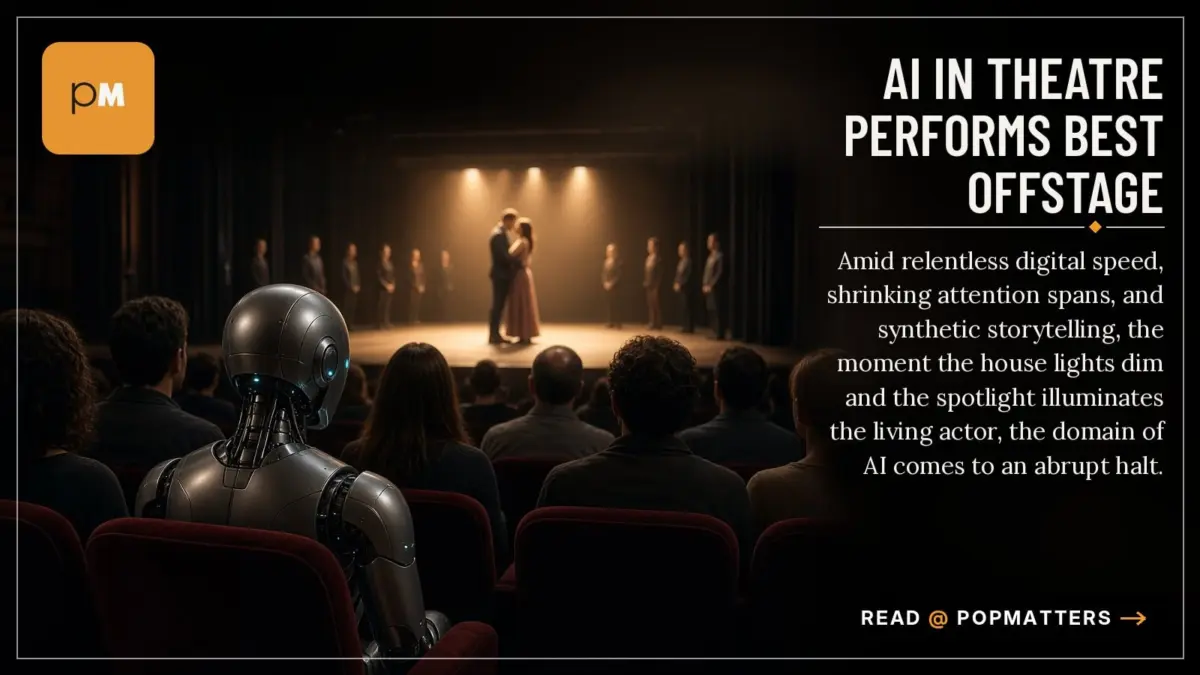
How, then, does live performance maintain its agency in a world where storytelling has become automated and streaming algorithms tailor content to the individual? As a practicing playwright, dramaturg, and the Artistic Director of a municipal city theatre who navigates this daily reality, I confront this practical and existential question daily, both at the writing desk and inside rehearsal halls. While generative artificial intelligence (AI) offers remarkable capabilities as a pre-production assistant, cultural administrator, and data-processing tool, the boundary where its authority halts is absolute: the moment the house lights dim, the spotlight strikes, and living actors step onto the stage.
Detailed Chronology: The Evolution of Cultural Consumption
To understand how the contemporary stage arrived at this critical crossroads, it is necessary to trace the historical evolution of media consumption alongside the structural shifts within theatrical production over the past century.
Phase I: The Mechanical Age and the Threat of Reproduction (Early to Mid-20th Century)
The friction between mechanical reproduction and live art is not entirely new. In the 1930s, as cinematic technology matured and radio expanded its reach, cultural theorists like Walter Benjamin began to grapple with the loss of artistic authenticity. Benjamin’s foundational concept of the “aura” established that the unique value of an artwork is inextricably bound to its authentic, physical presence in a specific time and space—something mechanical reproduction could never truly replicate. During this era, theatre faced its first major industrial challenger, prompting early modernist playwrights to break away from naturalism and experiment with Brechtian alienation effects and avant-garde staging to keep live performance distinct from the silver screen.
Phase II: The Digital Turn and Attention Fragmentation (Late 20th Century to 2010s)
As personal computers, the internet, and mobile devices saturated global markets, the daily rhythm of human life underwent a profound acceleration. The shift from appointment viewing to on-demand streaming drastically altered narrative consumption patterns. Television series evolved into binge-watchable formats, training audiences to digest hours of continuous narrative content within private, isolated domestic spaces. Concurrently, theatrical institutions began noticing subtle shifts in audience demographics; longer classics required more intentional marketing, and intermission habits transformed as smartphones became permanent extensions of the human hand.
Phase III: The Algorithmic Epoch and the Rise of Generative AI (Present Day)
We have now entered the algorithmic epoch, characterized by hyper-personalized digital streams, continuous short-form video feeds, and generative AI models capable of writing text, simulating images, and predicting narrative structures in milliseconds. This unprecedented saturation of synthetic content has not rendered theatre obsolete; rather, it has clarified its counter-cultural function. Municipal theatres and independent companies worldwide are witnessing a reactive pivot: audiences are flocking back to physical venues not for cinematic spectacle, but precisely to escape algorithmic predictability. The modern timeline of theatre is no longer defined merely by stylistic movements, but by its stubborn, necessary resistance to the digital velocity of everyday life.
Supporting Context & Metrics: The Philosophy and Mechanics of Live Performance
Evaluating the resilience of live performance in the age of artificial intelligence requires examining both foundational philosophical frameworks and contemporary theatrical metrics.
An Ancient Imperative: Mimesis, Homo Ludens, and Catharsis
Since the time of Aristotle, humanity has recognized an inherent drive toward representation (mimesis)—the embodied act of mirroring human existential anxiety, fears of mortality, love, and ethical dilemmas on stage. Furthermore, as Johan Huizinga articulated in Homo Ludens (1938), play is an indispensable, primordial cultural drive inherent to human nature. Theatre functions as a sanctuary of catharsis where human consciousness confronts its own truth through living representation.
Generative AI algorithms can expertly synthesize data patterns, textual syntax, and historical structures to imitate form. Yet, an algorithm cannot experience existential urgency nor engage in the embodied act of playing. Digital automation can output synthetic narratives, but it cannot supplant the primordial human drive to play, nor can it replicate the catharsis generated by living bodies on stage. Saturated by sterile digital content, contemporary audiences return to theatre halls precisely to witness the mortal, vulnerable presence of an actor taking genuine risks under the spotlight.
Local Memory, Social Responsibility, and Municipal Stage Practice
A fundamental limit of generative AI lies in its inability to comprehend local authenticity and civic engagement. While algorithms process vast global databases to output standardized narratives, they remain structurally blind to the specific socio-cultural memory, regional humor, and unique identity of a local community.
At Efeler City Theatre in Aydın, Turkey, where I serve as Artistic Director, our municipal stage practice directly demonstrates this human boundary daily. We do not merely stage ticketed plays; we actively produce theatrical content and performances addressing the most vital social themes of our local community: from empowering individuals with disabilities and engaging youth, to advocating for women’s rights and tackling environmental crises.
As theatre theorist Erika Fischer-Lichte notes regarding the “autopoietic feedback loop,” meaning in performance is not merely delivered by a pre-written text, but emerges dynamically through the live interaction between performer and spectator. Algorithmic tools can aggregate global data on environmental degradation or gender equity to generate a script, but software cannot replicate the visceral civic engagement, emotional solidarity, and collective healing generated when local citizens—women, youth, and disabled individuals—gather in a shared physical space. Live theatre remains a vital sanctuary of social responsibility that no digital system can automate.
The Pre-Production Assistant: Statistical Management and AI’s Practical Role
To evaluate artificial intelligence fairly, one must avoid dogmatic rejection or nostalgic Luddism. During pre-production processes and cultural administration phases—before a show meets its audience—generative AI tools can serve as a highly efficient “digital assistant” and an informational backbone.
In cultural management and theatre administration, AI offers immense analytical value. It enables precise statistical mapping of audience behaviors and demographics, evaluates contrastive expectations between enclosed auditoriums and summer outdoor amphitheatres, and measures spectator tempo reactions to varying play runtimes (e.g., single-act vs. two-act structures). This data processing provides theatre directors with strategic clarity and vast time efficiency.
Furthermore, during dramaturgical development and script rehearsals, utilizing AI output across the creative team (playwright, director, actors, and designers) yields a sweeping flow of information. However, a critical boundary must be acknowledged: the quality of AI output is directly proportional to the intellectual capacity and guiding vision of the person asking the questions. AI cannot independently generate aesthetic depth; its horizons are strictly defined by the intellectual scope of the dramaturg or artist operating it. When guided by a dramaturg possessing a rigorous intellectual background and the ability to frame precise, probing inquiries, AI transforms into an invaluable research partner. Conversely, shallow prompts yield nothing more than superficial, cliché-ridden data dumps.
Official Statements and Perspectives from the Rehearsal Hall
The Human Element: An Incident from the Stage
Reflecting on the lived reality of municipal stage practice reveals moments where automation falls infinitely short. I recall a profound moment during a performance featuring our integrated ensemble of actors with disabilities at Efeler City Theatre. An actor paused, momentarily missing a scripted cue. Instead of panicking, he looked directly into the auditorium with an authentic, unscripted smile—and the entire audience responded with a spontaneous, warm wave of applause.
This unscripted human connection encapsulates what theatre theorists study and what audiences seek: an autopoietic feedback loop driven by vulnerability. As artistic practitioners navigating both the writing desk and the rehearsal floor, our official stance is clear:
"AI can assist in mapping the statistical contours of our audiences, organizing administrative schedules, and serving as a sounding board during early dramaturgical research. However, the moment the actor steps onto the boards, the software is irrelevant. The theatre survives because it is dangerous, mortal, and shared. You cannot code a soul, and you cannot automate the collective intake of breath in a darkened room."
— Artistic Director and Playwright, Efeler City Theatre
The Algorithmic Ceiling on Stage
The moment the house lights dim and the spotlight strikes the living actor, the domain of automation comes to an abrupt halt. AI can construct optimal dialogue scenarios, simulate scenography, or calculate pacing, but it can never hold the pulse of a packed auditorium. Algorithmic systems operate on statistical probabilities, historical averages, and pattern optimization—principles that inherently favor polished, frictionless outputs. Yet, theatrical resonance relies on precisely the opposite: existential risk, emotional vulnerability, mortal presence, and unrepeatable immediacy.
An algorithm cannot feel the pulse of a packed auditorium. It cannot adjust the rhythm of a monologue in response to a collective intake of breath or a sudden cough in the third row. No software can simulate the fragile, electrifying moment when an actor’s voice cracks under genuine emotional weight, or the raw, quick-witted energy an actor pulls from the audience when navigating an unscripted stage impulse. It is precisely this vulnerable, error-prone human presence that captivates an audience.
Future Outlook: The Resilient Sanctuary of Live Performance
Today, streaming platforms and social media algorithms offer endless, personalized content directly to the screens in our pockets. However, this hyper-digital saturation has simultaneously induced a profound fatigue with digital mediation.
In managing city theatre programming and observing audience dynamics, one clear reality emerges: audiences do not attend live theatre merely to consume a narrative structure—they can consume narratives on high-definition home screens. Rather, spectators come to witness an authentic, risky human encounter that software cannot sanitize or smooth over. Box office attendance remains robust precisely when productions refrain from competing with digital media on terms of visual spectacle or cinematic velocity. When theatre attempts to emulate digital speed, it falters; but when it offers what screens cannot—a fragile, mortal, and unrepeatable human communion—audiences eagerly forget the smartphones in their pockets.
In short, AI can be a helpful research assistant in the pre-production kitchen, but the stage itself remains an unassailable sanctuary.
Amid relentless digital speed, shrinking attention spans, and synthetic storytelling, theatre stands as humanity’s most resilient stronghold—a space where local memory, civic responsibility, mimesis, the spirit of Homo Ludens, and live human consciousness confront mortality, unpredictability, and raw truth. Artificial intelligence can help us draft scripts and analyze demographic data, but the future of theatre belongs solely to those willing to share the same vulnerable moment in the dark.






Belum ada komentar. Jadilah yang pertama berkomentar!